
Pulp Fiction, 1920 · page 53 of 208
Adventure Magazine Cover — page 53: what you’re looking at
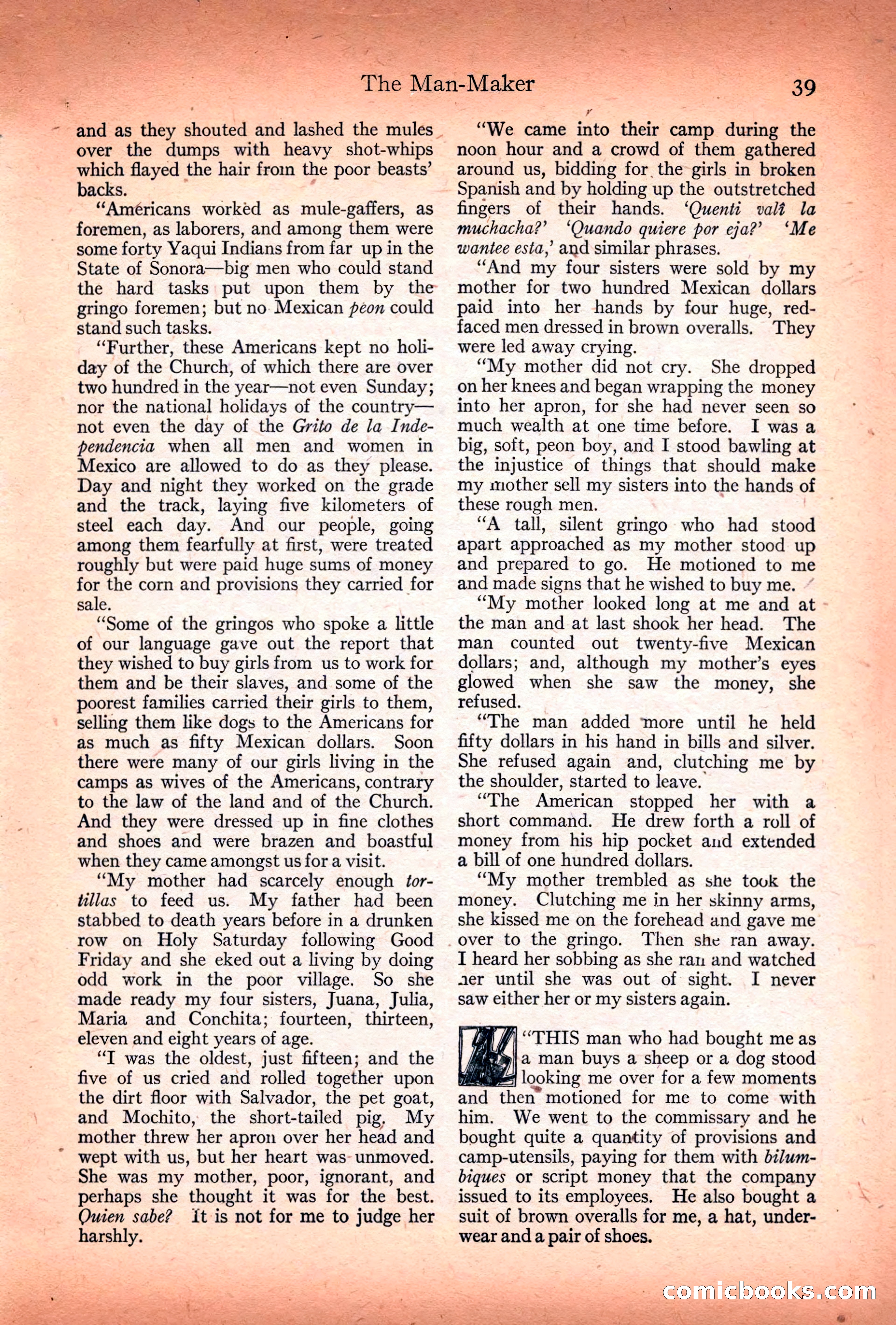
A restored page from Pulp Fiction, 1920. Page through the whole issue in the reader above.
📄 Transcribed text from this page (OCR, searchable)
Machine-transcribed from the original scan — historical spelling and the odd misread are preserved.
Ee oF = tad as they shouted and aahed the mule. over the dumps with heavy shot-whips _ which flayed | the hair from the poor beasts’ backs. ““Américans worked as mule-gaffers, as foremen, as laborers, and among them were some forty Yaqui Indians from far up in the State of Sonora—big men who could stand the hard tasks put upon them by the gringo foremen; but no Mexican péon could stand such tasks. “Further, these Americans kept no holi- day of the Church, of which there are over two hundred in the year—not even Sunday; nor the national holidays of the country— not even the day of the Grito de la Inde- pendencia when all men and women in Mexico are allowed to do as they please. Day and night they worked on the grade and the track, laying five kilometers of steel each day. And our people, going among them fearfully at first, were treated roughly but were paid huge sums of money for the corn and provisions they carried for sale. “Some of the gringos who spoke a little of our language gave out the report that they wished to buy girls from us to work for them and be their slaves, and some of the poorest families carried their girls to them, selling them like dogs to the Americans for as much as fifty Mexican dollars. Soon there were many of our girls living in the camps as wives of the Americans, contrary to the law of the land and of the Church. And they were dressed up in fine clothes and shoes and were brazen and boastful when they came amongst us for a visit. “My mother had scarcely enough for- lillas to feed us. My father had been stabbed to death years before in a drunken row on Holy Saturday following Good Friday and she eked out a living by doing odd work in the poor village. So she made ready my four sisters, Juana, Julia, Maria and Conchita; fourteen, thirteen, eleven and eight years of age. “T was the oldest, just fifteen; and the five of us cried and rolled together upon the dirt floor with Salvador, the pet goat, and Mochito, the short-tailed pig, My mother threw her apron over her head and wept with us, but her heart was- unmoved. She was my mother, poor, ignorant, and perhaps she thought it was for the best. Quien sabe? it is not for me to judge her = harshly. hee — . ~. ~~ # ail <a! een = ae - ; a “ ff Re ae “We came ip their camp aeage the? noon hour and a crowd of them gathered. around us, bidding for the girls in broken — - Spanish and by holding up the outstretched fingers of their hands. ‘Quenti valt la muchacha?’ ‘Quando quiere por eja?? ‘Me wantee esta,’ and similar phrases. “And my four sisters were sold by my mother for two hundred Mexican dollars paid into her hands by four huge, red- faced men dressed in brown overalls. They were led away crying. “My mother did not cry. She dropped on her knees and began wrapping the money into her apron, for she had never seen so much wealth at one time before. I was a big, soft, peon boy, and I stood bawling at the injustice of things that should make my mother sell my sisters into the hands of these rough men. “A tall, silent gringo who had stood apart approached as my mother stood up and prepared to go. He motioned to me and made signs that he wished to buy me. “ “My mother looked long at me and at - the man and at last shook her head. The man counted out twenty-five Mexican dollars; and, although my mother’s eyes glowed when she saw the money, she refused. “The man added more until he held fifty dollars in his hand in bills and silver. She refused again and, clutching me by the shoulder, started to leave. “The American stopped her with a short command. He drew forth a roll of money from his hip pocket and extended a bill of one hundred dollars. “My mother trembled as she tovk the money. Clutching me in her skinny arms, she kissed me on the forehead and gave me _over to the gringo. Then she ran away. I heard her sobbing as she ran and watched ner until she was out of sight. I never saw either her or my sisters again. Wl f\ “THIS man who had bought me as deo a man buys a sheep or a dog stood Mi looking me over for a few moments and then” motioned for me to come with him. We went to the commissary and he bought quite a quantity of provisions and camp-utensils, paying for them with bi/um- biques or script money that the company issued to its employees. He also bought a suit of brown overalls for me, a hat, under- wear and a pair of shoes. = > ry ~€, a