
Pulp Fiction, 1920 · page 23 of 208
Adventure Magazine Cover — page 23: what you’re looking at
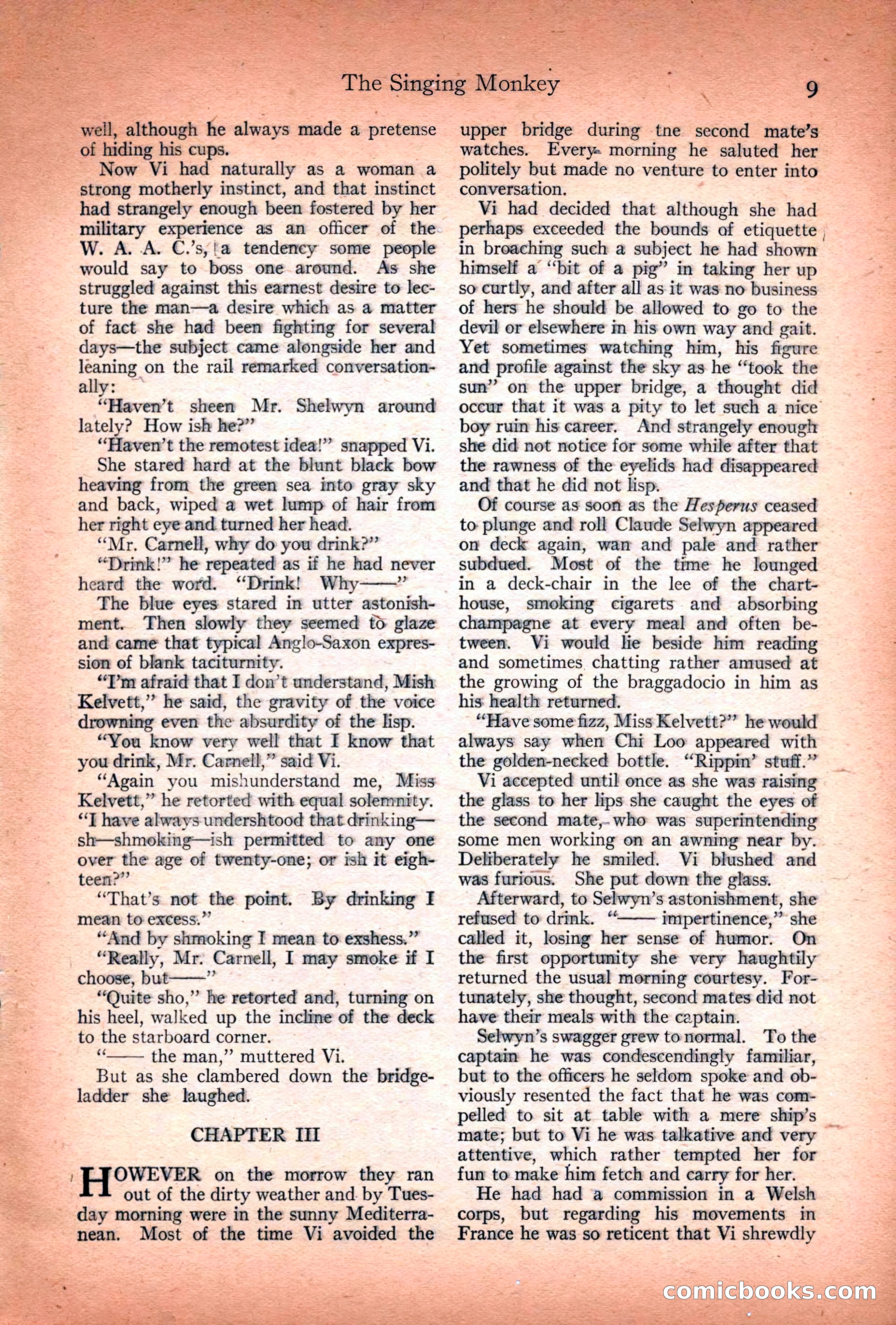
A restored page from Pulp Fiction, 1920. Page through the whole issue in the reader above.
📄 Transcribed text from this page (OCR, searchable)
Machine-transcribed from the original scan — historical spelling and the odd misread are preserved.
|, although he always made a pretense f his cu ~ Now Vi had naturally as a woman a 353 strong motherly instinct, and that instinct had strangely enough been fostered by her military experience as an officer of the W. A. A. C.’s,!a tendency some people would say to boss one around. As she struggled against this earnest desire to lec- ture the man—a desire which as a matter of fact she had been fighting for several days—the subject came alongside her and leaning on the rail remarked conversation- ally: “Haven't sheen Mr. Shelwyn around lately? How ish he?” “Haven't the remotest idea!” snapped Vi. She stared hard at the blunt black bow heaving from the green sea into gray sky and back, wiped @ wet lump of hair from her right eye and turned her head. “Mr. Carnell, why do you drink?” “Drink!” he repeated as if he had never heard the word. “Drink! Why——” The blue eyes stared in utter astonish- ment. Then slowly they seemed to glaze and came that typical Anglo-Saxon expres- sion of blank taciturnity. “T’m afraid that I don’t understand, Mish Kelvett,” he said, the gravity of the voice ing even the absurdity of the lisp. “You know very well that I know that you drink, Mr. Carnell,” said Vi. “Again you mishunderstand me, Miss Kelvett,” he retorted with equal solemnity. “T have always undershtood that drinking— sh—shmoking—ish permitted to amy one over the age of twenty-one; or ish it eigh- teem?”’ “That’s not the point. By drinking I mean toexcess.” ‘“‘And by shmoking I mean to exshess.” “Really, Mr. Carnell, I may smoke if I choose, but——”’ “Quite sho,” he retorted and, turning on his heel, walked up the incline of the deck to the starboard corner. “‘____ the man,”’ muttered Vi. But as she clambered down the bridge- ladder she laughed. CHAPTER III - Fpownver on the morrow they ran out of the dirty weather and by Tues- day morning were in the sunny Mediterra- nean. Most of the time Vi avoided the upper bridge during tne second mate’s : watches. Everye morning he saluted her politely but made no venture to enter into conversation. Vi had decided that although she had perhaps exceeded the bounds of etiquette | in breaching such a subject he had shown himself a “bit of a pig” in taking her up so curtly, and after all as it was no business of hers he should be allowed to go to the devil or elsewhere in his own way ‘and gait. Yet sometimes watching him, his figure and profile against the sky as he “took the sun” on the upper bridge, a thought did occur that it was a pity to let such a nice boy ruin his career. And strangely enough she did not notice for some while after that the rawness of the eyelids had disappeared and that he did not lisp. Of course as soon as the Hesperus ceased to plunge and roll Claude Selwyn appeared on deck again, wan and pale and rather subdued. Most of the time he lounged in a deck-chair in the lee of the chart- house, smoking cigarets and absorbing champagne at every meal and often be- tween. Vi would lie beside him reading and sometimes chatting rather amused at the growing of the braggadocio in him as his health returned. “Have some fizz, Miss Kelvett?” he would always say when Chi Loo appeared with the golden-necked bottle. “Rippin’ stuff.” Vi accepted until once as she was raising the glass to her lips she caught the eyes of the second mate,.who was superintending some men working on an awning near by. Deliberately he smiled. Vi blushed and was furious. She put down the glass. Afterward, to Selwyn’s astonishment, she refused to drmk. “ impertinence,” she called it, losing her sense of humor. On the first opportunity she very haughtily returned the usual morning courtesy. For- tunately, she thought, second mates did not have their meals with the captain. Selwyn’s swagger grew tonormal. To the captain he was condescendingly familiar, but to the officers he seldom spoke and ob- viously resented the fact that he was com- pelled to sit at table with a mere ship’s mate; but to Vi he was talkative and very — attentive, which rather tempted her for fun to make him fetch and carry for her. He had had a commission in a Welsh corps, but regarding his movements in France he was so reticent that Vi shrewdly c oe) ae See a! + fy ae i wen .¥ . ey wy vases