
Pulp Fiction, 1920 · page 197 of 208
Adventure Magazine Cover — page 197: what you’re looking at
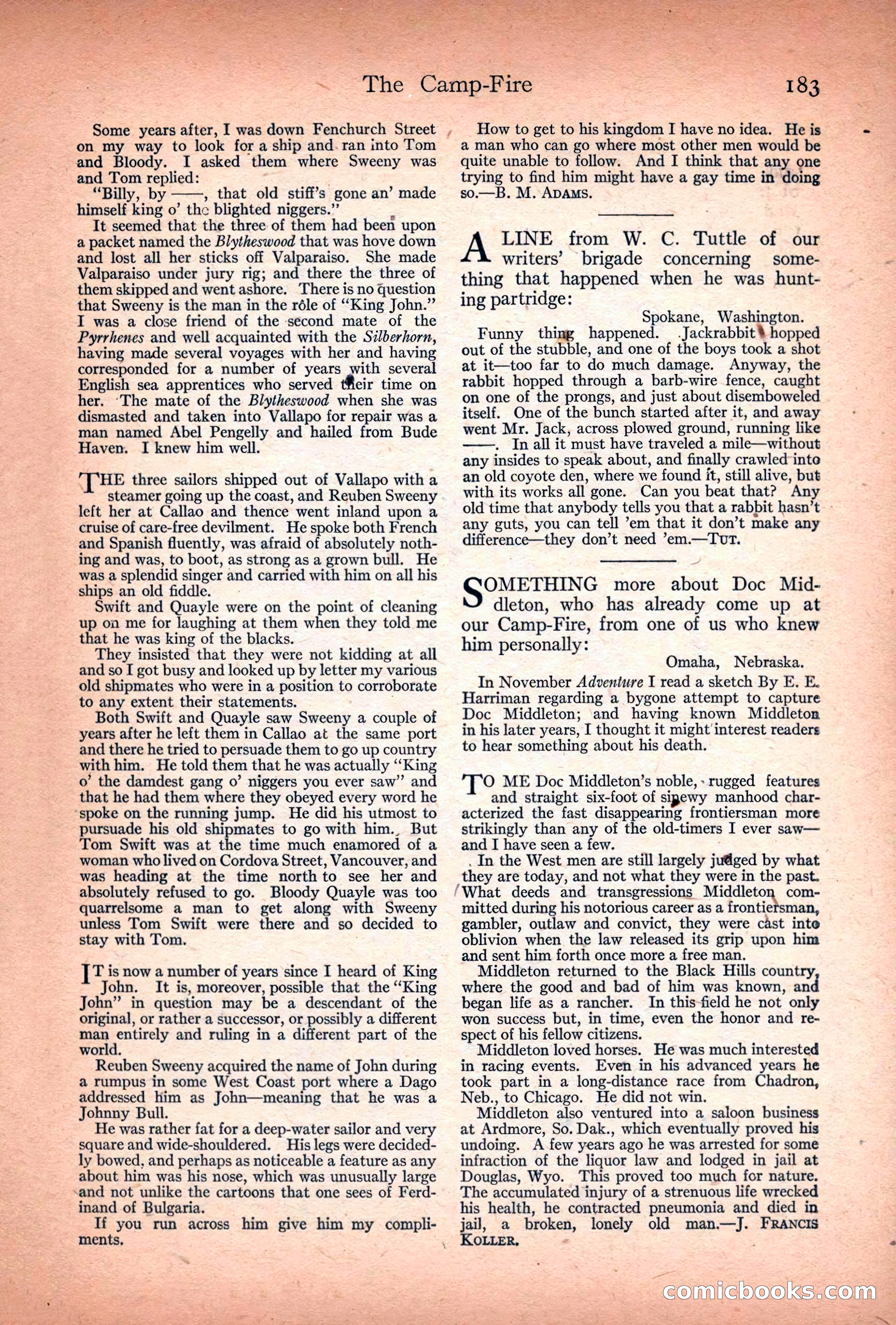
A restored page from Pulp Fiction, 1920. Page through the whole issue in the reader above.
📄 Transcribed text from this page (OCR, searchable)
Machine-transcribed from the original scan — historical spelling and the odd misread are preserved.
ke ee <The Camp-F “ fe = ire Some years after, I was down Fenchurch Street , How to get to his kingdom I have no idea. He is on my way to look for a ship and. ran into Tom and Bloody. I asked them where Sweeny was and Tom replied: : “Billy, by ——, that old stiff’s gone an’ made himself king o’ the blighted niggers.” : It seemed that the three of them had been upon a packet named the Blytheswood that was hove down and lost all her sticks off Valparaiso. She made Valparaiso under jury rig; and there the three of them skipped and went ashore. There is no question that Sweeny is the man in the réle of “King John.” I was a close friend of the second mate of the Pyrrhenes and well acquainted with the Szlberhorn, having made several voyages with her and having corresponded for a number of years with several English sea apprentices who served t&eir time on her. ‘The mate of the Blytheswood when she was dismasted and taken into Vallapo for repair was a man named Abel Pengelly and hailed from Bude Haven. I knew him well. | & HE three sailors shipped out of Vallapo with a steamer going up the coast, and Reuben Sweeny left her at Callao and thence went inland upon a cruise of care-free devilment. He spoke both French and Spanish fluently, was afraid of absolutely noth- ing and was, to boot, as strong as a grown bull. He was a splendid singer and carried with him on all his ships an old fiddle. Swift and Quayle were on the point of cleaning up on me for laughing at them when they told me that he was king of the blacks. They insisted that they were not kidding at all and so [ got busy and looked up by letter my various old shipmates who were in a position to corroborate to any extent their statements. Both Swift and Quayle saw Sweeny a couple of years after he left them in Callao at the same port and there he tried to persuade them to go up country with him. He told them that he was actually “King o’ the damdest gang o’ niggers you ever saw” and that he had them where they obeyed every word he ‘spoke on the running jump. He did his utmost to pursuade his old shipmates to go with him., But Tom Swift was at the time much enamored of a woman who lived on Cordova Street, Vancouver, and was heading at the time north to see her and absolutely refused to go. Bloody Quayle was too quarrelsome a man to get along with Sweeny unless Tom Swift were there and so decided to stay with Tom. [Tt is now a number of years since I heard of King John. It is, moreover, possible that the “King John” in question may be a descendant of the original, or rather a successor, or possibly a different man entirely and ruling in a different part of the world. Reuben Sweeny acquired the name of John during a rumpus in some West Coast port where a Dago addressed Him as John—meaning that he was a Johnny Bull. He was rather fat for a deep-water sailor and very square and wide-shouldered. His legs were decided- ly bowed, and perhaps as noticeable a feature as any about him was his nose, which was unusually large sand not unlike the cartoons that one sees of Ferd- inand of Bulgaria. If you run across him give him my compli- ments, ‘What deeds and transgressions Middleto a man who can go where most other men would be quite unable to follow. And I think that any one trying to find him might have a gay time in doing so.—B. M. ADAms. LINE from W. C. Tuttle of our writers’ brigade concerning some- thing that happened when he was hunt- ing partridge: Spokane, Washington. Funny thing happened. Jackrabbit} hopped out of the stubble, and one of the boys took a shot at it—too far to do much damage. Anyway, the rabbit hopped through a barb-wire fence, caught on one of the prongs, and just about disemboweled itself. One of the bunch started after it, and away went Mr. Jack, across plowed ground, running like ——. In all it must have traveled a mile—without any insides to speak about, and finally crawled inte an old coyote den, where we found it, still alive, but with its works all gone. Can you beat that? Any hs old time that anybody tells you that a rabbit hasn’t - any guts, you can tell ’em that it don’t make any difference—they don’t need ’em.—TotT. OMETHING more about Doc Mid- dleton, who has already come up at our Camp-Fire, from one of us who knew him personally: Omaha, Nebraska. In November Adventure I read a sketch By E. E. Harriman regarding a bygone attempt to capture Doc Middleton; and having known Middleton in his later years, I thought it might’ interest readers to hear something about his death. FO ME Doc Middleton’s noble, - rugged features and straight six-foot of sigewy manhood char- acterized the fast disappearing frontiersman more strikingly than any of the old-timers I ever saw— and I have seen a few. . In the West men are still largely ju@ged by what they are today, and not what they were in the past. com- mitted during his notorious career as a frontietsman, gambler, outlaw and convict, they were cast inte oblivion when the law released its grip upon him and sent him forth once more a free man. Middleton returned to the Black Hills country. where the good and bad of him was known, an began life as a rancher. In this-field he not only won success but, in time, even the honor and re- spect of his fellow citizens. Middleton loved horses. He was much interested in racing events. Even in his advanced years he took part in a long-distance race from Chadron, Neb., to Chicago. He did not win. Middleton also ventured into a saloon business at Ardmore, So. Dak., which eventually proved his undoing. A few years ago he was arrested for some infraction of the liquor law and lodged in jail at Douglas, Wyo. This proved too much for nature. The accumulated injury of a strenuous life wrecked his health, he contracted pneumonia and died in jail, a broken, lonely old man.—J. FRANCIS KOLLER. . 5 200KS