
Pulp Fiction, 1920 · page 178 of 208
Adventure Magazine Cover — page 178: what you’re looking at
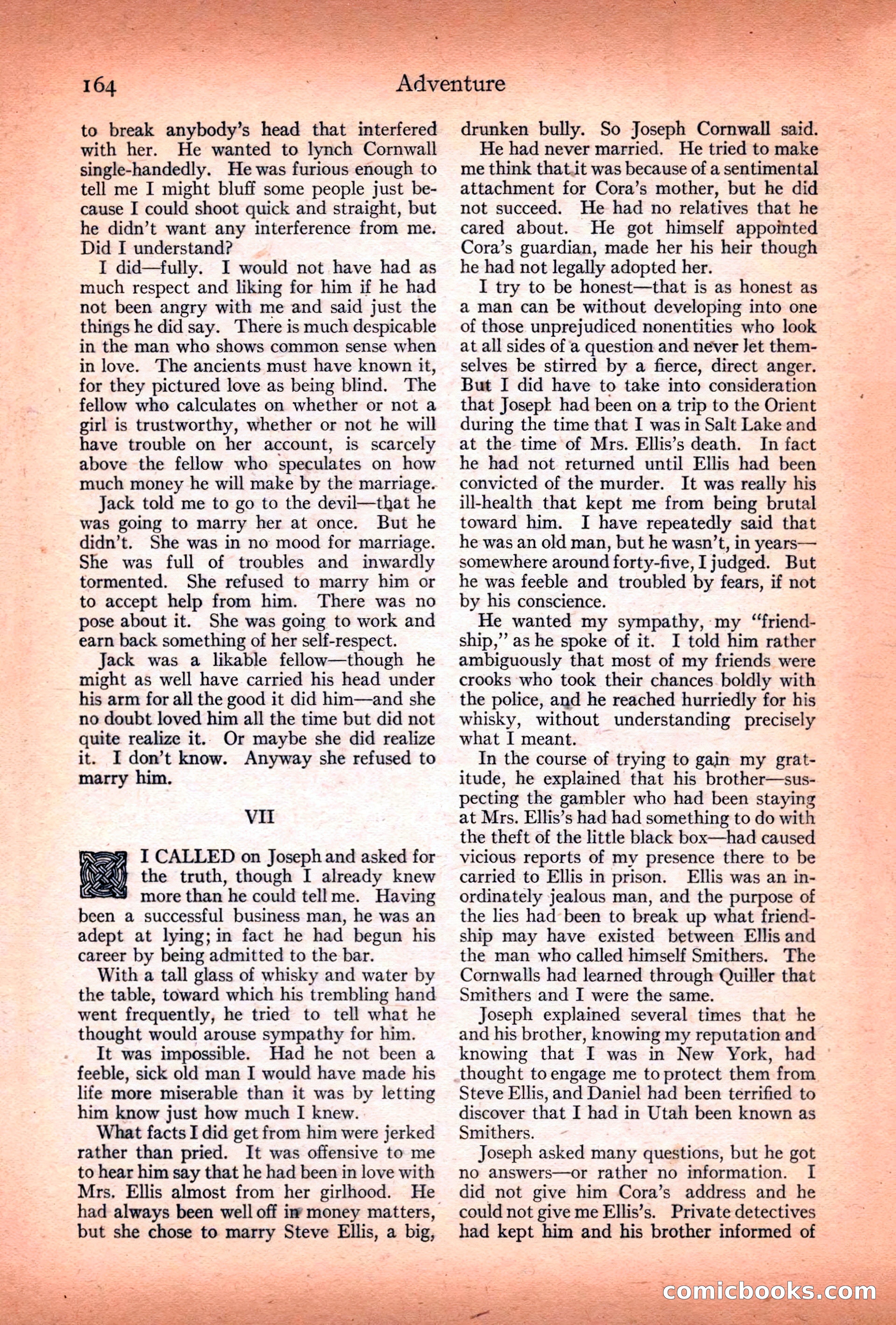
A restored page from Pulp Fiction, 1920. Page through the whole issue in the reader above.
📄 Transcribed text from this page (OCR, searchable)
Machine-transcribed from the original scan — historical spelling and the odd misread are preserved.
—— single-handedly. en to break anybody’s head that interfered with her. He wanted to lynch Cornwall He was furious enough to tell me I might bluff some people just be- cause I could shoot quick and straight, but he didn’t want any interference from me. Did I understand? I did—fully. I would not have had as much respect and liking for him if he had not been angry with me and said just the things he did say. There is much despicable in the man who shows common sense when in love. The ancients must have known it, for they pictured love as being blind. The _ fellow who calculates on whether or not a girl is trustworthy, whether or not he will have trouble on her account, is scarcely above the fellow who speculates on how much money he will make by the marriage. Jack told me to go to the devil—that he was going to marry her at once. But he didn’t. She was in no mood for marriage. She was full of troubles and inwardly tormented. She refused to marry him or to accept help from him. There was no pose about it. She was going to work and earn back something of her self-respect. Jack was a likable fellow—though he might as well have carried his head under his arm for all the good it did him—and she no doubt loved him all the time but did not quite realize it.. Or maybe she did realize it. I don’t know. Anyway she refused to marry him. Vil 9 I CALLED on Joseph and asked for Wy the truth, though I already knew more than he could tellme. Having been a successful business man, he was an adept at lying; in fact he had begun his career by being admitted to the bar. With a tall glass of whisky and water by the table, toward which his trembling hand went frequently, he tried to tell what he thought would arouse sympathy for him. It was impossible. Had he not been a | feeble, sick old man I would have made his life more miserable than it was by letting him know just how much I knew. What facts I did get from him were jerked rather than pried. It was offensive to me to hear him say that he had been in love with Mrs. Ellis almost from her girlhood. He had always been well off im money matters, but she chose to marry Steve Ellis, a big, oS, gat — ae. * —— = at w ~.= oe = or = Ae 5 ae ye : eo <S ne aS nay PR Rtg Pra Se UE SP ay ee wet S ae «ae eS 5p ee = - drunken bully. So Joseph Cornwall said. He had never married. He tried to make me think that.it was because of a sentimental attachment for Cora’s mother, but he did not succeed. He had no relatives that he cared about. He got himself appointed Cora’s guardian, made her his heir though he had not legally adopted her. I try to be honest—that is as honest as a man can be without developing into one of those unprejudiced nonentities who look at all sides of a question and never Jet them- selves be stirred by a fierce, direct anger. But I did have to take into consideration that Josepk had been on a trip to the Orient during the time that I was in Salt Lake and at the time of Mrs. Ellis’s death. In fact he had not returned until Ellis had been convicted of the murder. It was really his ill-health that kept me from being brutal toward him. I have repeatedly said that he was an old man, but he wasn’t, in years— somewhere around forty-five, I judged. But he was feeble and troubled by fears, if not by his conscience. He wanted my sympathy, my “friend- ship,” as he spoke of it. I told him rather ambiguously that most of my friends were crooks who took their chances boldly with the police, and he reached hurriedly for his whisky, without understanding precisely what I meant. In the course of trying to gain my grat- itude, he explained that his brother—sus- pecting the gambler who had been staying at Mrs. Ellis’s had had something to do with the theft of the little black box—had caused vicious reports of my presence there to be carried to Ellis in prison. Ellis was an in- ordinately jealous man, and the purpose of the lies had been to break up what friend- ship may have existed between Ellis and the man who called himself Smithers. The Cornwalls had learned through Quiller that Smithers and I were the same. Joseph explained several times that he and his brother, knowing my reputation and knowing that I was in New York, had © thought to engage me to protect them from. Steve Ellis, and Daniel had been terrified to discover that I had in Utah been known as Smithers. Joseph asked many questions, but he got no answers—or rather no information. I did not give him Cora’s address and he | could not give me Ellis’s. Private detectives had kept him and his brother informed of : eo 2 = gai =