
Pulp Fiction, 1920 · page 172 of 208
Adventure Magazine Cover — page 172: what you’re looking at
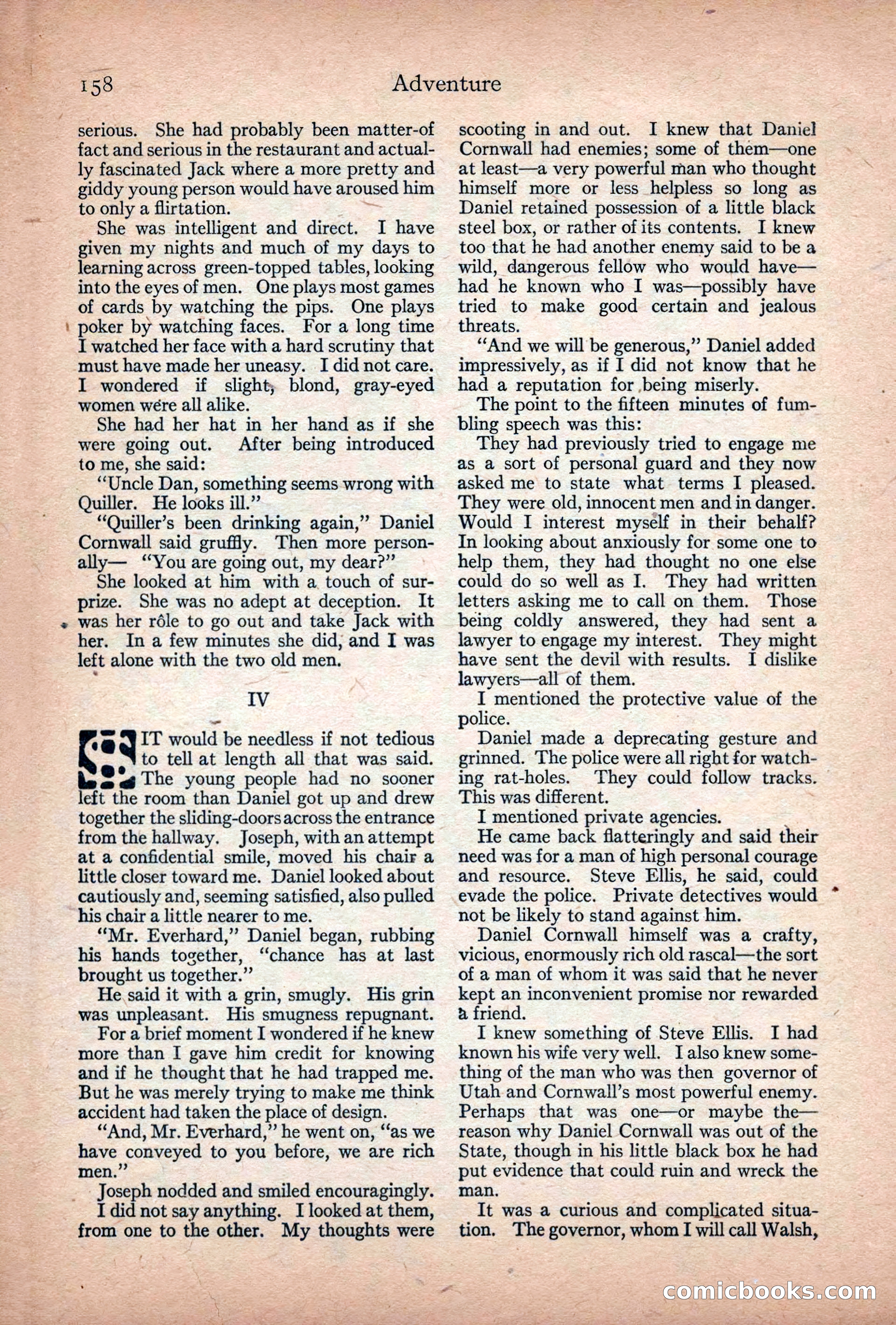
A restored page from Pulp Fiction, 1920. Page through the whole issue in the reader above.
📄 Transcribed text from this page (OCR, searchable)
Machine-transcribed from the original scan — historical spelling and the odd misread are preserved.
I 58 Adventure serious. She had probably been matter-of scooting in and out. I knew that Daniel fact and serious in the restaurant and actual- ly fascinated Jack where a more pretty and giddy young person would have aroused him to only a flirtation. She was intelligent and direct. I have given my nights and much of my days to learning across green-topped tables, looking into the eyes of men. One plays most games of cards by watching the pips. One plays poker by watching faces. For a long time I watched her face with a hard scrutiny that must have made her uneasy. I did not care. I wondered if slight; blond, gray-eyed women were all alike. She had her hat in her hand as if she were going out. After being introduced to me, she said: - “Uncle Dan, something seems wrong with Quiller. He looks ill.” “Quiller’s been drinking again,” Daniel Cornwall said gruffly. Then more person- ally— ‘You are going out, my dear?” She looked at him with a touch of sur- prize. She was no adept at deception. It was her réle to go out and take Jack with her. In a few minutes she did; and I was left alone with the two old men. IV :@ rT would be needless if not tedious to tell at length all that was said. be Os The young people had no sooner left the room than Daniel got up and drew together the sliding-doors across the entrance from the hallway. Joseph, with an attempt at a confidential smile, moved his chair a little closer toward me. Daniel looked about cautiously and, seeming satisfied, also pulled his chair a little nearer to me. “Mr. Everhard,” Daniel began, rubbing his hands together, “chance has at last brought us together.” He said it with a grin, smugly. His grin was unpleasant. His smugness repugnant. For a brief moment I wondered if he knew more than I gave him credit for knowing and if he thought that he had trapped me. But he was merely trying to make me think accident had taken the place of design. “And, Mr. Everhard,” he went on, “‘as we have conveyed to you before, we are rich men.” _ Joseph nodded and smiled encouragingly. I did not say anything. I looked at them, from one to the other. My thoughts were Cornwall had enemies; some of them—one at least—a very powerful man who thought himself more or less helpless so long as Daniel retained possession of a little black steel box, or rather of its contents. I knew too that he had another enemy said to be a wild, dangerous fellow who would have— had he known who I was—possibly have tried to make good certain and jealous threats. “‘And we will be generous,” Daniel added impressively, as if I did not know that he had a reputation for being miserly. The point to the fifteen minutes of fum- bling speech was this: They had previously tried to engage me as a sort of personal guard and they now asked me to state what terms I pleased. They were old, innocent men and in danger. Would I interest myself in their behalf? In looking about anxiously for some one to help them, they had thought no one else could do so well as I. They had written letters asking me to call on them. Those being coldly answered, they had sent a lawyer to engage my interest. They might have sent the devil with results. I dislike lawyers—all of them. I mentioned the protective value of the police. Daniel made a deprecating gesture and grinned. The police were all right for watch- ing rat-holes. This was different. I mentioned private agencies. He came back flatteringly and said their need was for a man of high personal courage and resource. Steve Ellis, he said, could evade the police. Private detectives would not be likely to stand against him. Daniel Cornwall himself was a crafty, vicious, enormously rich old rascal—the sort of a man of whom it was said that he never kept an inconvenient promise nor rewarded & friend. I knew something of Steve Ellis. known his wife very well. I also knew some- thing of the man who was then governor of Utah and Cornwall’s most powerful enemy. Perhaps that was one—or maybe the— reason why Daniel Cornwall was out of the State, though in his little black box he had put evidence that could ruin and wreck the man. It was a curious and complicated situa- tion. The governor, whom I will call Walsh, ECOMIEc They could follow tracks. | IT had JOOKS > com . - - a at ~ rag ee. FP “ ae - ee Aa + < = a ee