
Pulp Fiction, 1919 · page 64 of 208
Adventure Magazine Cover, December 18, 1919 — page 64: what you’re looking at
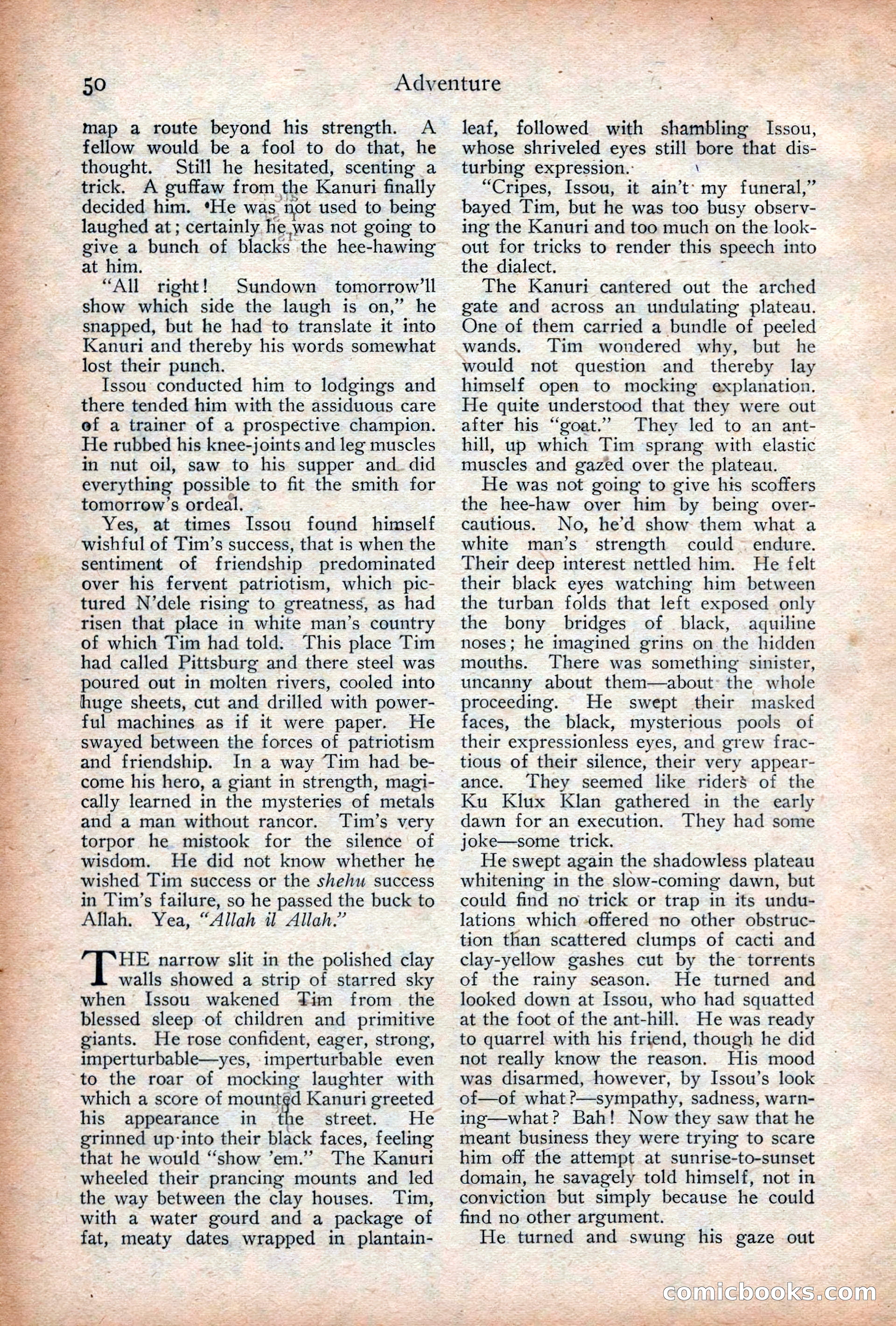
A restored page from Pulp Fiction, 1919. Page through the whole issue in the reader above.
📄 Transcribed text from this page (OCR, searchable)
Machine-transcribed from the original scan — historical spelling and the odd misread are preserved.
Is ~~ a NJ i EES Mea sata WARMTH Yi) y ste al ig td ye PAM) aa NUR SIR Ce ean AN As dee ? sh et > Py Yi $4 “V4 a tt AVR eT noma ORT RN te lore ROL ENT INES OO ONIN RE TSN MVR GE Srl “t 5 “yy 4 AEN IMAARR Ravernt hate ' ’ 50 map a route beyond his strength. A fellow would be a fool to do that, he thought. Still he hesitated, scenting a trick. A guffaw from the Kanuri finally decided him. *He was ‘not used to being laughed at; certainly he was not going to give a bunch of blacks the hee- hawing at him. “All right! Sundown tomorrow’ll show which side the laugh is on,” he snapped, but he had to translate it into Kanuri and thereby his words somewhat lost their punch. Issou conducted him to lodgings and there tended him with the assiduous care ef a trainer of a prospective champion. He rubbed his knee-joints and leg muscles in nut oil, saw to his supper and_ did everything possible to fit the smith for tomorrow’s ordeal. Yes, at times Issou found himself wishful of Tim’s success, that is when the sentiment of friendship predominated over his fervent patriotism, which pic- tured N’dele rising to greatness, as had risen that place in white man’s country of which Tim had told: This place Tim had called Pittsburg and there steel was poured out in molten rivers, cooled into huge sheets, cut and drilled with power- ful machines as if it were paper. He swayed between the forces of patriotism and friendship. In a way Tim had be- come his hero, a giant in strength, magi- cally learned in the mysteries of metals and a man without rancor. Tim’s very torpor he mistook for the silence of wisdom. He did not know whether he wished Tim success or the shehw success in Tim’s failure, so he passed the buck to Allah. Yea, “Allah il Allah.” HE narrow slit in the polished clay walls showed a strip of starred sky when I[ssou wakened Yim from. the blessed sleep of children and primitive giants. He rose confident, eager, strong, imperturbable—yes, imperturbable even ‘to the roar of mocking laughter with which a score of mounted Kanuri greeted his appearance in .the street. He grinned up-into their black faces, feeling that he would “show ’em.” The Kanuri wheeled their prancing mounts and led the way between the clay houses. Tim, with a water gourd and a package of fat, meaty dates wrapped in plantain- ‘Adventure leaf, followed with shambling Issou, whose shriveled eyes still bore that dis- turbing expression.: \ “Cripes, Issou, it ain’t‘ my funeral,” bayed Tim, but he was too busy observ- ing the Kanuri and too much on the look- out for tricks to render this speech into the dialect. The Kanuri cantered out the arched gate and across an undulating plateau. One of them carried a bundle of peeled wands. Tim wondered why, but he would not question and thereby lay himself open to mocking explanation. He quite understood that they were out after his “goat.” They led to an ant- hill, up which Tim sprang with elastic muscles and gazed over the plateau. He was not going to give his scoffers the hee-haw over him by being over- cautious. No, he’d show them what a white man’s’ strength could endure. Their deep interest nettled him. He felt their black eyes watching him between the turban folds that left exposed only the bony bridges of black, aquiline noses; he imagined grins on the hidden mouths. There was something sinister, uncanny about them—about: the whole proceeding. He swept their masked faces, the black, mysterious pools of their expressionless eyes, and grew frac- tious of their silence, their very appear- ance. They seemed like rider’ of the Ku Klux Klan gathered in the early dawn for an execution. They had some joke—some trick. He swept again the shadowless plateau whitening in the slow-coming dawn, but could find no trick or trap in its undu- lations which offered no other obstruc- tion than scattered clumps of cacti and clay-yellow gashes cut by the torrents of the rainy season. He turned and looked down at Issou, who had squatted at the foot of the ant-hill. He was ready to quarrel with his friend, though he did not really know the reason. His mood was disarmed, however, by Issou’s look of—of what?—sympathy, sadness, warn- ing—what? Bah! Now they saw that he meant business they were trying to scare him off the attempt at sunrise-to-sunset domain, he savagely told himself, not in conviction but simply because he could find no other argument. He turned and swung his gaze out EOPMIG OOO KS, - id - : 4 + ~ Ag ey ss ee a ee oe ee (E@)