
Pulp Fiction, 1919 · page 57 of 208
Adventure Magazine Cover, December 18, 1919 — page 57: what you’re looking at
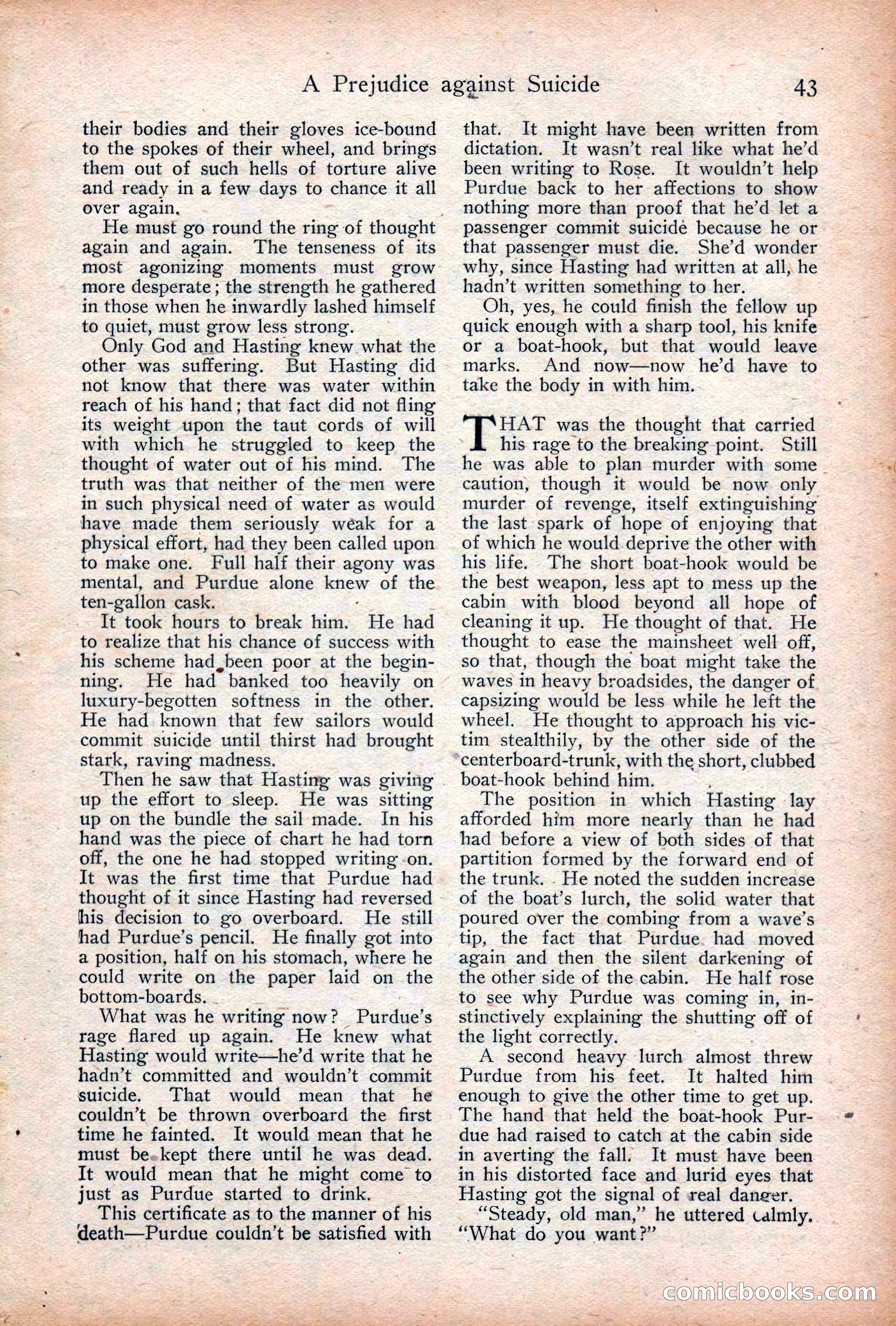
A restored page from Pulp Fiction, 1919. Page through the whole issue in the reader above.
📄 Transcribed text from this page (OCR, searchable)
Machine-transcribed from the original scan — historical spelling and the odd misread are preserved.
A Prejudice against Suicide 43 their bodies and their gloves ice-bound to the spokes of their wheel, and brings them out of such hells of torture alive and ready in a few days to chance it all over again, He must go round the ring of thought again and again. The tenseness of its most agonizing moments must grow more desperate ; the strength he gathered in those when he inwardly lashed himself to quiet, must grow less strong. Only God and Hasting knew what the other was suffering. But Hasting did not know that there was water within reach of his hand; that fact did not fling its weight upon the taut cords of will with which he struggled to keep the thought of water out of his mind. The truth was that neither of the men were in such physical need of water as would have made them seriously wéak for a physical effort, had they been called upon to make one. Full half their agony was mental, and Purdue alone mae of the ten- -gallon cask. It took hours to break him. He had to realize that his chance of success with his scheme had been poor at the begin- ning. He had banked too heavily on luxury-begotten softness in the other. He had known that few sailors would commit suicide until thirst had brought stark, raving madness. Then he saw that Hasting was giving up the effort to sleep. He was sitting up on the bundle the sail made. In his hand was the piece of chart he had torn off, the one he had stopped writing -on. It was the first time that Purdue had thought of it since Hasting had reversed his decision to go overboard. He still had Purdue’s pencil. He finally got into a position, half on his stomach, where he could write on the paper laid on the bottom-boards. . What was he writing now? Purdue’s rage flared up again. He knew what Hasting would write—he’d write that he hadn’t committed and wouldn’t commit suicide. That would mean that he couldn’t be thrown overboard the first time he fainted. It would mean that he must be.ekept there until he was dead. It would mean that he might come to just as Purdue started to drink. This certificate as to the manner of his death—Purdue couldn’t be satisfied with that. It might have been written from dictation. It wasn’t real like what he’d been writing to Rose. It wouldn’t help Purdue back to her affections to show nothing more than proof that he’d let a passenger commit suicide because he or that passenger must die. She’d wonder why, since Hasting had written at all) he hadn’t written something to her. Oh, yes, he could finish the fellow up quick enough with a sharp tool, his knife or a boat-hook, but that would leave marks. And now—now he’d have to take the body in with him. HAT was the thought that carried his rage to the breaking point. Still he was able to plan murder with some. caution, though it would be now only murder of revenge, itself extinguishing the last spark of hope of enjoying that of which he would. deprive the other with his life. The short boat-hook would be the best weapon, less apt to mess up the cabin with blood beyond all hope of cleaning it up. He thought of that. He thought to ease the mainsheet well off, so that, though the boat might take the waves in heavy broadsides, the danger of capsizing would be less while he left the wheel. He thought to approach his vic- tim stealthily, by the other side of the *centerboard- trunk, with the short, clubbed boat-hook behind him. The position in which Hasting lay afforded him more nearly than he had had before a view of both sides of that partition formed by the forward end of the trunk. . He noted the sudden increase of the boat’s lurch, the solid water that poured over the combing from a wave’s tip, the fact that Purdue. had moved again and then the silent darkening of the other side of the cabin. He half rose to see why Purdue was coming in, in- stinctively explaining the shutting off of the light correctly. A second heavy lurch almost threw Purdue from his feet. It halted him enough to give the other time to get up. The hand that held the boat-hook Pur- due had raised to catch at the cabin side in averting the fall. It must have been in his distorted face and lurid eyes that Hasting got the signal of real danger. “Steady, old man,” he uttered calmly. “What do you want; fv Gomicbooks (F@)