
Pulp Fiction, 1919 · page 51 of 208
Adventure Magazine Cover, December 18, 1919 — page 51: what you’re looking at
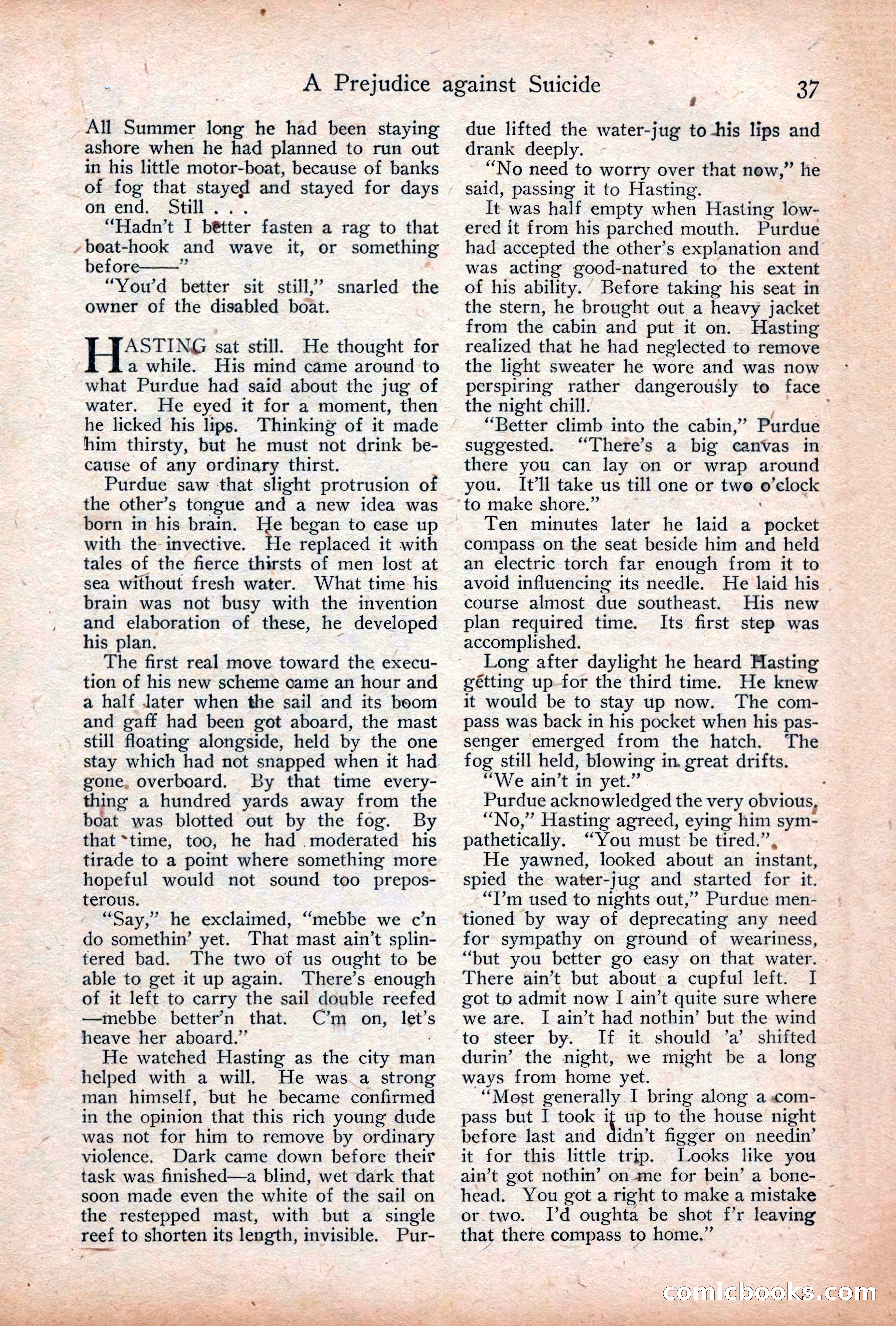
A restored page from Pulp Fiction, 1919. Page through the whole issue in the reader above.
📄 Transcribed text from this page (OCR, searchable)
Machine-transcribed from the original scan — historical spelling and the odd misread are preserved.
e a = —s .. a . . “ Se pe ne ee = vor hoe A Prejudice against Suicide All Summer long he had been staying ashore when he had planned to run out in his little motor-boat, because of banks of fog that stayed and stayed for days on end.-= Sui >... “Hadn't I b®tter fasten a rag to that boat-hook and wave it, or something before——” “You'd better sit still,’ snarled the owner of the disabled boat. ASTING sat still. He thought for a while. His mind came around to what Purdue had said about the jug of water. He eyed it for a moment, then he licked his lips. Thinking of it made him thirsty, but he must not drink be- cause of any ordinary thirst. Purdue saw that slight protrusion of the other’s tongue and a new idea was born in his brain. ne began to ease up with the invective. He replaced it with tales of the fierce thirsts of men lost at sea without fresh water. What time his brain was not busy with the invention and elaboration of these, he developed his plan. The first real move toward the execu- tion of his new scheme came an hour and a half later when the sail and its beom and gaff had been got aboard, the mast still floating alongside, held by the one stay which had not snapped when it had gone, overboard. By that time every- thing a hundred yards away from the boat was blotted out by the fog. By that *time, too, he had .moderated his tirade to a point where something more hopeful would not sound too prepos- terous. “Say,” he exclaimed, “mebbe we c’n do somethin’ yet. That mast ain’t splin- tered bad. The two of us ought to be able to get it up again. There’s enough of it left to carry the sail double reefed —imebbe better’n that. C’m on, eS heave her aboard.” He watched Hasting as the city man helped with a will, He was_a strong man himself, but he became confirmed in the opinion that this rich young dude was not for him to remove by ordinary violence. Dark came down before their task was finished—a blind, wet dark that soon made even the white of the sail on the restepped mast, with but a single reef to shorten its length, invisible. Pur- = pt : <se ¥ » — SS ne eee ee” 2 ee ae 37 due lifted the water-jug to-his lips and drank deeply. “No need to worry over that now,” he said, passing it to Hasting. It was half empty when Hasting low- ered it from his parched mouth. Purdue é had accepted the other’s explanation and was acting good-natured to the extent of his ability. Before taking his seat in the stern, he brought out a heavy jacket from the cabin and put it on. Hasting realized that he had neglected to remove the light sweater he wore and was now perspiring rather dangerously to face the night chill. : “Better climb into the cabin,” Purdue suggested. “There’s a big canvas in there you can lay on or wrap around you. It’ll take us till one or twe o'clock to make shore.” Ten minutes later he laid a wait compass on the seat beside him and held an electric torch far enough from it to avoid influencing its needle. He laid his course almost due southeast. His new plan required time. Its first step was accomplished. Long after daylight he heard Masting gétting up for the third time. He knew it would be to stay up now. The com- pass was back in his pocket when his pas- senger emerged from the hatch. The fog still held, blowing in. great drifts. “We ain’t in yet.” Purdue acknowledged the very obvious, “No,” Hasting agreed, eying him sym- pathetically. “You must be tired.”, He yawned, looked about an instant, spied the water-jug and started for it. “T’m used to nights out,” Purdue men- tioned by way of deprecating any need for sympathy on ground of weariness, “but you better go easy on that water. There ain’t but about a cupful left. [I got to admit now I ain’t quite sure where we are. [ ain’t had nothin’ but the wind to steer by. If it should ’a’ shifted durin’ the night, we might be a long ways from home yet. “Most generally I bring along a com- pass but I took if up to the house night before last and didn’t figger on needin’ it for this little trip. Looks like you ain’t got nothin’ on me for bein’ a bone- _ head. You got a right to make a mistake or two. I’d oughta be shot f’r leaving that there compass to home.” EOMMIC HOO < ing “Ondine (E@)