
Pulp Fiction, 1919 · page 203 of 208
Adventure Magazine Cover, December 18, 1919 — page 203: what you’re looking at
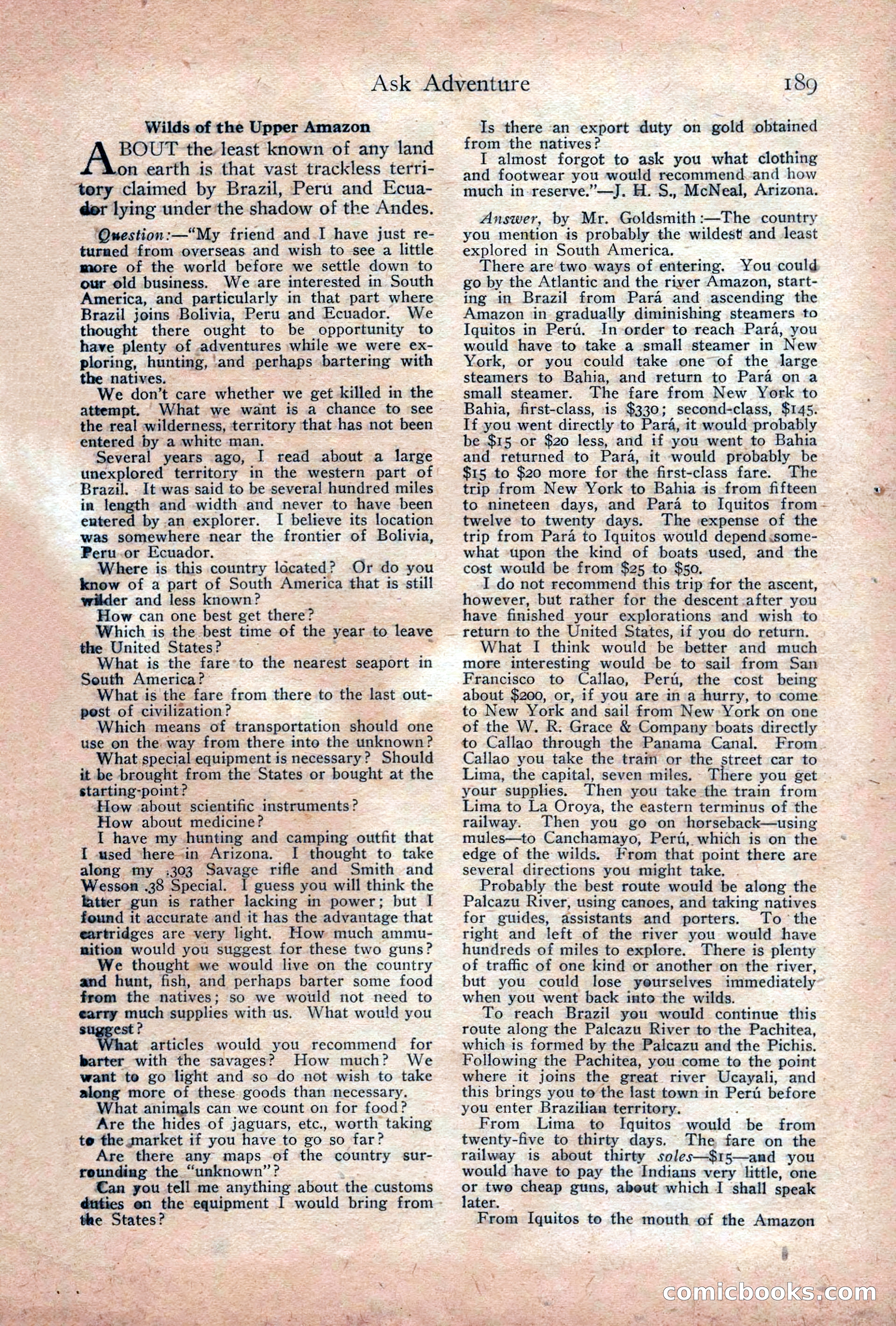
A restored page from Pulp Fiction, 1919. Page through the whole issue in the reader above.
📄 Transcribed text from this page (OCR, searchable)
Machine-transcribed from the original scan — historical spelling and the odd misread are preserved.
Ask Adventure Wilds of the Upper Amazon BOUT the least known of any land n earth is that vast trackless terri- tery claimed by Brazil, Peru and Ecua- dor lying under ‘the shadow of the Andes. ‘Onestion:—“My friend and_I have just re- turned from overseas and wish to see a little more of the world before we settle down to our old business. We are interested in South America, and particularly in that part where Brazil joins Bolivia, Peru and Ecuador. We thought there ought to be opportunity to have plenty of adventures while we were ex- ploring, hunting, ‘and perhaps bartering with the natives. We don’t care whether we get killed in the © attempt. What we want is a chance to see the real wilderness, territory that has not been entered by a white man. Several years ago, I read about a large unexplored territory in the western part of Brazil. - It -was said to be several hundred miles in length and width and never to have been entered by an explorer. I believe its location was somewhere near the frontier of Bolivia, Peru.or Ecuador. Where is this country located? Or do you know of a part of South America that is still wilder and less known? How can one best get there? Which is the best time of the year to leave the United States ? What is the fare°to the nearest seaport in South America? What is the fare from thers to the last out- pest of civilization? Which means of transportation should one use on the way from there into the unknown? What special equipment is necessary? Should it be brought from the States or bought at the starting-point? ‘How about scientific instruments? How about medicine? I have my hunting and camping outfit that I used ‘herein Arizona. I thought to take along my .303 Savage rifle and Smith and Wesson .38 Special. 1 guess you will think the latter gun is rather lacking in power; but I found it accurate and it has the advantage that eartridges are very light. How much ammu- nition would you suggest for these two guns? We thought we would live on the country and hunt, fish, and perhaps barter some food from the natives; so we wotld not need to carry —_ supplies with us. What would you "ene articles would you recommend for barter with the savages? How much? We want te go light and so do not wish to take along more of these goods than necessary. What animals can we count on for food? Are the hides of jaguars, etc., worth taking te the market if you have to go so far? Are there any maps of the country sur- rounding the “unknown’’? €an you tell me anything about the customs duties on the equipment I would bring from - the States? 189 Is there an export duty on gold obtained from the natives? I almost forgot to ask you what clothing and footwear you would recommend.and how much in-reserve.”—J. H. S., McNeal, Arizona. Answer, by Mr. Goldsmith :—The country you mention is probably the wildest and least explored in South America. There are two ways of entering. You could go by the Atlantic and the river Amazon, start- ing in Brazil from Para and ascending the Amazon in gradually diminishing steamers to Iquitos in Pert. In order to reach Para, you would have to take a small steamer in New York, or you could take one of the large steamers to Bahia, and return to Para ona small steamer. The fare from New York to Bahia, first-class, is $330; second-class, $145. If you went directly to Para, it would probably be $15 or $20 less, and if you went to Bahia and returned to Para, it would probably be $15 to $20 more for the first-class fare. The trip from New York to Bahia is from fifteen to nineteen days, and Para to Iquitos from twelve to twenty days. The expense of the trip from Para to Iquitos would depend .some- what upon the kind of boats used, and the cost would be from $25 to $50. I do not recommend this trip for the ascent, however, but rather for the descent .after you have finished your explorations and wish to _ return to the United States, if you do return. What I think would be better and much more interesting would be to sail from San Francisco to Callao, Pert, the cost being about $200, or, if you are ina hurry, to come to New York and sail from New York on one of the W. R: Grace & Company boats directly to Callao through the Panama Canal. From Callao you take the train or the street car to Lima, the capital, seven miles. There you get your supplies. Then you take the train from Lima to La Oroya, the eastern terminus of the railway. Then you go on horseback—using mules—to Canchamayo, Pert, which is on the edge of the wilds. several directions you might take, . Probably the best route would be along the Palcazu River, using canoes, and taking natives for guides, assistants and porters. To the right and left of the river you would have hundreds of miles to explore. There is plenty of traffic of one kind or another on the river, but you could lose yourselves immediately when you went back into the wilds. To reach Brazil you would continue this route along the Palcazu River tothe Pachitea, which is formed by the Palcazu and the Pichis. Following the Pachitea, you come to the point where it joins the great river Ucayali, this brings you to the last town in Pert before you enter Brazilian territory. From Lima to Iquitos would be from twenty-five to thirty days. The fare on the railway is about thirty soles—$15—and you would have to pay the Indians very little, one on two cheap guns, abeut which I shall speak ater. From Iquitos to the mouth of the Amazon 4 From that point there are \ sy comicbooks: and - St