
Pulp Fiction, 1919 · page 171 of 208
Adventure Magazine Cover, December 18, 1919 — page 171: what you’re looking at
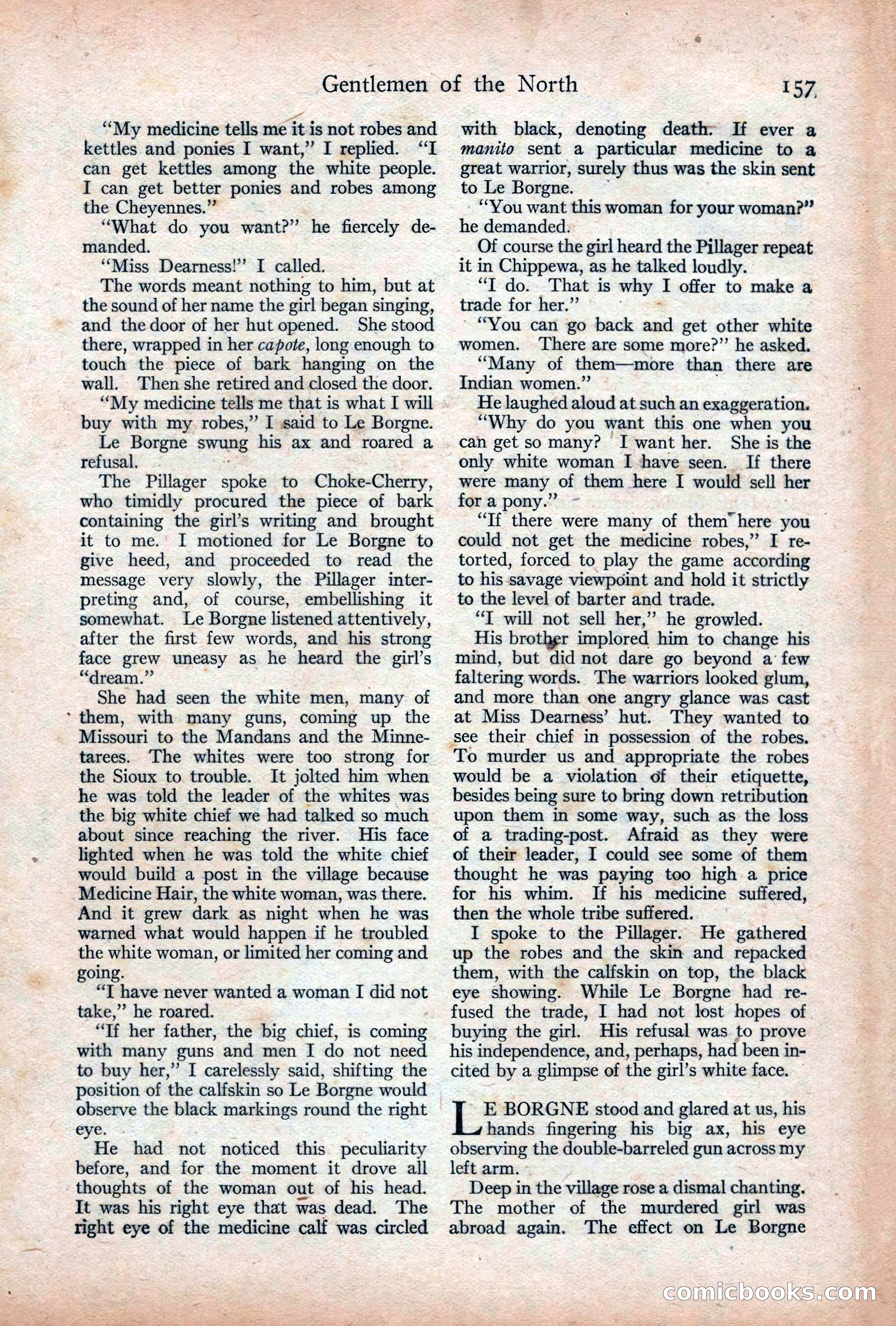
A restored page from Pulp Fiction, 1919. Page through the whole issue in the reader above.
📄 Transcribed text from this page (OCR, searchable)
Machine-transcribed from the original scan — historical spelling and the odd misread are preserved.
Gentlemen of the North “My medicine tells me it is not robes and kettles and ponies I want,” I replied. “I can get kettles among the white people. I can get better ponies and robes among the Cheyennes.” “What do you want?” he fiercely de- manded. ‘Miss Dearness!” I called. The words meant nothing to him, but at the sound of her name the girl began singing, and the door of her hut opened. She stood there, wrapped in her capote, long enough to touch the piece of bark hanging on the wall. Then she retired and closed the door. ‘““My medicine tells me that is what I will buy with my robes,” I said to Le Borgne. Le Borgne swung his ax and roared a refusal. The Pillager spoke to Choke-Cherry, who timidly procured the piece of bark containing the girl’s writing and brought it to me. I motioned for Le Borgne to give heed, and proceeded to read the message very slowly, the Pillager inter- preting and, of course, embellishing it somewhat. Le Borgne listened attentively, after the first few words, and his strong face grew uneasy as he heard the girl’s “dream.” She had seen the white men, many of ‘them, with many guns, coming up the Missouri to the Mandans and the Minne- tarees. The whites were too strong for the Sioux to trouble. It jolted him when he was told the leader of the whites was the big white chief we had talked so much about since reaching the river. His face lighted when he was told the white chief would build a post in the village because Medicine Hair, the white woman, was there. And it grew dark as night when he was warned what would happen if he troubled the white woman, or limited her coming and going. “T have never wanted a woman I did not take,” he roared. “Tf her father, the big chief, is coming with many guns and men I do not need to buy her,” I carelessly said, shifting the position of the calfskin so Le Borgne would observe the black markings round the right eye. . He had not noticed this peculiarity before, and for the moment it drove all thoughts of the woman out of his head. It was his right eye that was dead. The right eye of the medicine calf was circled 157, with black, denoting death: If ever a manito sent a particular medicine to a great warrior, surely thus was the skin sent to Le Borgne. ~ “Vou want this woman for your woman?” he demanded: Of course the girl heard the Pillager repeat it in Chippewa, as he talked loudly. “T-doz--That-is why I offer to make a trade for her.”’ ~ “You can go back and get other white women. ‘There are some more?” he asked. “Many of them—more than there are Indian women.’ He laughed aloud at such an exaggeration. “Why do you want this one when you can get so many? I wanther. She is the only white woman I have seen. If there were many of them here I would sell her for a pony.” “If there were many of them’ here you — could not get the medicine robes,” I re- torted, forced to play the game according to his savage viewpoint and hold it strictly to the level of barter and trade. “T will not sell her,” he growled. His brother implored him to change his mind, but did not dare go beyond a few faltering words. The warriors looked glum, and more than one angry glance was cast at Miss Dearness’ hut. ‘They wanted to see their chief in possession of the robes. ‘To murder us and appropriate the robes would be a violation of their etiquette, besides being sure to bring down retribution upon them in some way, such as the loss of a trading-post. Afraid as they were of their leader, I could see some of them thought he was paying too high a price for his whim. If his medicine suffered, then the whole tribe suffered. I spoke to the Pillager. He gathered up the robes and the skin and repacked them, with the calfskin on top, the black eye showing. While Le Borgne had re- fused the trade, I had not lost hopes of buying the girl. His refusal was to prove his independence, and, perhaps, had been in- cited by a glimpse of the girl’s white face. _ E BORGNE stood and glared at us, his hands fingering his big ax, his eye observing the double-barreled gun across my left arm. Deep in the village rose a dismal chanting. The mother of the murdered girl was abroad again. The effect on Le Borgne (€() 9)(0)(6) ile Ss (E@) m