
Pulp Fiction, 1919 · page 155 of 208
Adventure Magazine Cover, December 18, 1919 — page 155: what you’re looking at
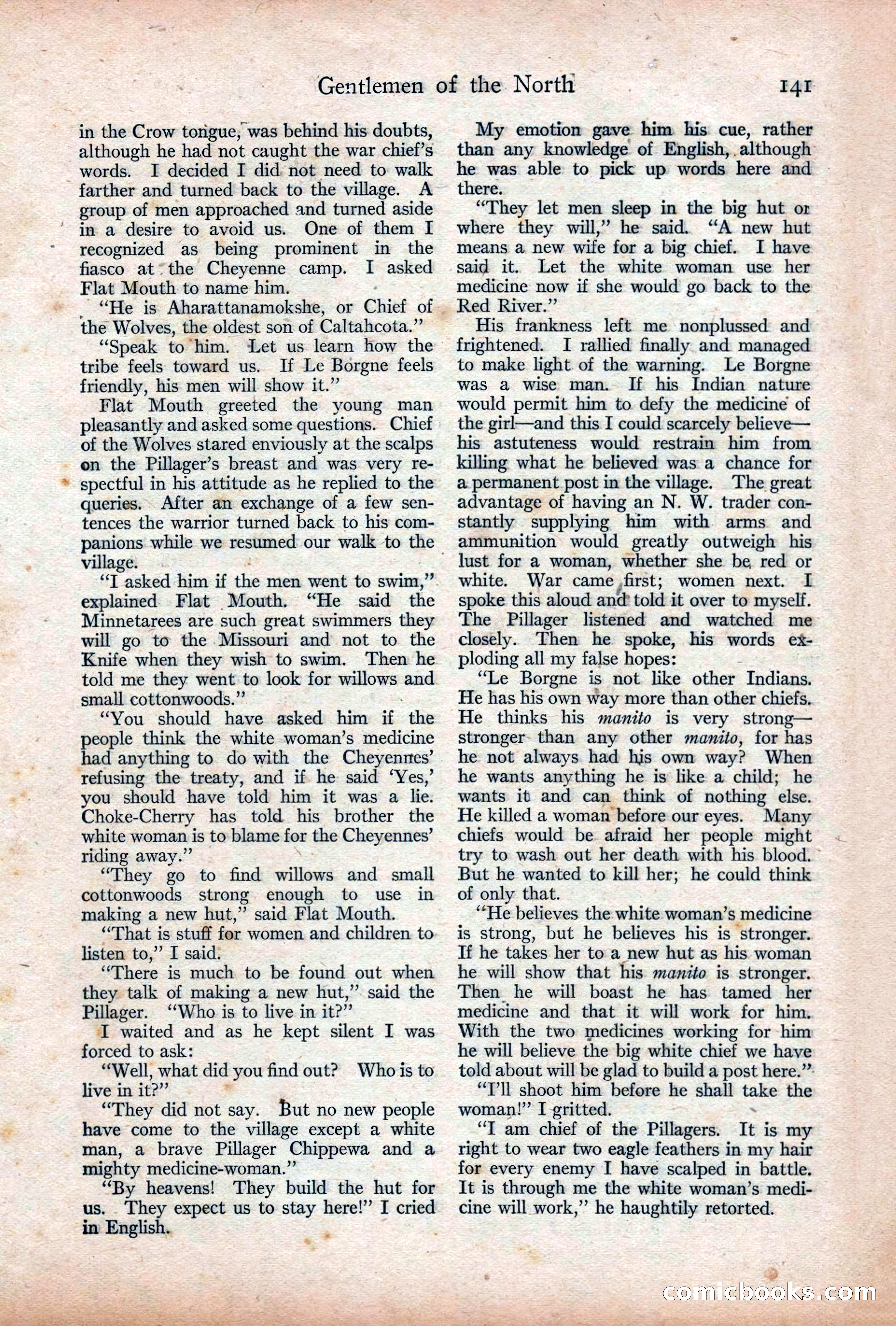
A restored page from Pulp Fiction, 1919. Page through the whole issue in the reader above.
📄 Transcribed text from this page (OCR, searchable)
Machine-transcribed from the original scan — historical spelling and the odd misread are preserved.
’ in a desire to avoid us. Gentlemen of the North in the Crow tongue, was behind his doubts, although he had not caught the war chief’s words. I decided I did not need to walk farther and turned back to the village. A group of men approached and turned aside One of them I recognized as being prominent in the fiasco at*the Cheyenne camp. I asked Flat Mouth to name him. “We is Aharattanamokshe, or Chief of . the Wolves, the oldest son of Caltahcota. _ “Speak to him. ‘Let us learn how the tribe feels toward us. If Le Borgne feels friendly, his men will show it.” Flat Mouth greeted the young man pleasantly and asked some questions. Chief of the Wolves stared enviously at the scalps on the Pillager’s breast and was very re- spectful in his attitude as he replied to the queries. After an exchange of a few sen- tences the warrior turned back to his com- panions while we resumed our walk to the e. “T asked him if the men went to swim,” explained Flat Mouth. “He said the Minnetarees are such great swimmers they will go to the Missouri and not to the Knife when they wish to swim. Then he told me they went to look for willows —_ small cottonwoods.”’ “You should have asked him if ‘the people think the white woman’s medicine had anything to do with the Cheyentes’ refusing the treaty, and if he said ‘Yes,’ you should have told him it was a lie. Choke-Cherry has told his brother the white woman Is to blame for the Cheyennes’ riding away.” “They go to find willows and small cottonwoods strong enough to use in making a new hut,” said Flat Mouth. “That is stuff for women and children to listen to,” I said. “There is much to be found out when they talk of making a new hut,” said the Pillager. ‘Who is to live in it?” I waited and as he kept silent I was forced to ask: “Well, what did L you find out? live in it?” “They did not say. But no new people have come to the village except a white man, a brave Pillager Chippewa and a mighty medicine-woman.”’ “By heavens! They build the hut for Who is to us. They expect us to stay here!” I cried in English. I4I My emotion gave him his cue, rather than any knowledge of English,. although: he was able to pick up words here and — there. “They let men sleep in the big hut or where they will,” he said. “A new hut means a new wife for a big chief. I have said it. Let the white woman use her medicine now if she would go back to the Red River.” His frankness left me nonplussed and frightened. I rallied finally and managed to make light of the warning. Le Borgne was a wise man. If his Indian nature would permit him to defy the medicine of the girl—and this I could scarcely believe— his astuteness would restrain him from killing what he believed wasa chance for a permanent post in the village. The great advantage of having an N. W. trader con- stantly supplying him with arms and ammunition would greatly outweigh his lust for a woman, whether she be red or white. War came first; women next. I spoke this aloud and’ told it over to myself. The Pillager listened and watched me closely. Then he spoke, his words ex- ploding all my false hopes: “Le Borgne is not like other Indians. He has his own way more than other chiefs. He thinks his manito is very strong— stronger- than any other manito, for has he not always had his own way? When he wants anything he is like a child; he wants it and can think of nothing else. He killed a woman before our eyes. Many chiefs would be. afraid her people might try to wash out her death with his blood. But he wanted to kill her; he could think of only that. ““He believes the white woman’s medicine is strong, but he believes his is stronger. If he takes her to a new hut as his woman he will show that his manito is stronger. Then he will boast he has tamed her medicine and that it will work for him. With the two medicines working for him he will believe the big white chief we have told about will be glad to build a post here.” “T’ll shoot him before he shall = the woman!” I gritted. “I am chief of the Pillagers. It is my right to wear two eagle feathers in my hair for every enemy I have scalped in battle. It is through me the white woman’s medi- cine will work,” he haughtily retorted. EORNIG OOOL< (E(9)