
Pulp Fiction, 1919 · page 130 of 208
Adventure Magazine Cover, December 18, 1919 — page 130: what you’re looking at
A restored page from Pulp Fiction, 1919. Page through the whole issue in the reader above.
📄 Transcribed text from this page (OCR, searchable)
Machine-transcribed from the original scan — historical spelling and the odd misread are preserved.
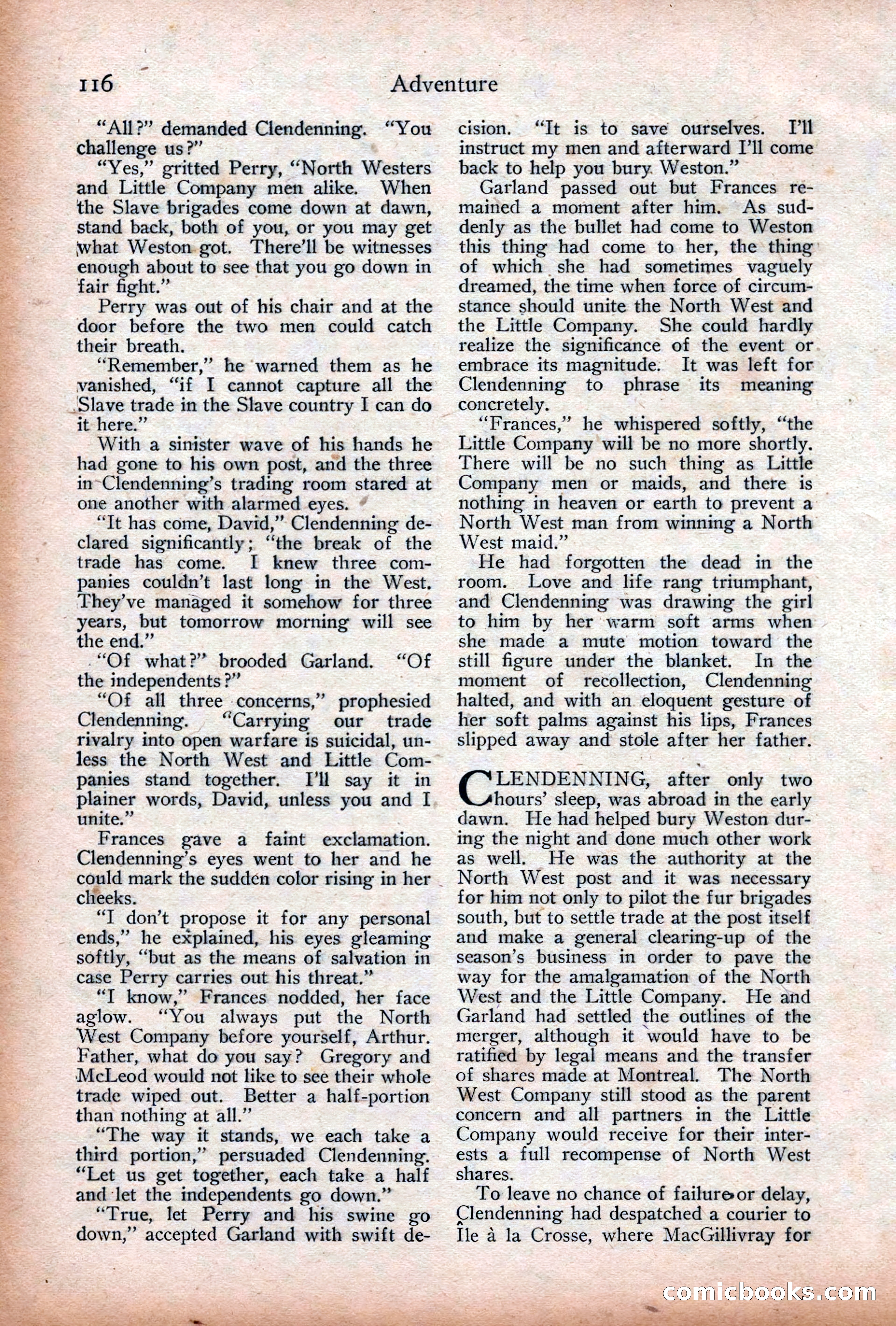
N! A AT ee ANY Yes oe La! SB amy ew Oe al Oe BD ee ee 0 A al Davy) A Rts " if inet. ig “4 ¥ x a, AAs F = PERI M NS aa yh AN MARU NEA MURR ST EG »\ PEE tw eee TUS 116 Adventure “All?” demanded Ciendenning. “You challenge us?” “Yes,” gritted Perry, “North Wesiers and Little Company men alike. When the Slave brigades come down at dawn, stand back, both of you, or you may get what Weston got. There’ll be witnesses enough about to see that you go down in fair fight.” Perry was out of his chair and at the door before the two men could catch their breath. “Remember,” he warned them as he vanished, “if I cannot capture all the Slave trade in the Slave country I can do it here.” With a sinister wave of his hands he had gone to his own post, and the three in~Clendenning’s trading room stared at one another with alarmed eyes. “ “It has come, David,” Clendenning de- clared significantly; “the break of the trade has come. I knew three com- panies couldn’t last long in the West. They’ve managed it somehow for three years, but tomorrow morning will see the end.” .“Of what?” brooded Garland. “Of the independents ?” “Of all three concerns,” prophesied Clendenning. “Carrying our trade rivalry into open warfare is suicidal, un- less the North West and Little €om=" panies stand together. I'll say it in plainer words, David, unless you and I unite.” _ Frances gave a faint exclamation. Clendenning’s eyes went to her and he could mark the sudden color rising in her - cheeks. “J don’t propose it for any personal ends,’ he explained, his eyes gleaming softly, “but as the means of salvation in case Perry carries out his threat.” *T know,” Frances nodded, her face aglow. “You always put the North West Company before yourself, Arthur. Father, what do you say? Gregory and McLeod would not like to see their whole trade wiped out. Better a half-portion than nothing at all.” “The way it stands, we each take a third portion,” persuaded Clendenning. “Let us get together, each take a half and ‘let the independents go down.” “True, let Perry and his swine go down,” accepted Garland with swift de- cision. “It is to save ourselves. I'll instruct my men and afterward I'll come back to help you bury. Weston.” Garland passed out but Frances re- mained a moment after him. As sud- denly as the bullet had come to Weston this thing had come to her, the thing’ of which she had sometimes vaguely dreamed, the time when force of circum- stance should unite the North West and the Little Company. She could hardly realize the significance of the event or. embrace its magnitude. It was left for Clendenning to phrase its meaning concretely. “Frances,” he whispered softly, “the Little Company will be no more shortly. There will be no such thing as Little Company men or maids, and there is — nothing in heaven or earth to prevent a North West man from winning a North West maid.” He had forgotten the dead in the room. Love and life rang triumphant, and Clendenning was drawing the girl to him by her warm soft arms when she made a mute motion toward the still figure under the blanket. In the moment of recollection, Clendenning halted, and with an eloquent gesture of her soft palms against his lips, Frances slipped away and stole after her father. LENDENNING, after only two hours’ sleep, was abroad in the early dawn. He had helped bury Weston dur-_ ing the night and done much other work as well. He was the authority at the North West post and it was necessary for him not only to pilot the fur brigades south, but to settle trade at the post itself and make a general clearing-up of the season’s business in order to pave the way for the amalgamation of the North West and the Little Company. He and Garland had settled the outlines of the merger, although it would have to be ratified by legal means and the transfer of shares made at Montreal. The North West Company still stood as the parent concern and all partners in the Little Company would receive for their inter- ests a full recompense of North West shares. To leave no chance of failureor delay, Clendenning had despatched a courier to Ile a la Crosse, where MacGillivray for v % ~n +e nb) 5 ee Fi * rs t -