
Pulp Fiction, 1919 · page 127 of 208
Adventure Magazine Cover, December 18, 1919 — page 127: what you’re looking at
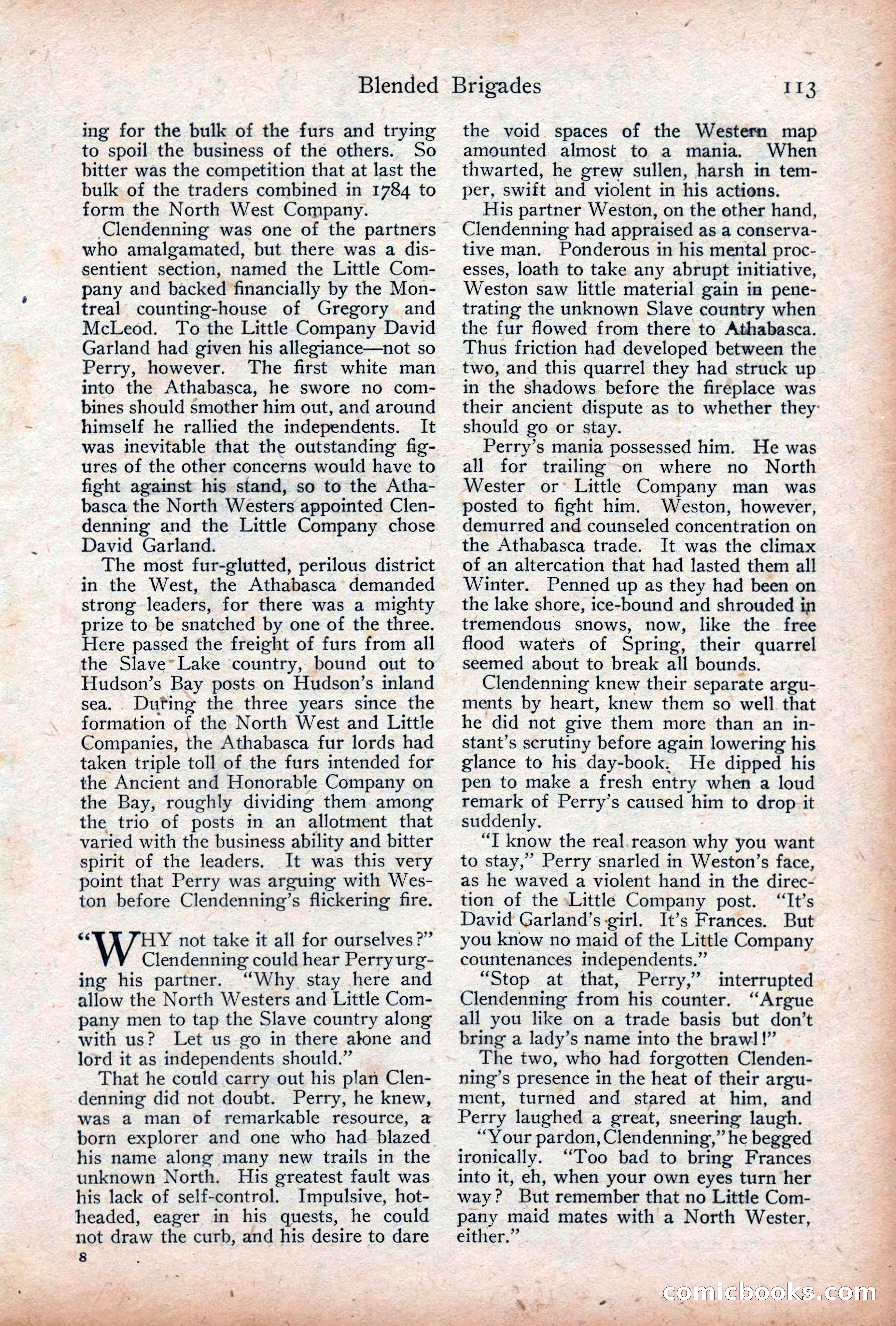
A restored page from Pulp Fiction, 1919. Page through the whole issue in the reader above.
📄 Transcribed text from this page (OCR, searchable)
Machine-transcribed from the original scan — historical spelling and the odd misread are preserved.
ee en ae aN ee: “a Blended Brigades ing for the bulk of the furs and trying to spoil the business of the others. So bitter was the competition that at last the bulk of the traders combined in 1784 to form the North West Company. Clendenning was one of the partners who amalgamated, but there was a dis- sentient section, named the Little Com- pany and backed financially by the Mon- treal counting-house of Gregory and McLeod. To the Little Company David Garland had given his allegiance—not so Perry, however. The first white man into the Athabasca, he swore no com- bines should smother him out, and around himself he rallied the independents. It was inevitable that the outstanding fig- ures of the other concerns would have to fight against his stand, so to the Atha- basca the North Westers appointed Clen- denning and the Little Company chose David Garland. The most fur-glutted, perilous district in the West, the Athabasca demanded strong leaders, for there was a mighty prize to be snatched by one of the three. Here passed the freight of furs from all the Slave> Lake country, bound out to Hudson’s Bay posts on Hudson’s inland sea.. Dufing the three years since the formation of the North West and Little Companies, the Athabasca fur lords had taken triple toll of the furs intended for the Ancient and Honorable Company on the Bay, roughly dividing them among the trio of posts in an allotment that varied with the business ability and bitter spirit of the leaders. It was this very point that Perry was arguing with Wes- ton before Clendenning’s flickering fire. = HY not take it all for ourselves ?” Clendenning could hear Perry urg- ing his partner. “Why stay here and allow the North Westers and Little Com- pany men to tap the Slave country along with us? Let us go in there atone and lord it as independents should.” That he could carry out his plan Clen- denning did not doubt. Perry, he knew, was a man of remarkable resource, a born explorer and one who had blazed his name along many new trails in the unknown North. His greatest fault was his lack of self-control. Impulsive, hot- headed, eager in his quests, he could not draw the curb, and his desire to dare = 3 - Pn RA ee Pa a ee <a oa 113 the void spaces of the Western map amounted almost to a mania. When thwarted, he grew sullen, harsh in tem- per, swift and violent in his actions. His partner Weston, on the other hand, Clendenning had appraised as a conserva- tive man. Ponderous in his mental proc- esses, loath to take any abrupt initiative, Weston saw little material gain in pene- trating the unknown Slave country when the fur flowed from there to Athabasca. Thus friction had developed between the _ two, and this quarrel they had struck up in the shadows before the fireplace was their ancient dispute as to whether they: should go or stay. Perry’s mania possessed him. He was all for trailing on where no North Wester or Little Company man was posted to fight him. Weston, however, demurred and counseled concentration on the Athabasca trade. It was the climax of an altercation that had lasted them all Winter. Penned up as they had been on the lake shore, ice-bound and shrouded in tremendous snows, now, like the free flood waters of Spring, their quarrel seemed about to break all bounds. Clendenning knew their separate argu- ments by heart, knew them so well that he did not give them more than an in- stant’s scrutiny before again lowering his glance to his day-book. He dipped his pen to make a fresh entry when a loud remark of Perry’s caused him to drop it suddenly. “T know the real.reason why you want to stay,’ Perry snarled in Weston’s face, as he waved a violent hand in the direc- tion of the »Little Company post. “It’s David Garland’s girl. It’s Frances. But you know no maid of the Little Company countenances independents.” “Stop. at. that, . Perry,” Clendenning from his counter. “Argue all you like on a trade basis but don’t bring a lady’s name into the brawl!” The two, who had forgotten Clenden- ning’s presence in the heat of their argu- ment, turned and stared at him, and Perry laughed a great, sneering laugh. “Your pardon, Clendenning,” he begged ironically. “Too bad to bring Frances into it, eh, when your own eyes turn her way? But remember that no Little Com- pany maid mates with a North Wester, either.” .IOOkK interrupted | ) i. * ee , =m Y (EO)