
Pulp Fiction, 1919 · page 117 of 208
Adventure Magazine Cover, December 18, 1919 — page 117: what you’re looking at
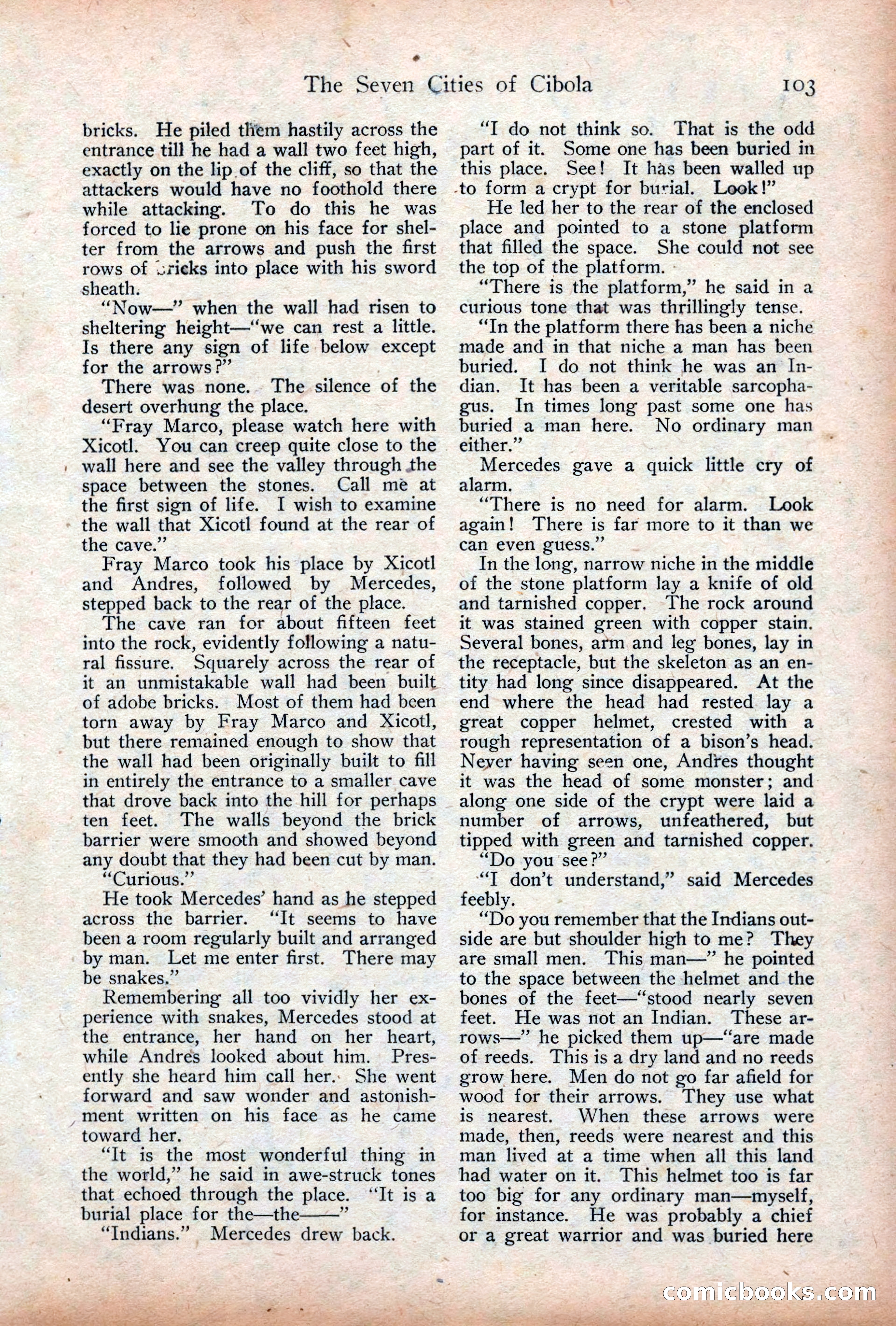
A restored page from Pulp Fiction, 1919. Page through the whole issue in the reader above.
📄 Transcribed text from this page (OCR, searchable)
Machine-transcribed from the original scan — historical spelling and the odd misread are preserved.
‘ o The Seven Cities of Cibola bricks. He piled tliem hastily across the entrance till he had a wall two feet high, exactly on the lip of the cliff, so that the attackers would have no foothold there while attacking. To do this he was forced to lie prone on his face for shel- ter from the arrows and push the first rows of wrieks into place with his sword sheath. ‘“Now—” when the wall had risen to sheltering height—‘‘we can rest a little. Is there any sign of life below except for the arrows?” : There was none. The silence of the desert overhung the place. “Fray Marco, please watch here with Xicotl. You can creep quite close to the wall here and see the valley through the space between the stones. Call me at the first sign of life. I wish to examine - the wall that Xicotl found at the rear of the cave.” Fray Marco took his place by Xicotl and Andres, followed by Mercedes, stepped back to the rear of the place. The cave ran for about fifteen feet into the rock, evidently following a natu- ral fissure. Squarely across the rear of it an unmistakable wall had been built of adobe bricks. Most of them had been torn away by Fray Marco and Xicotl, but there remained enough to show that the wall had been originally built to fill in entirely the entrance to a smaller cave that drove back into the hill for perhaps ten feet. The walls beyond the brick barrier were smooth and showed beyond any doubt that they had been cut by man. “Curious.” He took Mercedes’ hand as he stepped across the barrier. “It seems to have been a room regularly built and arranged by man. Let me enter first. There may be snakes,” Remembering all too vividly her ex- perience with snakes, Mercedes stood at the entrance, her hand on her heart, while Andrés looked about him. Pres- ently she heard him call her.. She went forward and saw wonder and astonish- _ment written on his face as he came toward her. | “It is the most wonderful thing in the world,” he said in awe-struck tones that echoed through the place. “It is a burial place for the—the : “Indians.” Mercedes drew back. -to form a crypt for burial. 103 “T do not think so. That is the odd part of it. Some one has been buried in this place. See! It has been walled up Look !” He led her to the rear of the enclosed place and pointed to a stone platform that filled the space. She could not see the top of the platform. - “There is the platform,” he said in a curious tone that was thrillingly tense. “In the platform there has been a niche made and in that niche a man has been buried. I do not think he was an In- dian. It has been a veritable sarcopha- gus. In times long past some one has buried a man here. No ordinary man either.” Mercedes gave a quick little cry of alarm. “There is no need for alarm. Look again! There is far more to it than we can even guess.” In the long, narrow niche in the middle of the stone platform lay a knife of old and tarnished copper. The rock around it was stained green with copper stain. Several bones, arm and leg bones, lay in the receptacle, but the skeleton as an en- tity had long since disappeared. At the end where the head had rested lay a great copper helmet, crested with a rough representation of a bison’s head. Never having seen one, Andres thought it was the head of some monster; and. along one side of the crypt were laid a number of arrows, unfeathered, but tipped with green and tarnished copper. “Do you see?” “T don’t understand,” said Mercedes feebly. “Do you remember that the Indians out- side are but shoulder high to me? They are small men. This man—” he pointed to the space between the helmet and the bones of the feet—‘stood nearly seven feet. He was not an Indian. These ar- rows—” he picked them up—‘are made of reeds. This is a dry land and no reeds grow here. Men do not go far afield for wood for their arrows. They use what is nearest. When these arrows were made, then, reeds were nearest and this man lived at a time when all this land had water on it. This helmet too is far too big for any ordinary man—myself, for instance. He was probably a chief or a great warrior and was buried here ~“ GEomichboo S €o — see a - - x os ; ~~ a -