
Pulp Fiction, 1919 · page 107 of 208
Adventure Magazine Cover, December 18, 1919 — page 107: what you’re looking at
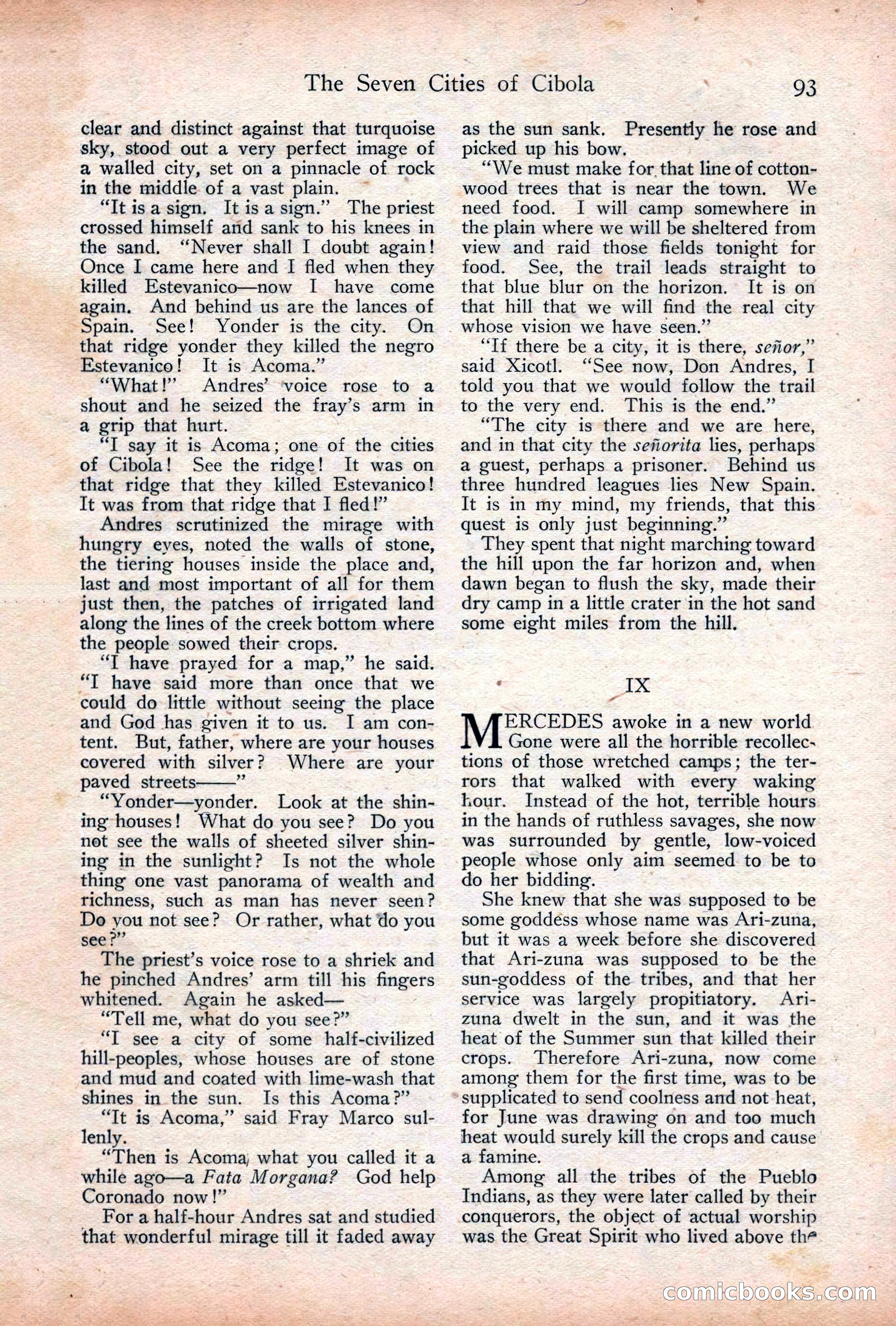
A restored page from Pulp Fiction, 1919. Page through the whole issue in the reader above.
📄 Transcribed text from this page (OCR, searchable)
Machine-transcribed from the original scan — historical spelling and the odd misread are preserved.
The Seven Cities of Cibola clear and distinct against that turquoise sky, stood out a very perfect image of a walled city, set on a pinnacle of rock in the middle of a vast plain. “Itisasign. Itisasign.” The priest crossed himself arid sank to his knees in the sand. “Never shall I doubt again! Once I came here and I fled when they killed Estevanico—now I have come again. And behind us are the lances of Spain. See! Yonder is the city. On that ridge yonder they killed the negro Estevanico! It is Acoma.” “What!’’ Andres’ ‘voice rose to a shout and he seized the fray’s arm in a grip that hurt. “TI say it is Acoma; one of the cities of Cibola! See the ridge! It was on that ridge that they killed Estevanico! It was from that ridge that I fled!” Andres scrutinized the mirage with hungry eyes, noted the walls of stone, the tiering houses inside the place and, last and most important of all for them just then, the patches of irrigated land along the lines of the creek bottom where the people sowed their crops. “T have prayed for a map,” he said. “T have said more than once that we could do little without seeing the place and God has given it to us. I am con- tent. But, father, where are your houses covered with silver? Where are your paved streets “ “Yonder—yonder. Look at the shin- ing houses! What do you see? Do you net see the walls of sheeted silver shin- ing in the sunlight? Is not the whole thing one vast panorama of wealth and richness, such as man has never seen? Do you not see? Or rather, what do you see?” The priest’s voice rose to a shriek and he pinched Andres’ arm till his fingers whitened. Again he asked— “Tell me, what do you see?” “T see a city of some half-civilized hill-peoples, whose houses are of stone and mud and coated with lime-wash that shines in the sun. Is this Acoma?” “Tt is Acoma,” said Fray Marco sul- lenly. “Then is Acoma, what you called it a while ago—a Fata Morgana? God help Coronado now!” For a half-hour Andres sat and studied that wonderful mirage till it faded away 93 as the sun sank. Presently he rose and picked up his bow. “We must make for that line of cotton- wood trees that is near the town. We need food. I will camp somewhere in the plain where we will be sheltered from view and raid those fields tonight for food. See, the trail leads straight to that blue blur on the horizon. It is on that hill that we will find the real city whose vision we have seen.” “If there be a city, it is there, sefior,” said Xicotl. “See now, Don Andres, I told you that we would follow the trail to the very end. This is the end.” “The city is there and we are here, and in that city the sefiorita lies, perhaps a guest, perhaps a prisoner. Behind us three hundred leagues lies New Spain. It is in my mind, my friends, that this quest is only just beginning.” They spent that night marching toward the hill upon the far horizon and, when dawn began to flush the sky, made their dry camp in a little crater in the hot sand some eight miles from the hill. - Ix “ ERCEDES awoke in a new world. Gone were all the horrible recollec- tions of those wretched camps; the ter- rors that walked with every waking hour. Instead of the hot, terrible hours in the hands of ruthless savages, she now was surrounded by gentle, low-voiced people whose only aim seemed to be to do her bidding. She knew that she was supposed to be some goddess whose name was Ari-zuna, but it was a week before she discovered that Ari-zuna was supposed to be the sun-goddess of the tribes, and that her service was largely propitiatory. Ari- zuna dwelt in the sun, and it was the heat of the Summer sun that killed their crops. Therefore Ari-zuna, now come among them for the first time, was to be ‘supplicated to send coolness and not heat, for June was drawing on and too much heat would surely kill the crops and cause a famine. Among all the tribes of the Pueblo Indians, as they were later called by their conquerors, the object of actual worship was the Great Spirit who lived above thé cS EORMICLOOO© (C@)