
Pulp Fiction, 1917 · page 99 of 228
Adventure, February 1917 — page 99: what you’re looking at
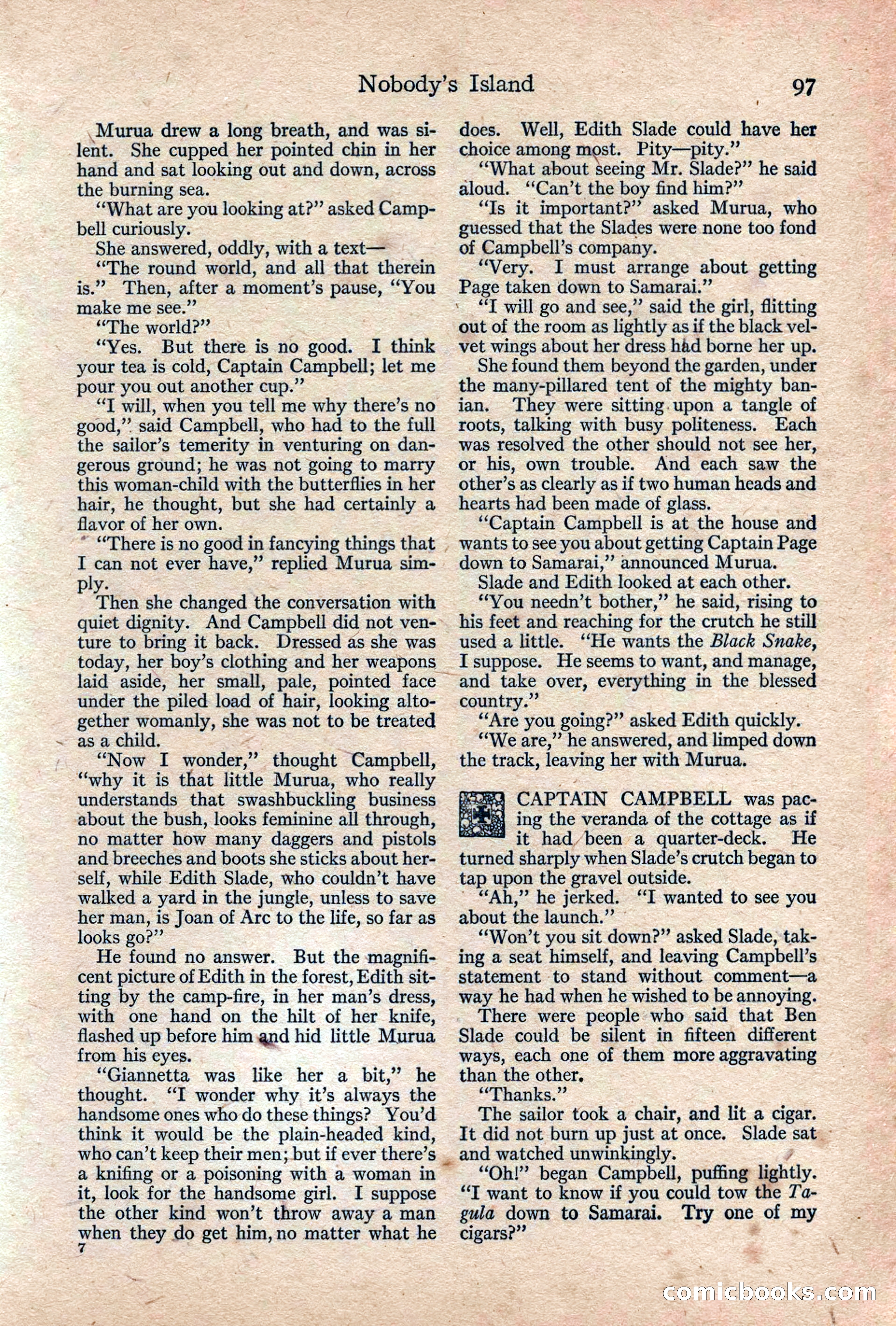
A restored page from Pulp Fiction, 1917. Page through the whole issue in the reader above.
📄 Transcribed text from this page (OCR, searchable)
Machine-transcribed from the original scan — historical spelling and the odd misread are preserved.
Nobody’s Island Murua drew a long breath, and was si- lent. She cupped her pointed chin in her hand and sat looking out and down, across the burning sea. ‘What are you looking at?” asked Camp- bell curiously. She answered, oddly, with a text— “The round world, and all that therein is.” Then, after a moment's pause, “You make me see.’ “The world?” “Ves. But there is no good. I think your tea is cold, Captain Campbell; let me pour you out another cup.” ye! will, when you tell me why there’s no good,” said Campbell, who had to the full the sailor’s temerity in venturing on dan- gerous ground; he was not going to marry this woman-child with the butterflies in her hair, he thought, but she had certainly a flavor of her own. * “There is no good in fancying things that | I can not ever have,” ly. Then she changed the conversation with replied Murua sim- quiet dignity. And Campbell did not ven- ture to bring it back. Dressed as she was today, her boy’s clothing and her weapons laid aside, her small, pale, pointed face under the piled load of hair, looking alto- gether womanly, she was not to be treated as a child. “Now I wonder?” thought Campbell, “why it is that little Murua, who really understands that swashbuckling business about the bush, looks feminine all through, no matter how many daggers and pistols and breeches and boots she sticks about her- self, while Edith Slade, who couldn’t have walked a yard in the jungle, unless to save her man, is Joan of Arc to the life, so far as looks go?” He found no answer. But the magnifi- cent picture of Edith in the forest, Edith sit- ting by the camp-fire, in her man’s dress, with one hand on the hilt of her knife, flashed up before him and hid little Murua from his eyes. “Giannetta was like her a bit,” he thought. “I wonder why it’s always the handsome ones who do these things? You’d think it would be the plain-headed kind, who can’t keep their men; but if ever there’s _ a knifing or a poisoning with a woman in it, look for the handsome girl. I suppose the other kind won’t throw away a man When they do get him, no matter what he 97 does. choice among most. Pity—pity.” “What about seeing Mr. Slade?” he said aloud. ‘“Can’t the boy find him?” “Ts it important?” asked Murua, who guessed that the Slades were none too fond of Campbell’s company. “Very. I must arrange about getting Page taken down to Samarai.” ‘ “T will go and see,” said the girl, flitting out of the room as lightly as if the black vel- vet wings about her dress had borne her up. She found them beyond the garden, under the many-pillared tent of the mighty ban- ian. They were sitting.upon a tangle of roots, talking with busy politeness. Each was resolved the other should not see her, or his, own trouble. other’s as clearly as if two human heads and hearts had been made of glass. “Captain Campbell is at the house and wants to see you about getting Captain Page down to Samarai,’”’ announced Murua. Slade and Edith looked at each other. ‘You needn’t bother,’’ he said, rising to his feet and reaching for the crutch he still used a little. “He wants the Black Snake, I suppose. He seems to want, and manage, ~ and take over, everything in the blessed country.” ‘Are you going?” asked Edith quickly. “We are,” he answered, and limped down the track, leaving her with Murua. ee CAPTAIN CAMPBELL was pac- i ya, ing the veranda of the cottage as if “<4 it had been a quarter-deck. He ariel a shane when Slade’s crutch began to tap upon the gravel outside. - “Ah,” he jerked. ‘I wanted to see you about the launch.” “‘Won’t you sit down?” asked Slade, tak- ing a seat himself, and leaving Campbell’s statement to stand without comment—a way he had when he wished to be annoying. There were people who said that Ben Slade could be silent in fifteen different ways, each one of them more aggravating than the other. “Thanks.” The sailor took a chair, — lit a cigar. Well, Edith Slade could have her And each saw the It did not burn up just at once. Slade sat and watched unwinkingly. “Oh!” began Campbell, puffing lightly. “T want to know if you could tow the Ta- gula down to Samarai. Try one of my cigars?” WoOOk (elo) wr GO