
Pulp Fiction, 1917 · page 95 of 228
Adventure, February 1917 — page 95: what you’re looking at
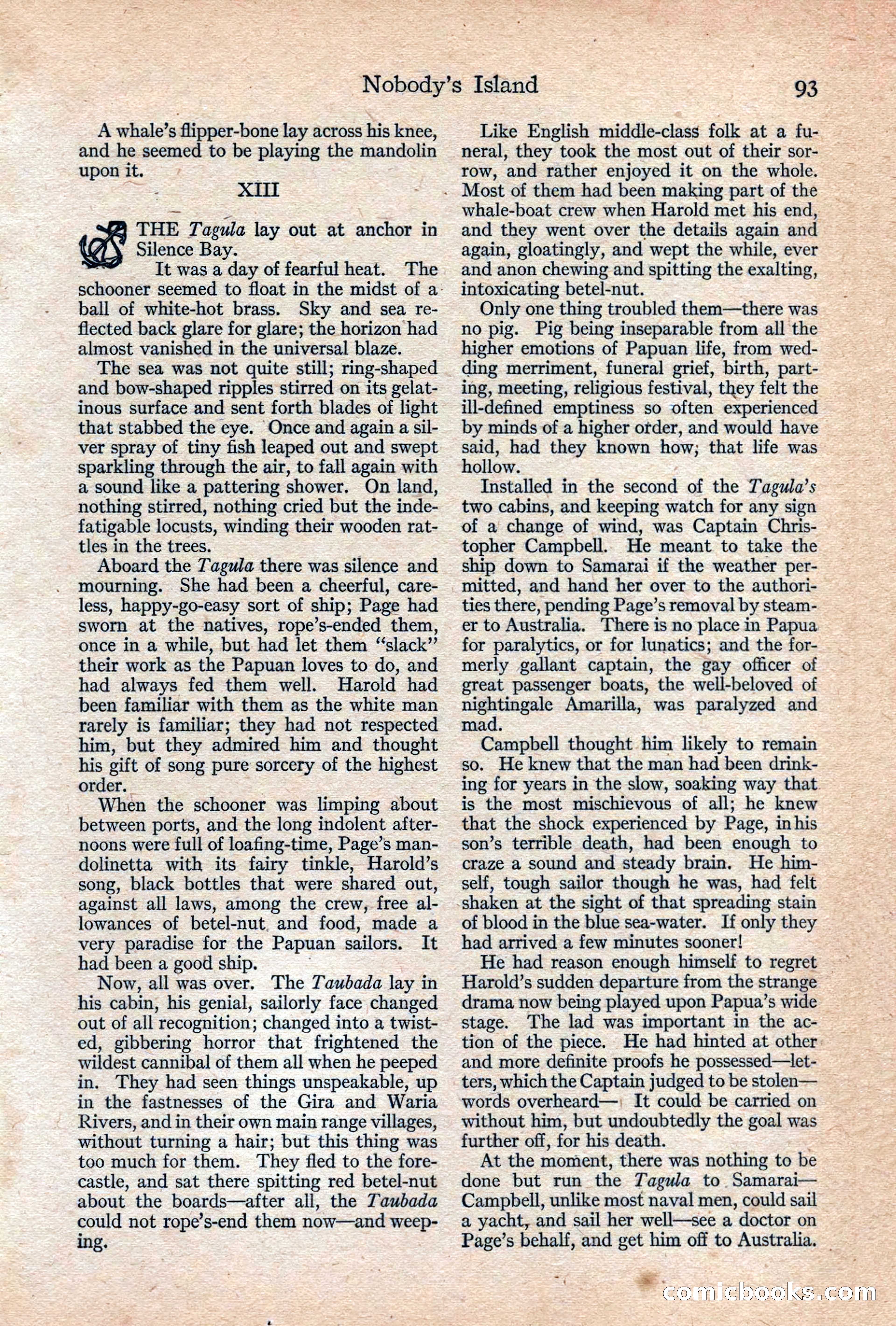
A restored page from Pulp Fiction, 1917. Page through the whole issue in the reader above.
📄 Transcribed text from this page (OCR, searchable)
Machine-transcribed from the original scan — historical spelling and the odd misread are preserved.
Nobody’s Island A whale’s flipper-bone lay across his knee, and he seemed to be playing the mandolin upon it. | XIII Cay THE Tagule lay out at anchor in Silence Bay. It was a day of fearful heat. The schooner seemed to float in the midst of a- ball of white-hot brass. Sky and sea re- flected back glare for glare; the horizon had almost vanished in the universal blaze. ‘The sea was not quite still; ring-shaped and bow-shaped ripples stirred on its gelat- inous surface and sent forth blades of light that stabbed the eye. Once and again a sil- ver spray of tiny fish leaped out and swept sparkling through the air, to fall again with a sound like a pattering shower. On land, nothing stirred, nothing cried but the inde- fatigable locusts, winding their wooden rat- tles in the trees. Aboard the Tagula there was silence and mourning. She had been a cheerful, care- less, happy-go-easy sort of ship; Page had sworn at the natives, rope’s-ended them, once in a while, but had let them “slack” their work as the Papuan loves to do, and had always fed them well. Harold had been familiar with them as the white man rarely is familiar; they had not respected him, but they admired him and thought his gift of song pure sorcery of the highest order. When the schooner was limping about between ports, and the long indolent after- noons were full of loafing-time, Page’s man- dolinetta with its fairy tinkle, Harold’s song, black bottles that were shared out, against all laws, among the crew, free al- lowances of betel-nut. and food, made a very paradise for the Papuan sailors. It had been a good ship. Now, all was over. The Taubada lay in his cabin, his genial, sailorly face changed out of all recognition; changed into a twist- ed, gibbering horror that frightened the wildest cannibal of them all when he peeped in. They had seen things unspeakable, up in the fastnesses of the Gira and Waria Rivers, and in their own main range villages, without turning a hair; but this thing was too much for them. They fled to the fore- castle, and sat there spitting red betel-nut about the boards—after all, the Zaubada could not rope’s-end them now—and weep- ing. 93 Like English middle-class folk at a fu- neral, they took the most out of their sor- row, and rather enjoyed it on the whole. - Most of them had been making part of the whale-boat crew when Harold met his end, and they went over the details again and again, gloatingly, and wept the while, ever and anon chewing and spitting the exalting, intoxicating betel-nut. Only one thing troubled them—there was no pig. Pig being inseparable from all the higher emotions of Papuan life, from wed- ding merriment, funeral grief, birth, part- ing, meeting, religious festival, they felt the ill-defined emptiness so often experienced by minds of a higher order, and would have said, had they known how; that life was hollow. Installed in the second of the Tagula’s two cabins, and keeping watch for any sign of a change of wind, was Captain Chris- topher Campbell.. He meant to take the ship down to Samarai if the weather per- mitted, and hand her over to the authori- ties there, pending Page’s removal by steam- er to Australia. There is no place in Papua for paralytics, or for lunatics; and the for- merly gallant captain, the gay officer of great passenger boats, the well-beloved of nightingale Amarilla, was paralyzed and mad. Campbell thought him likely to remain so. He knew that the man had been drink- ing for years in the slow, soaking way that. is the most mischievous of all; he knew that the shock experienced by Page, in his son’s terrible death, had been enough to craze a sound and steady brain. He him- self, tough sailor though he was, had felt -shaken at the sight of that spreading stain of blood in the blue sea-water. If only they had arrived a few minutes sooner! He had reason enough himself to regret Harold’s sudden departure from the strange © drama now being played upon Papua’s wide stage. The lad was important in the ac- tion of the piece. He had hinted at other: and more definite proofs he possessed—let- ters, which the Captain judged to be stolen— — words overheard—: It could be carried on without him, but undoubtedly the goal was ~ further off, for his death. At the moment, there was nothing to be done but run the 7 agula to. Samarai— Campbell, unlike most naval men, could sail a yacht, and sail her well—see a doctor on a. Gomichboo cS Page’s behalf, and get him off to Australia. — (Ee)