
Pulp Fiction, 1917 · page 74 of 228
Adventure, February 1917 — page 74: what you’re looking at
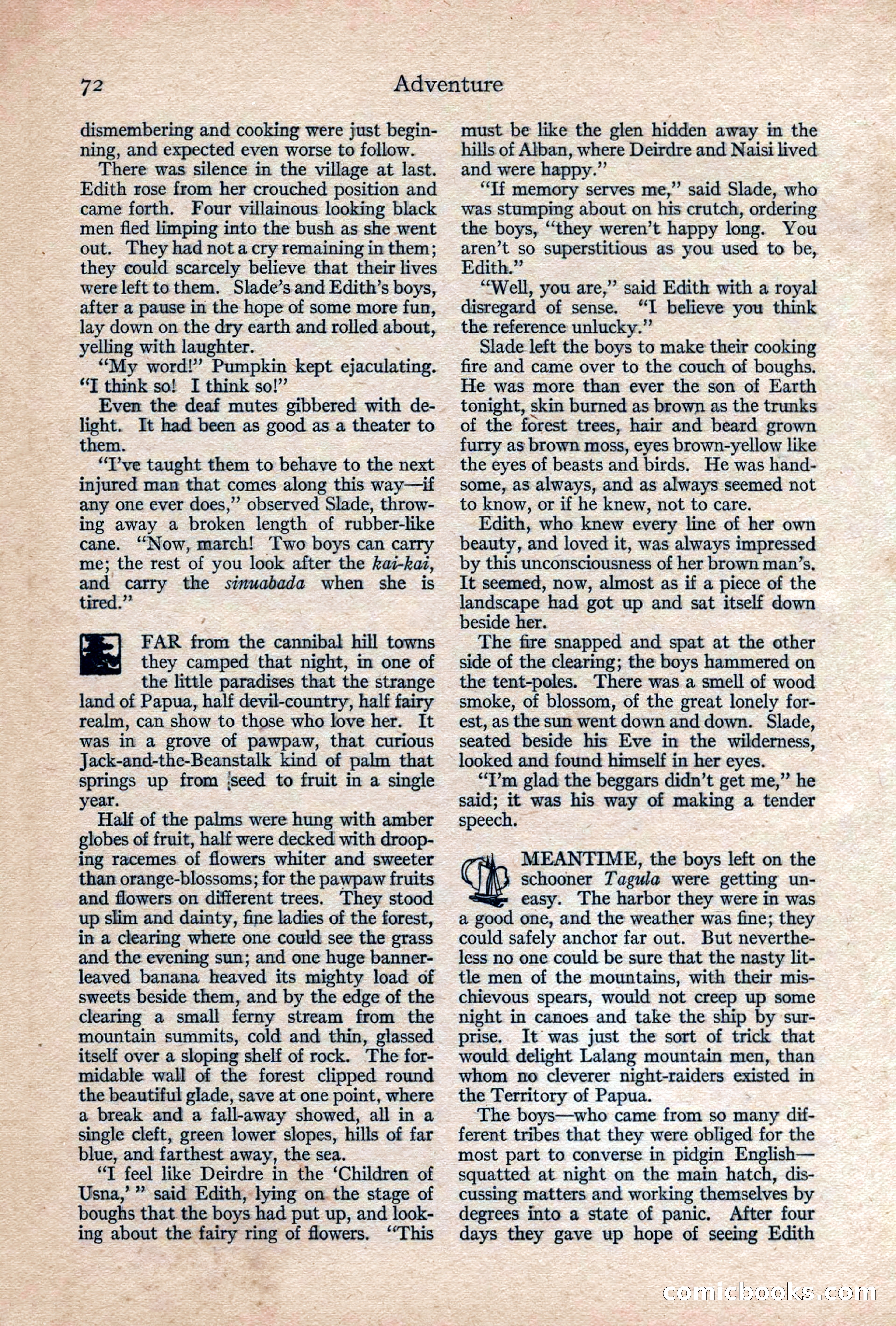
A restored page from Pulp Fiction, 1917. Page through the whole issue in the reader above.
📄 Transcribed text from this page (OCR, searchable)
Machine-transcribed from the original scan — historical spelling and the odd misread are preserved.
72 dismembering and cooking were just begin- ning, and expected even worse to follow. There was silence in the village at last. Edith rose from her crouched position and came forth. Four villainous looking black men fled limping into the bush as she went out. They had not a cry remaining in them; they could scarcely believe that their lives were left tothem. Slade’s.and Edith’s boys, after a pause in the hope of some more fun, lay down on the dry earth and rolled about, yelling with laughter. “My word!” Pumpkin kept ejaculating. “T think so! I think so!’ Even the deaf mutes gibbered with de- light. It had been as good as a theater to the m. “T’ve taught them to behave to the next injured man that comes along this way—if any one ever does,” observed Slade, throw- ing away a broken length of rubber-like cane. “Now, march! Two boys can carry me; the rest of you look after the kai-kai, and, carry the sinuabada when she is ‘ae } FAR from the cannibal hill towns me they camped that night, m one of the little paradises that the strange land of Papua, half devil-country, half fairy realm, can show to those who love her. It was in a grove of pawpaw, that curious Jack-and-the-Beanstalk kind of palm that springs up from ;seed to fruit in a single year. Half of the palms were hung with amber globes of fruit, half were decked with droop- ing racemes of flowers whiter and sweeter than orange-blossoms; for the pawpaw fruits and flowers on different trees. They stood up slim and dainty, fine ladies of the forest, in a clearing where one could see the grass and the evening sun; and one huge banner- leaved banana heaved its mighty load of sweets beside them, and by the edge of the clearing a small ferny stream from the mountain summits, cold and thin, glassed itself over a sloping shelf of rock. The for- midable wall of the forest clipped round the beautiful glade, save at one point, where a break and a fall-away showed, all in a single cleft, green lower slopes, hills of far blue, and farthest away, the sea. “T feel like Deirdre in the ‘Children of Usna,’ ” said Edith, lying on. the stage of boughs that the boys had put up, and look- ing about the fairy ring of flowers. ‘This Adventure must be like the glen hidden away in the hills of Alban, where Deirdre and Naisi lived and were happy.” “Tf memory serves me,” said Slade, who was stumping about on his crutch, ordering the boys, “they weren’t happy long. You aren’t so superstitious as you used to be, — Edith.” “Well, you are,” said Edith with a royal disregard of sense. “I believe you think the reference unlucky.” Slade left the boys to make their cooking fire and came over to the couch of boughs. = ‘was more than ever the son of Earth night, skin burned as brown as the trunks of the forest trees, hair and beard grown furry as brown moss, eyes brown-yellow like the eyes of beasts and birds. He was hand- some, as always, and as always seemed not to know, or if he knew, not to care. Edith, who knew every line of her own beauty, and loved it, was always impressed by this unconsciousness of her brown man’s, It seemed, now, almost as if a piece of the landscape had got up and sat itself down beside her. The fire snapped and spat at the other side of the clearing; the boys hammered on the tent-poles. There was a smell of wood smoke, of blossom, of the great lonely for- est, as the sum went down and down. Slade, seated beside his Eve in the oo eas looked and found himself in her ey “I’m glad the beggars didn’t oA on he said; it was his way of making a tender speech. Gp schooner Tagula were getting un- easy. The harbor they were in was a good one, and the weather was fine; they could safely anchor far out. But neverthe- less no one could be sure that the nasty lit- tle men of the mountains, with their mis- chievous spears, would not creep up some night in canoes and take the ship by sur- prise. It was just the sort of trick that would delight Lalang mountain men, than whom no cleverer night-raiders existed in the Territory of Papua. The boys—who came from so many dif- ferent tribes that they were obliged for the most part to converse in pidgin English— squatted at night on the main hatch, dis- cussing matters and working themselves by degrees into a state of panic. After four days they gave up hope of seeing Edith mie S MEANTIME, the boys left on the (©) (E(0) 9)(0)(6)