
Pulp Fiction, 1917 · page 70 of 228
Adventure, February 1917 — page 70: what you’re looking at
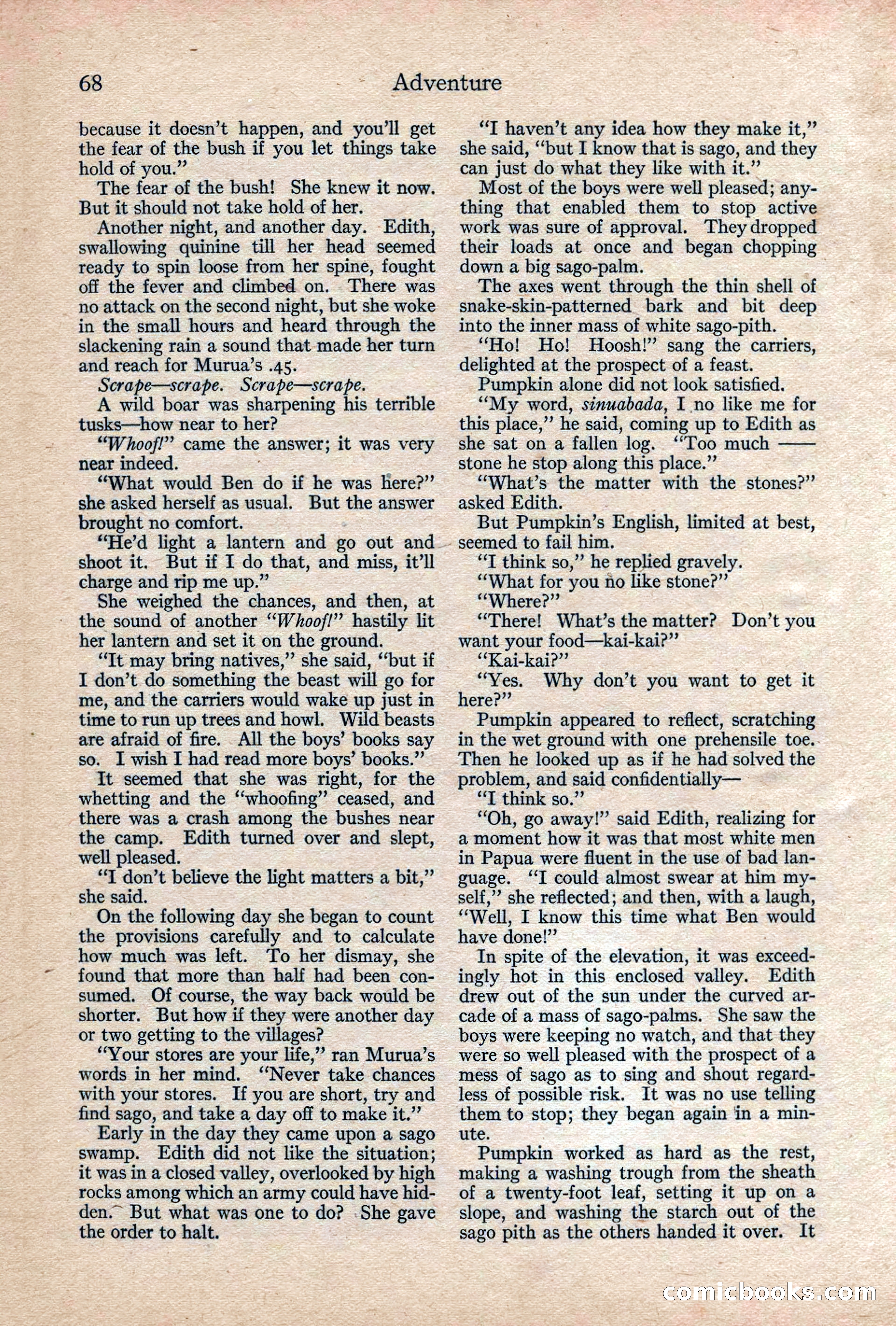
A restored page from Pulp Fiction, 1917. Page through the whole issue in the reader above.
📄 Transcribed text from this page (OCR, searchable)
Machine-transcribed from the original scan — historical spelling and the odd misread are preserved.
68 because it doesn’t happen, and you'll get the fear of the bush if you let things take hold of you.” The fear of the bush! She knew it now. But it should not take hold of her. Another night, and another day. Edith, swallowing quinine till her head seemed ready to spin loose from her spine, fought off the fever and climbed on. There was no attack on the second night, but she woke in the small hours and heard through the slackening rain a sound that made her turn and reach for Murua’s .45. Scrape—scrape. Scrape—scrape. A wild boar was sharpening his terrible tusks—how near to her? “W hoofl’’ came the answer; it was very near indeed. _ “What would Ben do if he was here?” she asked herself as usual. But the answer brought no comfort. “He’d light a lantern and go out and shoot it. But if I do that, and miss, it’ll charge and rip me up.” She weighed the chances, and then, at - the sound of another “Whoof!” hastily lit her lantern and set it on the ground. “Tt may bring natives,” she said, “but if I don’t do something the beast will go for me, and the carriers would wake up just in time to run up trees and howl. Wild beasts are afraid of fire. All the boys’ books say so. I wish I had read more boys’ books.” It seemed that she was right, for the whetting and the ‘‘whoofing” ceased, and there was a crash among the bushes near the camp. Edith turned over and slept, well pleased. “I don’t believe the light matters a bit,” she said. On the following day she began = count the provisions carefully and to calculate how much was left. To her dismay, she found that more than half had been con- sumed. Of course, the way back would be shorter. But how if they were another day or two getting to the villages? “Your stores are your life,” ran Murua’s words in her mind. “Never take chances with your stores. If you are short, try and find sago, and take a day off to make it.” Early in the day they came upon a sago swamp. Edith did not like the situation; it was in a closed valley, overlooked by high rocks among which an army could have hid- den.” But what was one to do? She gave the order to halt. Adventure “T haven’t any idea how they make it,” she said, “but I know that is sago, and they can just do what they like with it.” Most of the boys were well pleased; any- thing that enabled them to stop active work was sure of approval. They dropped their loads at once and began chopping» down a big sago-palm. The axes went through the thin shell of snake-skin-patterned bark and bit deep into the inner mass of white sago-pith. “Ho! Ho! MHoosh!” sang the carriers, delighted at the prospect of a feast. Pumpkin alone did not look satisfied. “My word, simuabada, I no like me for this place,’’ he said, coming up to Edith as she sat on a fallen log. ‘“Too much —— stone he stop along this place.” “What’s the matter with the stones?” asked Edith. But Pumpkin’s English, limited at best, - seemed to fail him. “T think so,” he replied gravely. “What for you no like stone?” “Where?” “There! What’s the matter? Don’t you want your food—kai-kai?”’ ““Kai-kai?”’ “Yes. Why don’t you want to get it here?” Pumpkin appeared to reflect, scratching in the wet ground with one prehensile toe.. Then he looked up as if he had solved the problem, and said confidentially— “T think so.”’ “Oh, go away!” said Edith, realizing for a moment how it was that most white men in Papua were fluent in the use of bad lan- guage. “TI could almost swear at him my- self,’ she reflected; and then, with a laugh, “Well, I know this time what Ben would have done!” In spite of the elevation, it was exceed- ingly hot in this enclosed valley. Edith drew out of the sun under the curved ar- cade of a mass of sago-palms. She saw the boys were keeping no watch, and that they were so well pleased with the prospect of a mess of sago as to sing and shout regard- less of possible risk. It was no use telling them to stop; they began again in a min- ute. Pumpkin worked as hard as the rest, making a washing trough from the sheath of a twenty-foot leaf, setting it up on a slope, and washing the starch out of the sago pith as the others handed it over. It MIGLOOOKS (Eo) (EO)