
Pulp Fiction, 1917 · page 64 of 228
Adventure, February 1917 — page 64: what you’re looking at
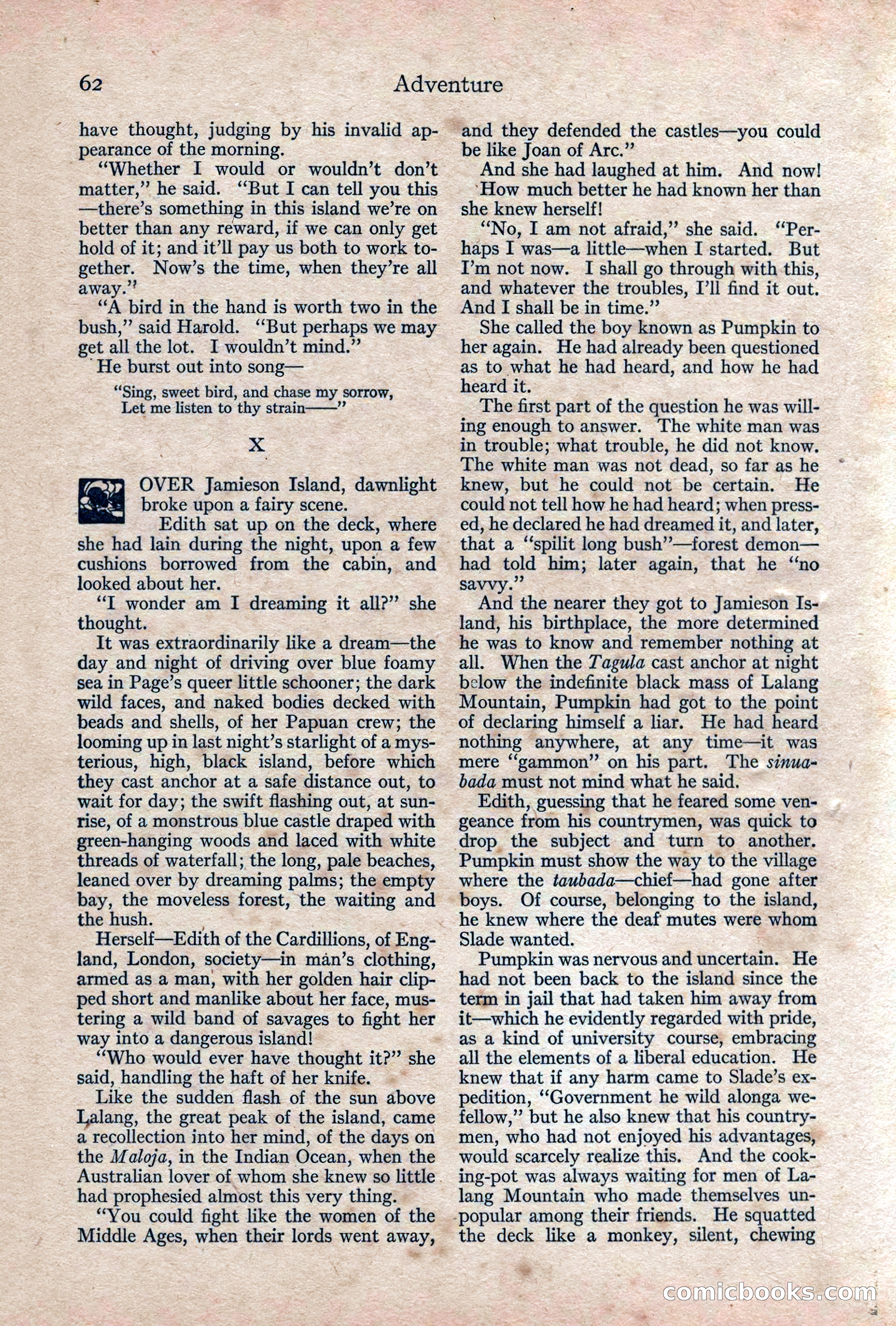
A restored page from Pulp Fiction, 1917. Page through the whole issue in the reader above.
📄 Transcribed text from this page (OCR, searchable)
Machine-transcribed from the original scan — historical spelling and the odd misread are preserved.
62 have thought, judging by his invalid ap- pearance of the morning. “Whether I would or wouldn’t don’t matter,” he said. “But I can tell you this —there’s something in this island we’re on better than any reward, if we can only get _ hold of it; and it’ll pay us both to work to- gether. Now’s the time, when they’re all away.” ‘“‘A bird in the hand is worth two in the bush,” said Harold. get all the lot. I wouldn’t mind.” ‘He burst out into song— “Sing, sweet bird, and chase my sorrow, Let me listen to thy strain——” x oy OVER Jamieson Island, dawnlight “1 broke upon a fairy scene. Edith sat up on the deck, where she had lain during the night, upon a few cushions borrowed from the cabin, and looked about her. “YT wonder am I dreaming it all?’ she thought. It was extraordinarily like a dream—the day and night of driving over blue foamy sea in Page’s queer little schooner; the dark wild faces, and naked bodies decked with beads and shells, of her Papuan crew; the looming up in last night’s starlight of a mys- terious, high, black island, before which they cast anchor at a safe distance out, to wait for day; the swift flashing out, at sun- rise, of a monstrous blue castle draped with green-hanging woods and laced with white threads of waterfall; the long, pale beaches, leaned over by dreaming palms; the empty bay, the moveless forest, the waiting and the hush. Herself—Edith of the Cardillions, of Eng- land, London, society—in man’s clothing, armed as a man, with her golden hair clip- ped short and manlike about her face, mus- tering a wild band of savages to fight her way into a dangerous island! ‘“‘Who would ever have thought it?” she said, handling the haft of her knife. ~~ Like the sudden flash of the sun above Lalang, the great peak of the island, came a recollection into her mind, of the days on the Maloja, in the Indian Ocean, when the Australian lover of whom she knew so little . had prophesied almost this very thing. “You could fight like the women of the Middle Ages, when their lords went away, “But perhaps we may -popular among their friends. Adventure -and they defended the castles—you could be like Joan of Arc.” And she had laughed at him. And now! ‘How much better he had known her than she knew herself! “No, I am not afraid,” she said. ‘‘Per- haps I was—a little—when I started. But I’m not now. I shall go through with this, and whatever the troubles, I’ll find it out. And I shall be in time.” She called the boy known as Pumpkin to her again. He had already been questioned as to what he had heard, and how he had heard it. The first part of the question he was will- ing enough to answer. The white man was in trouble; what trouble, he did not know. The white man was not dead, so far as he knew, but he could not be certain. He could not tell how he had heard; when press- ed, he declared he had dreamed. it, and later, that a “‘spilit long bush”—forest demon— had told him; later again, that he “no Savvy.’ And the nearer they got to Jamieson Is- land, his birthplace, the more determined he was to know and remember nothing at all. When the Zagula cast anchor at night below the indefinite black mass of Lalang Mountain, Pumpkin had got to the point of declaring himself a liar. He had heard nothing anywhere, at any time—it was mere “gammon” on his part. The sinua- bada must not mind what he said. Edith, guessing that he feared some ven- geance from his countrymen, was quick to drop the subject and turn to another. Pumpkin must show the way to the village where the taubada—chief—had gone after boys. Of course, belonging to the island, he knew where the deaf mutes were whom Slade wanted. Pumpkin was nervous and uncertain. He had not been back to the island since the term in jail that had taken him away from it—which he evidently regarded with pride, as a kind of university course, embracing all the elements of a liberal education. He knew that if any harm came to Slade’s ex- pedition, ‘Government he wild alonga we- fellow,” but he also knew that his country- men, who had not enjoyed his advantages, would scarcely realize this. And the cook- ing-pot was always waiting for men of La- lang Mountain who made themselves un- He squatted the deck like a monkey, silent, chewing ote EOPMICE OOO KS (C (E©)