
Pulp Fiction, 1917 · page 60 of 228
Adventure, February 1917 — page 60: what you’re looking at
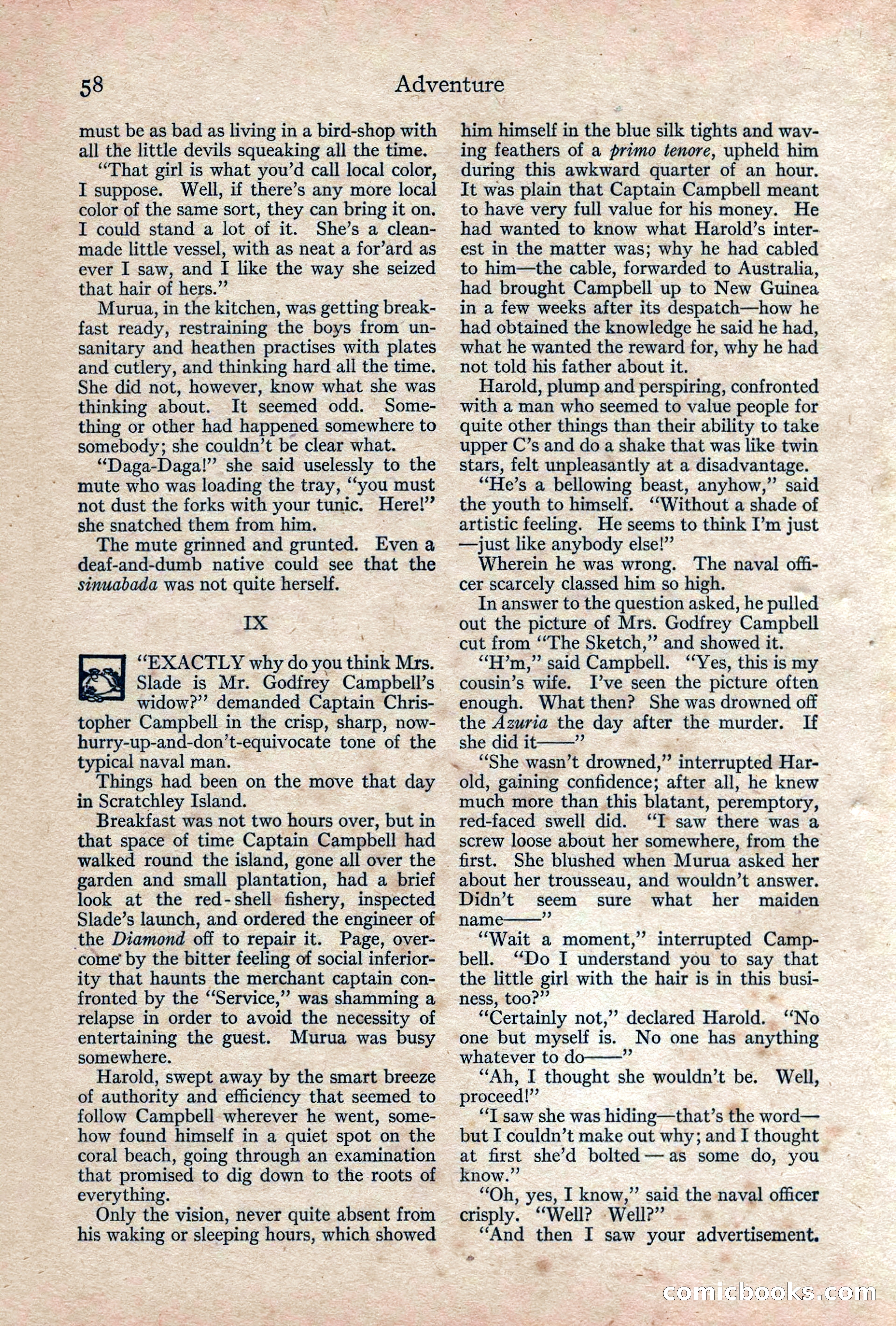
A restored page from Pulp Fiction, 1917. Page through the whole issue in the reader above.
📄 Transcribed text from this page (OCR, searchable)
Machine-transcribed from the original scan — historical spelling and the odd misread are preserved.
58 must be as bad as living in a bird-shop with all the little devils squeaking all the time. “That girl is what you’d call local color, I suppose. Well, if there’s any more local color of the same sort, they can bring it on. I could stand a lot of it. She’s a clean- made little vessel, with as neat a for’ard as ever I saw, and I like the way she seized that hair of hers.” Murua, in the kitchen, was getting break- fast ready, restraining the boys from un- sanitary and heathen practises with plates and cutlery, and thinking hard all the time. She did not, however, know what she was thinking about. It seemed odd. Some- thing or other had happened somewhere to somebody; she couldn’t be clear what. “Daga-Daga!” she said uselessly to the mute who was loading the tray, “you must not dust the forks with your tunic. Here!” she snatched them from him. The mute grinned and grunted. Even a deaf-and-dumb native could see that the sinuabada was not quite herself. IX “EXACTLY why do you think Mrs. “== widow?” demanded Captain Chris- topher Campbell in the crisp, sharp, now- hurry-up-and-don’t-equivocate tone of the typical naval man. Things had been on the move that day in Scratchley Island. Breakfast was not two hours over, but in that space of time Captain Campbell had walked round the island, gone all over the garden and small plantation, had a brief look at the red-shell fishery, inspected Slade’s launch, and ordered the engineer of the Diamond off to repair it. Page, over- come by the bitter feeling of social inferior- ity that haunts the merchant captain con- fronted by the ‘‘Service,” was shamming a relapse in order to avoid the necessity of entertaining the guest. Murua was busy somewhere. Harold, swept away by the smart breeze of authority and efficiency that seemed to follow Campbell wherever he went, some- how found himself in a quiet spot on the coral beach, going through an examination that promised to dig down to the roots of everything. Only the vision, never quite absent from his waking or sleeping hours, which showed M Slade is Mr. Godfrey Campbell’s. ’ whatever to do——”’ Adventure him himself in the blue silk tights and wav- ing feathers of a primo tenore, upheld him during this awkward quarter of an hour. It was plain that Captain Campbell meant to have very full value for his money. He had wanted to know what Harold’s inter- est in the matter was; why he had cabled to him—the cable, forwarded to Australia, had brought Campbell up to New Guinea in a few weeks after its despatch—how he had obtained the knowledge he said he had, what he wanted the reward for, why he had not told his father about it. Harold, plump and perspiring, confronted with a man who seemed to value people for quite other things than their ability to take upper C’s and do a shake that was like twin stars, felt unpleasantly at a disadvantage. ““He’s a bellowing beast, anyhow,” said the youth to himself. ‘‘Without a shade of artistic feeling. He seems to think I’m just —just like anybody else!’’ Wherein he was wrong. The naval offi- cer scarcely classed him so high. In answer to the question asked, he pulled out the picture of Mrs. Godfrey Campbell ~ cut from ‘“The Sketch,” and showed it. “H’m,” said Campbell. ‘“‘Yes, this is my cousin’s wife. I’ve seen the picture often enough. What then? She was drowned off the Azuria the day after the murder. If she did it——” “She wasn’t drowned,” frerraptia Har- old, gaining confidence; after all, he knew much more than this blatant, peremptory, red-faced swell did. ‘I saw there was a screw loose about her somewhere, from the first. She blushed when Murua asked her about her trousseau, and wouldn’t answer. Didn’t seem sure what her maiden name——”’ “Wait a moment,” interrupted Camp- bell. “Do I understand you to say that the little girl with the hair is in this busi- ness, too?” . “Certainly not,” declared Harold. ‘‘No one but myself is. No one has anything “Ah, I thought she wouldn’t be. Well, proceed!”’ “I saw she was hiding—that’s the word— but I couldn’t make out why; and I thought at first she’d bolted —as some do, you know.” “Oh, yes, I know,” said the naval officer crisply. ‘“‘Well? Well?” “And then I saw your advertisement. NOOLKES (E©) EGOMIE