
Pulp Fiction, 1917 · page 56 of 228
Adventure, February 1917 — page 56: what you’re looking at
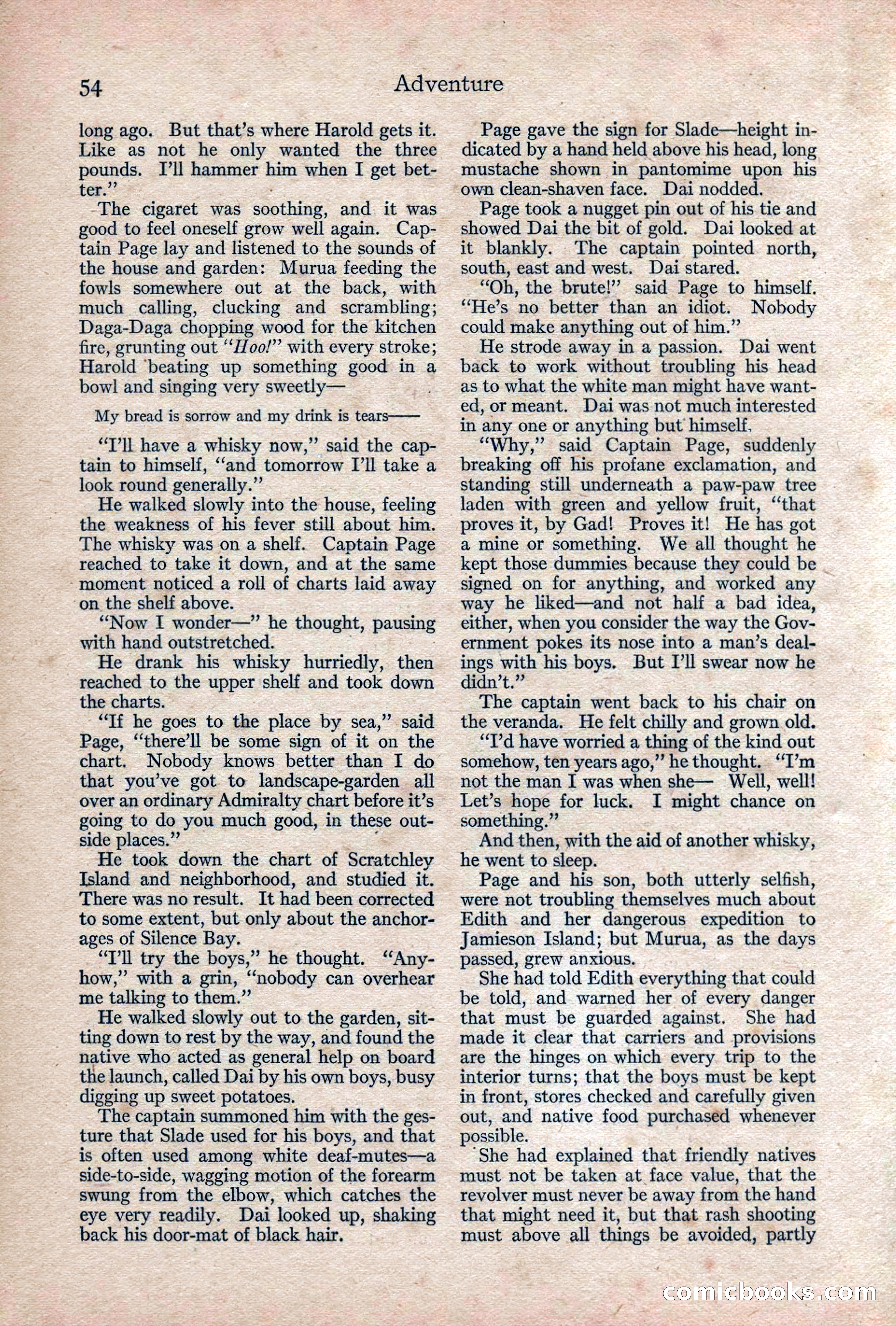
A restored page from Pulp Fiction, 1917. Page through the whole issue in the reader above.
📄 Transcribed text from this page (OCR, searchable)
Machine-transcribed from the original scan — historical spelling and the odd misread are preserved.
o4 long ago. But that’s where Harold gets it. Like as not he only wanted the three pounds. T’ll hammer him when I get bet- ter.” -The cigaret was eietnine and it was good to feel oneself grow well again. Cap- tain Page lay and listened to the sounds of the house and garden: Murua feeding the fowls somewhere out at the back, with much calling, clucking and scrambling; Daga-Daga chopping wood for the kitchen fire, grunting out ‘Hoo!’ with every stroke; Harold ‘beating up something good in a bowl and singing very sweetly— : My bread is sorrow and my drink is tears—— “lll have a whisky now,” said the cap- tain to himself, ‘‘and tomorrow I’ll take a look round generally.” He walked slowly into the house, feeling the weakness of his fever still about him. The whisky was on a shelf. Captain Page reached to take it down, and at the same -moment noticed a roll of charts laid away on the shelf above. “Now I wonder—” he thought, pausing with hand outstretched. He drank his whisky hurriedly, then reached to the upper shelf and took down the charts. “Tf he goes to the place by sea, ” said Page, ‘‘there’ll be some sign of it on the chart. Nobody knows better than I do that you’ve got to landscape-garden all over an ordinary Admiralty chart before it’s going to do you much good, in these out- side places.” He took down the chart of Scratchley Island and neighborhood, and studied it. There was no result. It had been corrected to some extent, but only about the anchor- ages of Silence Bay. “T’'ll try the boys,” he thought. ‘‘Any- how,” with a grin, ,, nobody can overhear me talking to them He walked slowly out to the garden, sit- ting down to rest by the way, and found the native who acted as general help on board the launch, called Dai by his own boys, busy _ digging up sweet potatoes. The captain summoned him with the ges- ture that Slade used for his boys, and that is often used among white deaf-mutes—a side-to-side, wagging motion of the forearm swung from the elbow, which catches the eye very readily. Dai looked up, shaking back his door-mat of black hair. Adventure Page gave the sign for Slade—height in- dicated by a hand held above his head, long mustache shown in pantomime upon his ‘own clean-shaven face. Dai nodded. Page took a nugget pin out of his tie and showed Dai the bit of gold. Dai looked at it blankly. The captain pointed north, south, east and west. Dai stared. “Oh, the brute!’’ said Page to himself. | ‘““He’s no better than an idiot. could make anything out of him.” He strode away in a passion. Dai went back to work without troubling his head as to what the white man might have want- ed, or meant. Dai was not much interested in any one or anything but himself. “Why,” said Captain Page, suddenly breaking off his profane exclamation, and standing still underneath a paw-paw tree laden with green and yellow fruit, “that proves it, by Gad! Proves it! He has got a mine or something. We all thought he Nobody kept those dummies because they could be - signed on for anything, and worked any way he liked—and not half a bad idea, either, when you consider the way the Gov- ernment pokes its nose into a man’s deal- ings with his boys. But I’ll swear now he didn’t.” The captain went back to his chair on the veranda. He felt chilly and grown old. “Td have worried a thing of the kind out somehow, ten years ago,”’ he thought. “T’m not the man I was when she— Well, well! Let’s hope for luck. I might chance on something.” And then, with the aid of another whisky, he went to sleep. Page and his son, both utterly selfish, were not troubling themselves much about Edith and her dangerous expedition to Jamieson Island; but Murua, as the days passed, grew anxious. She had told Edith everything that could be told, and warned her of every danger that must be guarded against. She had made it clear that carriers and provisions are the hinges on which every trip to the interior turns; that the boys must be kept in front, stores checked and carefully given out, and native food purchased whenever possible. She had explained that friendly natives must not be taken at face value, that the revolver must never be away from the hand that might need it, but that rash shooting must above all things be avoided, partly ECOmIcbooks (C§@)