
Pulp Fiction, 1917 · page 54 of 228
Adventure, February 1917 — page 54: what you’re looking at
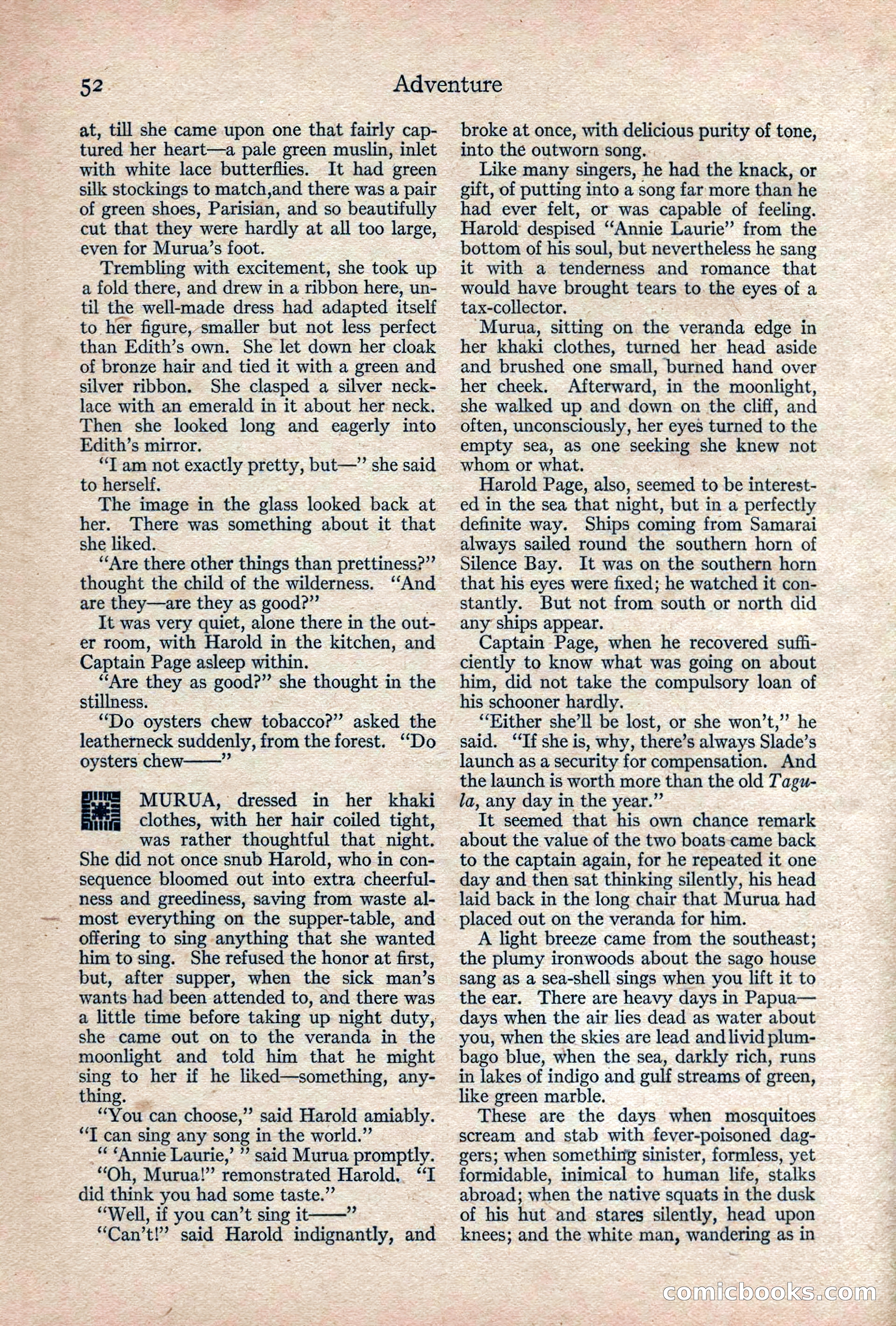
A restored page from Pulp Fiction, 1917. Page through the whole issue in the reader above.
📄 Transcribed text from this page (OCR, searchable)
Machine-transcribed from the original scan — historical spelling and the odd misread are preserved.
52. at, till she came upon one that fairly cap- tured her heart—a pale green muslin, inlet with white lace butterflies. It had green silk stockings to match,and there was a pair of green shoes, Parisian, and so beautifully cut that they were hardly at all too large, even for Murua’s foot. Trembling with excitement, she took up a fold there, and drew in a ribbon here, un- - til the well-made dress had adapted itself to her figure, smaller but not less perfect than Edith’s own. She let down her cloak of bronze hair and tied it with a green and silver ribbon. She clasped a silver neck- lace with an emerald in it about her neck. Then she looked long and eagerly into Edith’s mirror. “T am not exactly pretty, but—”’ she said to herself. The image in the glass looked back at her. There was something about it that she liked. ‘‘Are there other things than prettiness?”’ thought the child of the wilderness. ‘“‘And are they—are they as good?” It was very quiet, alone there in the out- er room, with Harold in the kitchen, and Captain Page asleep within. ‘“‘Are they as good?” she thought in the stillness. “Do oysters chew tobacco?” asked the leatherneck suddenly, from the forest. “Do oysters chew——” MURUA, dressed in her khaki clothes, with her hair coiled tight, was rather thoughtful that night. She did not once snub Harold, who in con- sequence bloomed out into extra cheerful- _ness and greediness, saving from waste al- most everything on the supper-table, and offering to sing anything that she wanted him to sing. She refused the honor at first, but, after supper, when the sick man’s wants had been attended to, and there was a little time before taking up night duty, she came out on to the veranda in the moonlight and told him that he might sing to her if he liked—something, any- thing. ot can choose,” said Harold amiably. “T can sing any song in the world.” ** “Annie Laurie,’ ” said Murua promptly. “Oh, Murua!” remonstrated Harold. “TI did think you had some taste.” | “Well, if you can’t sing it——” “Can't!” said Harold Say, and Adventure broke at once, with delicious purity of tone, into the outworn song. Like many singers, he had the knack, or gift, of putting into a song far more than he had ever felt, or was capable of feeling. Harold despised “Annie Laurie” from the bottom of his soul, but nevertheless he sang it with a tenderness and romance that would have brought tears to the eyes of | a tax-collector. ‘Murua, sitting on the veranda edge in her khaki clothes, turned her head aside and brushed one small, ‘burned hand over her cheek. Afterward, in the moonlight, she walked up and down on the cliff, and often, unconsciously, her eyes turned to the empty sea, aS one seeking she knew not whom or what. Harold Page, also, seemed to be interest- ed in the sea that night, but in a perfectly definite way. Ships coming from Samarai always sailed round the southern horn of Silence Bay. It was on the southern horn that his eyes were fixed; he watched it con- stantly. But not from south or north did any ships appear. Captain Page, when he recovered sufhi- ciently to know what was going on about him, did not take the compulsory loan of his schooner hardly. - “Either she’ll be lost, or she won’t,’’ he said. “If she is, why, there’s always Slade’s launch as a security for compensation. And the launch is worth more than the old Tagu- la, any day in the year.” It seemed that his own chance remark about the value of the two boats came back to the captain again, for he repeated it one day and then sat thinking silently, his head laid back in the long chair that Murua had placed out on the veranda for him. A light breeze came from the southeast; the plumy ironwoods about the sago house sang as a sea-shell sings when you lift it to the ear. There are heavy days in Papua— days when the air lies dead as water about you, when the skies are lead and livid plum- bago blue, when the sea, darkly rich, runs in lakes of indigo and gulf streams of green, like green marble. These are the days when mosquitoes scream and stab with fever-poisoned dag- gers; when something sinister, formless, yet formidable, inimical to human life, stalks abroad; when the native squats in the dusk of his hut and stares silently, head upon knees; and the white man, wandering as in CORMICOOOKS (EO)