
Pulp Fiction, 1917 · page 52 of 228
Adventure, February 1917 — page 52: what you’re looking at
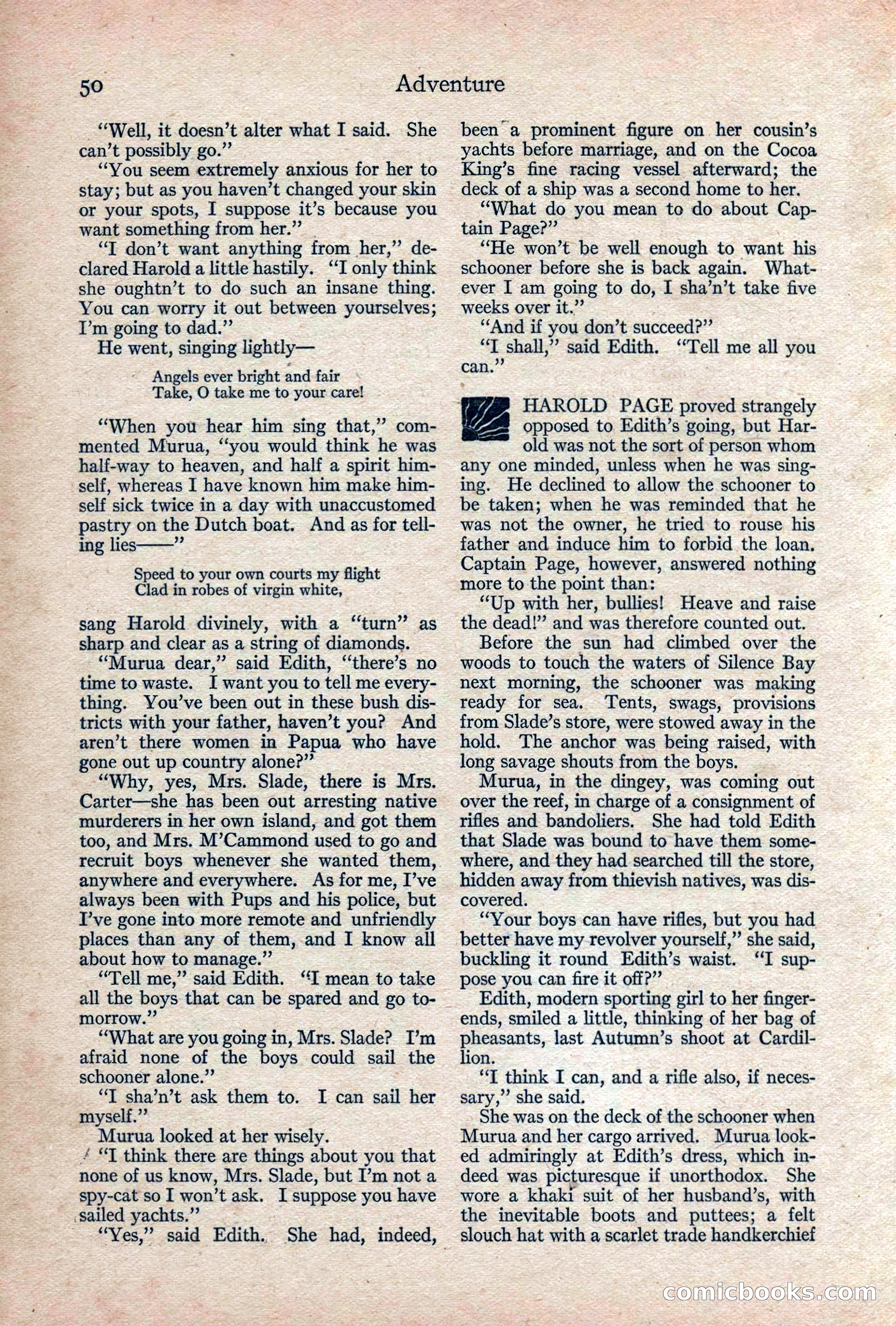
A restored page from Pulp Fiction, 1917. Page through the whole issue in the reader above.
📄 Transcribed text from this page (OCR, searchable)
Machine-transcribed from the original scan — historical spelling and the odd misread are preserved.
50 “Well, it doesn’t alter what I said. She can’t possibly go.” “You seem extremely anxious for her to stay; but as you haven’t changed your skin or your spots, I suppose it’s because you want something from her.” _ “TJ don’t want anything from her,” de- clared Harold a little hastily. “TI only think she oughtn’t to do such an insane thing. You can worry it out between yourselves; I’m going to dad.”’ He went, singing lightly— Angels ever bright and fair Take, O take me to your care! “When you hear him sing that,” com- mented Murua, “‘you would think he was half-way to heaven, and half a spirit him- self, whereas I have known him make him- self sick twice in a day with unaccustomed pastry on the Dutch boat. And as for tell- ing lies——” Speed to your own courts my flight Clad in robes of virgin white, sang Harold divinely, with a “turn” as sharp and clear as a string of diamonds. “Murua dear,” said Edith, “there’s no time to waste. I want you to tell me every- thing. You’ve been out in these bush dis- tricts with your father, haven’t you? And aren’t there women in Papua who have gone out up country alone?” “Why, yes, Mrs. Slade, there is Mrs. Carter—she has been out arresting native murderers in her own island, and got them too, and Mrs. M’Cammond used to go and recruit boys whenever she wanted them, anywhere and everywhere. As for me, I’ve always been with Pups and his police, but I’ve gone into more remote and unfriendly places than any of them, and I know all about how to manage.” “Tell me,” said Edith. “I mean to take all the boys that can be spared and go to- morrow.” “What are you going in, Mrs. Slade? I’m afraid none of the boys could sail the schooner alone.” “T sha’n’t ask them to. I can sail her myself.”’ Murua looked at her wisely. ’ “JT think there are things about you that none of us know, Mrs. Slade, but I’m not a spy-cat so I won’t ask. I suppose you have sailed yachts.” “Yes,” said Edith. She had, indeed, Adventure been a prominent figure on her cousin’s yachts before marriage, and on the Cocoa King’s fine racing vessel afterward; the deck of a ship was a second home to her. “What do you mean to do about Cap- tain Page?” | “He won’t be well enough to want his schooner before she is back again. What- ever I am going to do, I sha’n’t take five weeks over it.” | “And if you don’t succeed?” “I shall,” said Edith. ‘Tell me all you can. . HAROLD PAGE proved strangely opposed to Edith’s going, but Har- old was not the sort of person whom any one minded, unless when he was sing- ing. He declined to allow the schooner to be taken; when he was reminded that he was not the owner, he tried to rouse his father and induce him to forbid the loan, Captain Page, however, answered nothing more to the point than: “Up with her, bullies! Heave and raise the dead!”’ and was therefore counted out. Before the sun had climbed over the woods to touch the waters of Silence Bay next morning, the schooner was making ready for sea. Tents, swags, provisions from Slade’s store, were stowed away in the hold. The anchor was being raised, with long savage shouts from the boys. Murua, in the dingey, was coming out over the reef, in charge of a consignment of rifles and bandoliers. She had told Edith that Slade was bound to have them some- where, and they had searched till the store, hidden away from thievish natives, was dis- covered. “Your boys can have rifles, but you had better have my revolver yourself,” she said, buckling it round Edith’s waist. “I sup- pose you can fire it off?” Edith, modern sporting girl to her finger- ends, smiled a little, thinking of her bag of pheasants, last Autumn’s shoot at Cardil- lion. “T think I can, and a rifle also, if neces- sary,” she said, She was on the deck of the schooner when Murua and her cargo arrived. Murua look- ed admiringly at Edith’s dress, which in- deed was picturesque if unorthodox. She wore a khaki suit of her husband’s, with the inevitable boots and puttees; a felt slouch hat with a scarlet trade handkerchief CORMIG OOOKS (c (CO) |