
Pulp Fiction, 1917 · page 46 of 228
Adventure, February 1917 — page 46: what you’re looking at
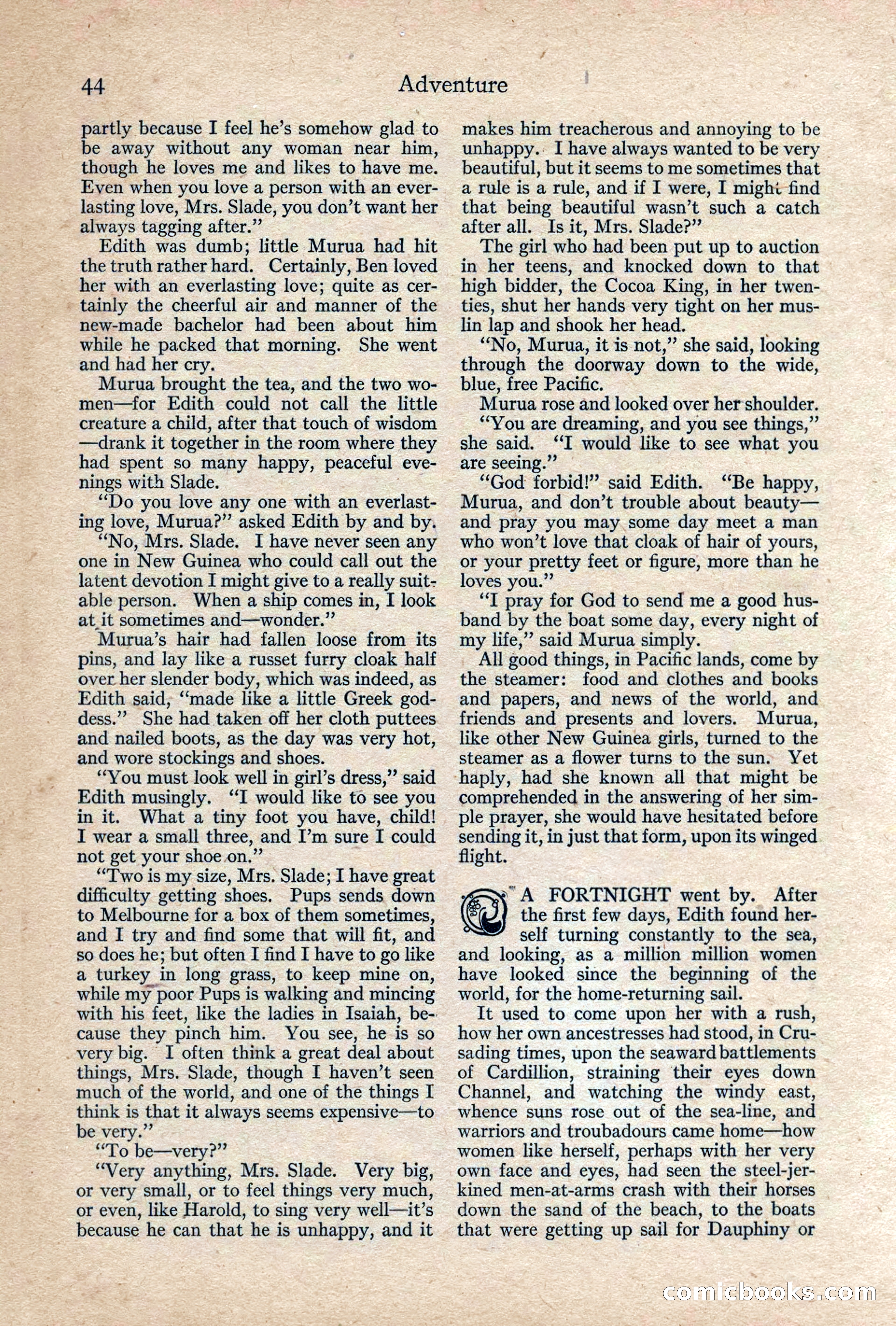
A restored page from Pulp Fiction, 1917. Page through the whole issue in the reader above.
📄 Transcribed text from this page (OCR, searchable)
Machine-transcribed from the original scan — historical spelling and the odd misread are preserved.
A4 partly because I feel he’s somehow glad to be away without any woman near him, though he loves me and likes to have me. Even when you love a person with an ever- lasting love, Mrs. Slade, you don’t want her always tagging after.” Edith was dumb; little Murua had hit the truth rather hard. Certainly, Ben loved _ her with an everlasting love; quite as cer- - tainly the cheerful air and manner of the new-made bachelor had been about him while he packed that morning. She went and had her cry. Murua brought the tea, and the two wo- men—for Edith could not call the little creature a child, after that touch of wisdom —drank it together in the room where they had spent so many happy, peaceful eve- nings with Slade. “Do you love any one with an everlast- ing love, Murua?” asked Edith by and by. “No, Mrs. Slade. I have never seen any one in New Guinea who could call out the latent devotion I might give to a really suit- able person. When a ship comes in, I look at_it sometimes and—wonder.”’ Murua’s hair had fallen loose from its pins, and lay like a russet furry cloak half over her slender body, which was indeed, as Edith said, ‘“‘made like a little Greek god- dess.”’ She had taken off her cloth puttees and nailed boots, as the day was very hot, and wore stockings and shoes. “You must look well in girl’s dress,”’ said Edith musingly. “I would like to see you in it. What a tiny foot you have, child! I wear a small three, and I’m sure I could not get your shoe.on.” “Two is my size, Mrs, Slade; I have great difficulty getting shoes. Pups sends down to Melbourne for a box of them sometimes, and I try and find some that will fit, and < does he; but often I find I have to go like a turkey in long grass, to keep mine on, while my poor Pups is walking and mincing with his feet, like the ladies in Isaiah, be-: cause they pinch him. You see, he is so _very big. I often think a great deal about things, Mrs. Slade, though I haven’t seen much of the world, and one of the things I think is that it always seems expensive—to be very.” “To be—very?”’ “Very anything, Mrs. Slade. Very big, or very small, or to feel things very much, or even, like Harold, to sing very well—it’s because he can that he is unhappy, and it Adventure makes him treacherous and annoying to be unhappy. I have always wanted to be very © beautiful, but it seems to me sometimes that a rule is a rule, and if I were, I might find that being beautiful wasn’t such a catch after all. Is it, Mrs. Slade?’ The girl who had been put up to auction in her teens, and knocked down to that high bidder, the Cocoa King, in her twen- ties, shut her hands very tight on her mus- lin lap and shook her head. “No, Murua, it is not,” she said, looking through the doorway down to the wide, blue, free Pacific. Murua rose and looked over her shoulder. “You are dreaming, and you see things,” she said. “I would like to see what you are seeing.” “God forbid!” said Edith. “Be happy, Murua, and don’t trouble about beauty— and pray you may some day meet a man who won’t love that cloak of hair of yours, or your pretty feet or figure, more than he loves you.” “TI pray for God to send me a good hus- band by the boat some day, every night of my life,” said Murua simply. All good things, in Pacific lands, come by the steamer: food and clothes and books and papers, and news of the world, and friends and presents and lovers. Murua, like other New Guinea girls, turned to the steamer as a flower turns to the sun. Yet ‘haply, had she known all that might be comprehended in the answering of her sim- ple prayer, she would have hesitated before sending it, in just that form, upon its winged flight. © A FORTNIGHT went by. After the first few days, Edith found her- self turning constantly to the sea, and looking, as a million million women have looked since the beginning of the world, for the home-returning sail. It used to come upon her with a rush, how her own ancestresses had stood, in Cru- sading times, upon the seaward battlements of Cardillion, straining their eyes down Channel, and watching the windy east, whence suns rose out of the sea-line, and warriors and troubadours came home—how women like herself, perhaps with her very own face and eyes, had seen the steel-jer- kined men-at-arms crash with their horses down the sand of the beach, to the boats that were getting up sail for Dauphiny or Gomicbooks (C©)