
Pulp Fiction, 1917 · page 38 of 228
Adventure, February 1917 — page 38: what you’re looking at
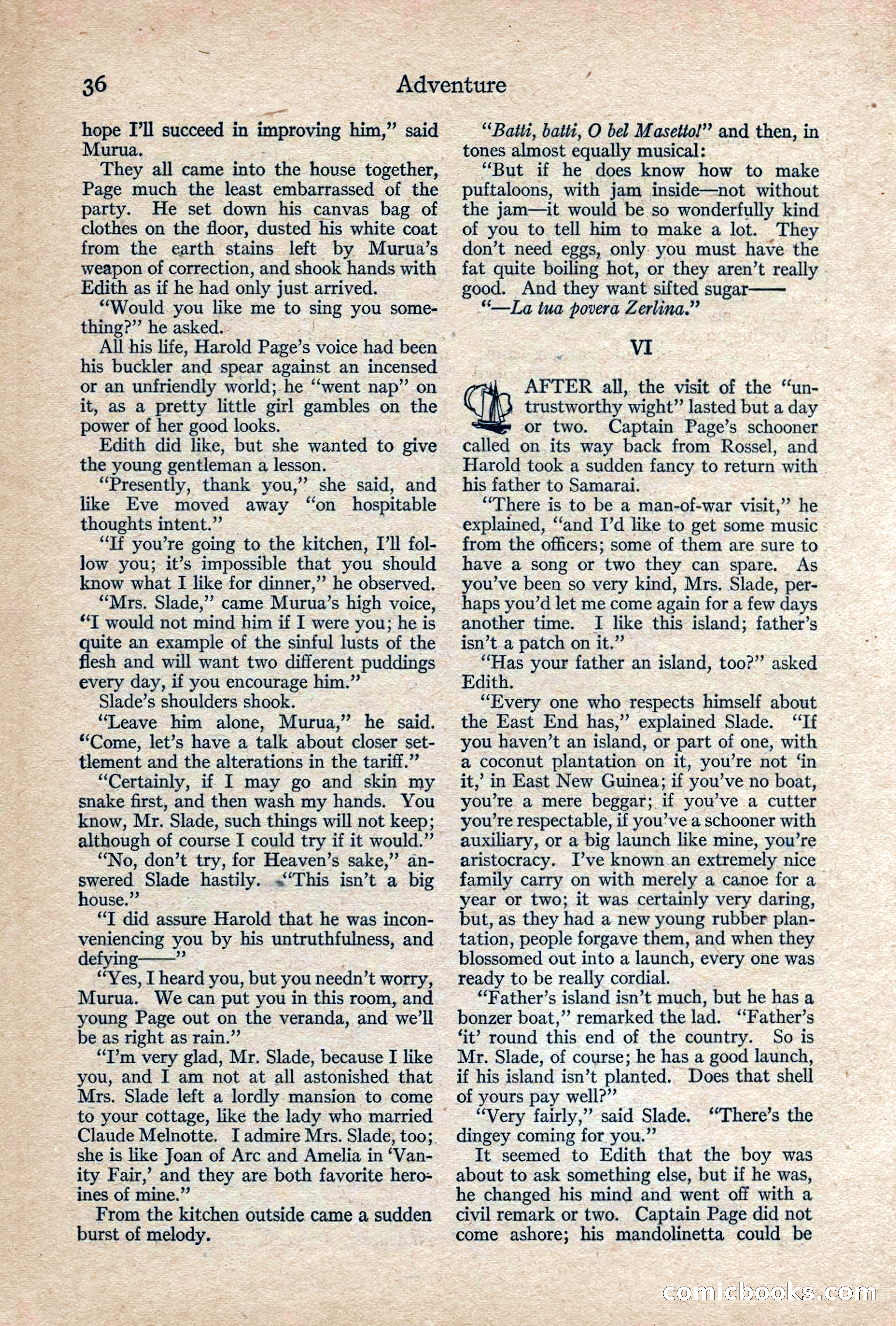
A restored page from Pulp Fiction, 1917. Page through the whole issue in the reader above.
📄 Transcribed text from this page (OCR, searchable)
Machine-transcribed from the original scan — historical spelling and the odd misread are preserved.
36 hope I’ll succeed in improving him,” said Murua. ‘They all came into the house together, Page much the least embarrassed of the party. He set down his canvas bag of clothes on the floor, dusted his white coat from the earth stains left by Murua’s weapon of correction, and shook hands with _. Edith as if he had only just. arrived. “Would you like me to sing you some- thing?” he asked.. All his life, Harold Page’ s voice had been _ his buckler and spear against an Ber or an unfriendly world; he “went nap” it, as a pretty little girl gambles on the power of her good looks. —_ Edith did like, but she wanted to give the young gentleman a lesson. “Presently, thank you,” she said, and like Eve moved away “on hospitable thoughts intent.” “If you’re going to the kitchen, I’ll fol- low you; it’s impossible that you should know what I like for dinner,” he observed. “Mrs. Slade,” came Murua’s high voice, “T would not mind him if I were you; he is quite an example of the sinful lusts of the flesh and will want two different pueune every day, if you encourage him.” Slade’s shoulders shook. “Leave him alone, Murua,” he said. “Come, let’s have a talk about closer set- tlement and the alterations in the tariff.” “Certainly, if I may go and skin my snake first, and then wash my hands. You know, Mr. Slade, such things will not keep; although of course I could try if it would.” “No, don’t try, for Heaven’s sake,” an- swered Slade hastily. «‘‘This isn’t a big house.” “T did assure Harold that he was incon- veniencing you by his untruthfulness, and defying——”’ “Yes, I heard you, but you needn’t worry, Murua. We can put you in this room, and young Page out on the veranda, and ‘we'll be as right as rain.” “T’m very glad, Mr. Slade, because I like you, and I am not at all astonished that Mrs. Slade left a lordly mansion to come to your cottage, like the lady who married © Claude Melnotte. I admire Mrs. Slade, too;. she is like Joan of Arc and Amelia in ‘Van- ity Fair,’ and they are both favorite hero- ines of mine.” : From the kitchen outside came a sudden burst of melody. Adventure “Bati, batti, O bel Masettol” and then, in tones almost equally musical: “But if he does know how to make puftaloons, with jam inside—not without the jam—it would be so wonderfully kind of you to tell him to make a lot. They don’t need eggs, only. you must have the fat quite boiling hot, or they aren’t really . Boot: And they want sifted sugar—— VI —La iua povera Zerlina.” AFTER all, the visit of the “un- Gp trustworthy wight” lasted but a day or two. Captain Page’s schooner called on its way back from Rossel, and Harold took a sudden fancy to return with his father to Samarai. ‘There is to be a man-of-war visit,” he explained, ‘‘and I’d like to get some music from the officers; some of them are sure to have a song or two they can spare. As you’ve been so very kind, Mrs. Slade, per- haps you’d let me come again for a few days another time. I like this island; father’s isn’t a patch on it.” “Has your father an island, too?” asked Edith. “Every one who respects himself about the East End has,” explained Slade. “If you haven’t an island, or part of one, with a coconut plantation on it, you re not ‘in it,’ in East New Guinea; if you’ve no boat, you're a mere beggar; if you've a cutter you're respectable, if you’ve a schooner with auxiliary, or a big launch like mine, you’re aristocracy. I’ve known an extremely nice family carry on with merely a canoe for a year or two; it was certainly very daring, but, as they had a new young rubber plan- tation, people forgave them, and when they blossomed out into a launch, every one was ready to be really cordial. ‘“Father’s island isn’t much, but he has a bonzer boat,” remarked the lad. “Father’s “t? round this end of the country. So is Mr. Slade, of course; he has a good launch, if his island isn’t planted. Does that shell of yours pay well?” “Very fairly,” said Slade. “There’s the dingey coming for you.” It seemed to Edith that the boy was about to ask something else, but if he was, — he changed his mind and went off with a civil remark or two. Captain Page did not come ashore; his mandolinetta could be (e(0) JOOKS ALG (E@) S|