
Pulp Fiction, 1917 · page 35 of 228
Adventure, February 1917 — page 35: what you’re looking at
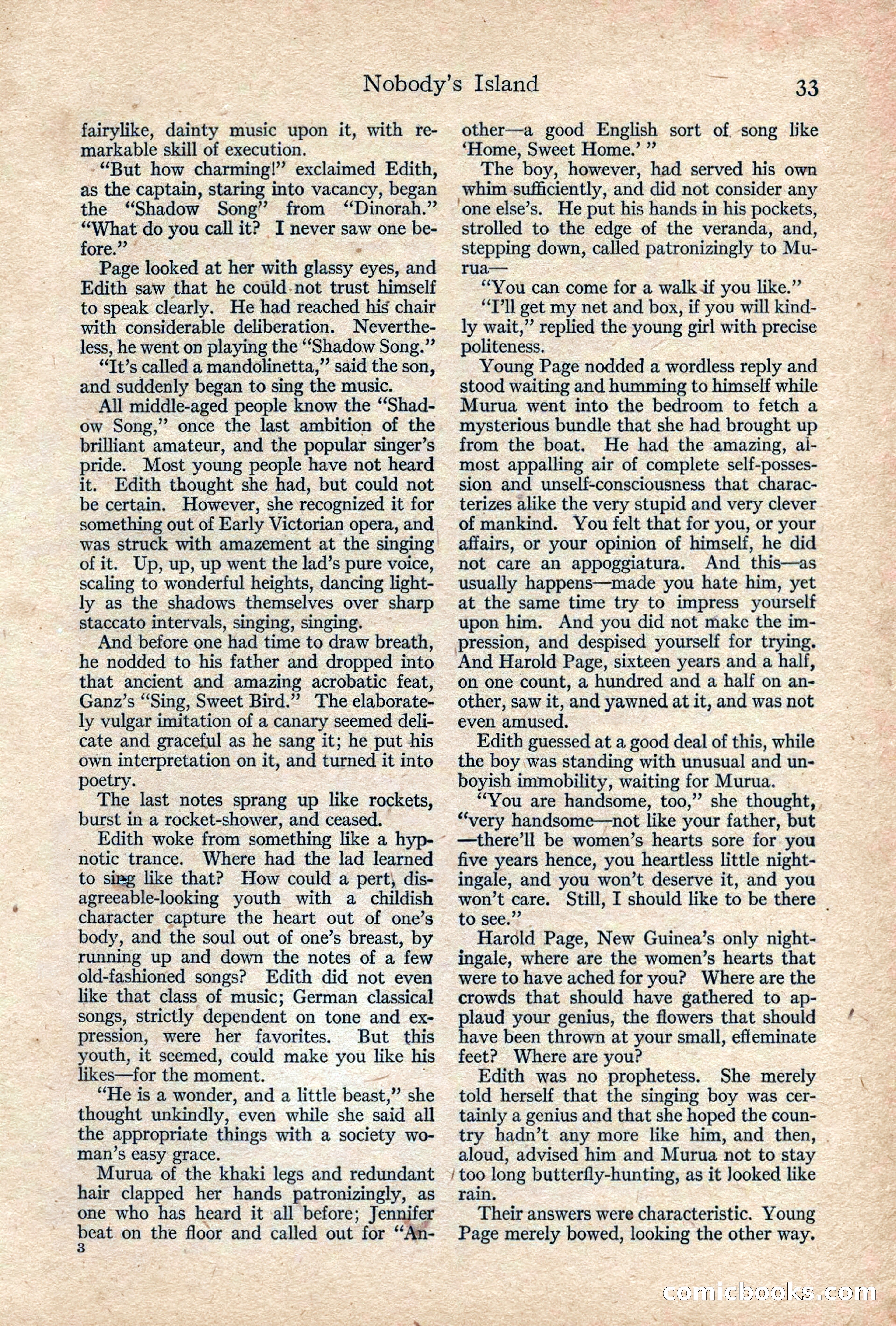
A restored page from Pulp Fiction, 1917. Page through the whole issue in the reader above.
📄 Transcribed text from this page (OCR, searchable)
Machine-transcribed from the original scan — historical spelling and the odd misread are preserved.
Nobody’s Island 2 <= fairylike, dainty music upon it, with re- markable skill of execution. -“But how charming!” exclaimed Edith, as the captain, staring into vacancy, began the “Shadow Song” from “Dinorah.” ~ What do you call it? I never saw one be- fore’ Page looked at her with alansy eyes, and Edith saw that he could-not trust himself to speak clearly. He had reached his chair with considerable deliberation. Neverthe- less, he went on playing the ‘Shadow Song.” “Tt’s called a mandolinetta,’’ said the son, and suddenly began to sing the music. All middle-aged people know the “Shad- ow Song,” once the last ambition of the brilliant amateur, and the popular singer’s pride. Most young people have not heard it. Edith thought she had, but could not be certain. However, she recognized it for something out of Early Victorian opera, and. was struck with amazement at the singing of it. Up, up, up went the lad’s pure voice, scaling to wonderful heights, dancing light- ly as the shadows themselves over sharp staccato intervals, singing, singing. _ And before one had time to draw breath, he nodded to his father and dropped into that ancient and amazing acrobatic feat, Ganz’s “Sing, Sweet Bird.” The elaborate- ly vulgar imitation of a canary seemed deli- cate and graceful as he sang it; he put his own interpretation on it, and turned it into poetry. ae The last notes sprang up like rockets, burst in a rocket-shower, and ceased. Edith woke from something like a hyp- ~ notic trance. Where had the lad learned to sipg like that? How could a pert, dis- agreeable-looking youth with a childish character capture the heart out of one’s body, and the soul out of one’s breast, by running up and down the notes of a few old-fashioned songs? Edith did not even like that class of music; German classical songs, strictly dependent on tone and ex- pression, were her favorites. But this youth, it seemed, could make you like his likes—for the moment. “He is a wonder, and a little beast, ” she thought unkindly, even while she said all the appropriate things with a society wo- man’s easy grace. Murua of the khaki legs and redundant hair clapped her hands patronizingly, as one who has heard it all before; jenjen beat on the floor and called out for “An- ‘one else’s. 33 other—a good English sort of. song like ‘Home, Sweet Home.’ ” The boy, however, had served his own whim sufficiently, and did not consider any He put his hands in his pockets, strolled to the edge of the veranda, and, stepping down, called patronizingly to Mu- rua— “You can come for a walkf you like.” ad ig! get my net and box, if you will kind- ly wait,” replied the young girl with precise politeness. Young Page nodded a wordless reply and stood waiting and humming to himself while Murua went into the bedroom to fetch a mysterious bundle that she had brought up from the boat. most appalling air of complete self-posses- sion and unself-consciousness that charac- terizes alike the very stupid and very clever. of mankind. You felt that for you, or your affairs, or your opinion of himself, he did not care an appoggiatura. And this—as usually happens—made you hate him, yet at the same time try to impress yourself upon him. And you did not make the im- pression, and despised yourself for trying. And Harold Page, sixteen years and a half, on one count, a hundred and a half on an- other, saw it, and yawned at it, and was not even amused. Edith guessed at a good deal of this, while the boy was standing with unusual and un- boyish immobility, waiting for Murua. “You are handsome, too,” she thought, “very handsome—not like your father, but —there’ll be women’s hearts sore for you five years hence, you heartless little night- ingale, and you won’t deserve it, and you won’t care. to see.” Harold Page, New Guinea’s only night- ingale, where are the women’s hearts that were to have ached for you? Where are the crowds that should have gathered to ap- plaud your genius, the flowers that should have been thrown at your small, effeminate feet? Where are you? Edith was no prophetess. She merely told herself that the singing boy was cer- tainly a genius and that she hoped the coun- He had the amazing, al- | Still, I should like to be there — ,. try hadn’t any more like him, and then, | aloud, advised him and Murua not to stay /too long butterfly-hunting, as it Jooked like rain. Their answers were characteristic. Young Page merely bowed, looking the other way. Gomichbooks (CO)