
Pulp Fiction, 1917 · page 33 of 228
Adventure, February 1917 — page 33: what you’re looking at
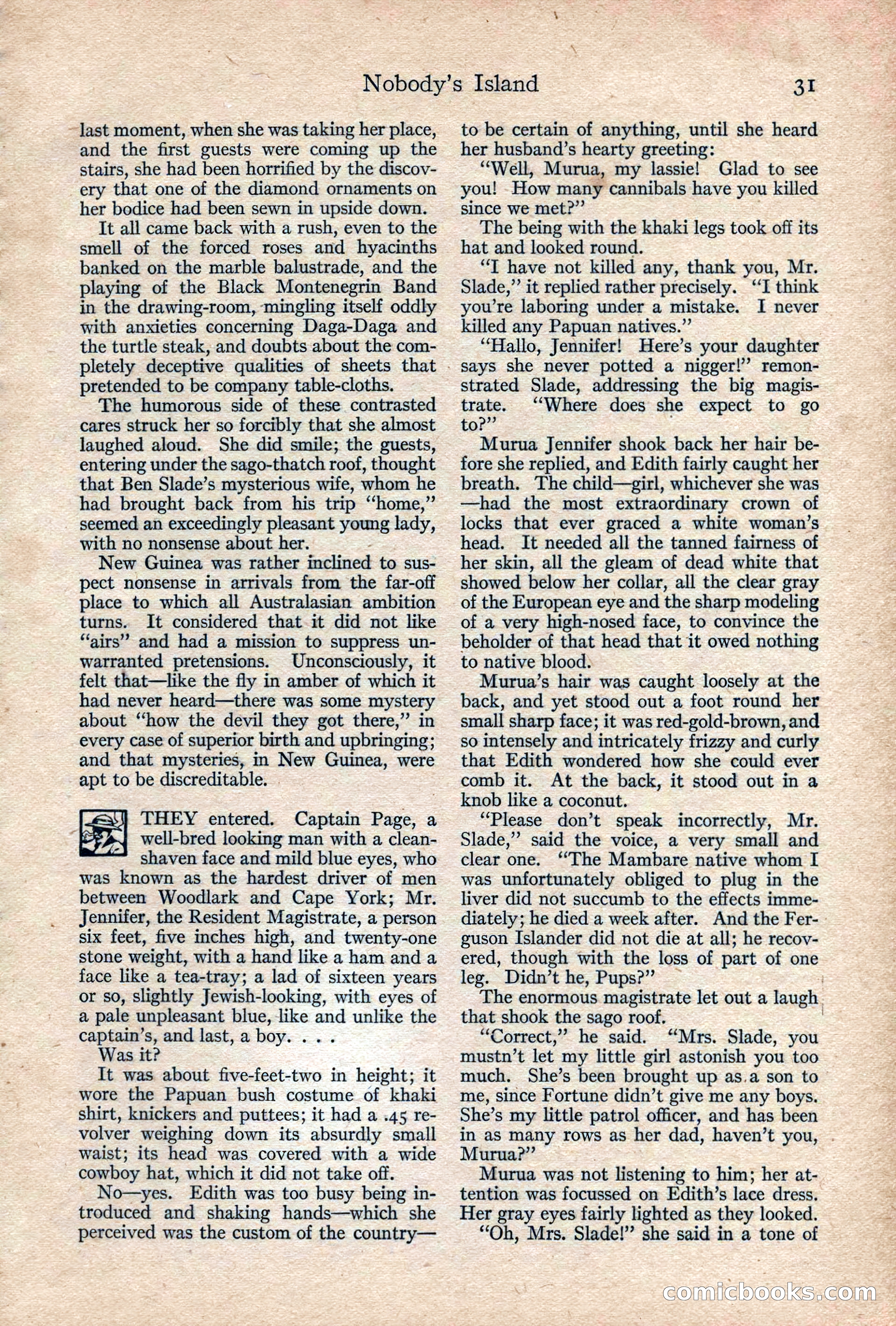
A restored page from Pulp Fiction, 1917. Page through the whole issue in the reader above.
📄 Transcribed text from this page (OCR, searchable)
Machine-transcribed from the original scan — historical spelling and the odd misread are preserved.
Nobody’s Island ~ last moment, when she was taking her place, and the first guests were coming up the stairs, she had been horrified by the discov- that one of the diamond ornaments on her bodice had been sewn in upside down. It all came back with a rush, even to the smell of the forced roses and hyacinths banked on the marble balustrade, and the playing of the Black Montenegrin Band in the drawing-room, ‘mingling itself oddly With anxieties concerning Daga-Daga and the turtle steak, and doubts about the com- pletely deceptive qualities of sheets that . pretended to be company table-cloths. The humorous side of these contrasted cares struck her so forcibly that she almost laughed aloud. She did smile; the guests, entering under the sago-thatch roof, thought that Ben Slade’s mysterious wife, whom he had brought back from his trip “home,” seemed an exceedingly pleasant young lady, with no nonsense about her. New Guinea was rather inclined to sus- pect nonsense in arrivals from the far-off place to which all Australasian ambition turns. It considered that it did not like “airs” and had a mission to suppress un- watranted pretensions. Unconsciously, it felt that—like the fly in amber of which it had never heard—there was some mystery about “‘how the devil they got there,’ in every case of superior birth and upbringing; and that mysteries, im New Guinea, were apt to be discreditable. <3 THEY entered. Captain Page, a : FB. well-bred looking man with a clean- shaven face and mild blue eyes, who was known as the hardest driver of men between Woodlark and Cape York; Mr. Jennifer, the Resident Magistrate, a person six feet, five inches high, and twenty-one stone weight, with a hand like a ham and a face like a tea-tray; a lad of sixteen years or so, slightly Jewish-looking, with eyes of a pale unpleasant blue, like and unlike the captain’s, and last, a boy. . Was it? It was about five-feet-two in height; it wore the Papuan bush costume of khaki shirt, knickers and puttees; it had a .45 re- volver weighing down its absurdly small waist; its head was covered with a wide cowboy hat, which it did not take off. No—yes. Edith was too busy being in- troduced and shaking hands—which she perceived was the custom of the country— 3t to be certain of anything, until she heard her husband’s hearty greeting: “Well, Murua, my lassie! Glad to see you! How many cannibals have you killed since we met?” The being with the khaki legs took off its hat and looked round. “T have not killed any, thank you, Mr. Slade,”’ it replied rather precisely. “I think you're laboring under a mistake. killed any Papuan natives.” “Hallo, Jennifer! Here’s your daughter says she never potted a nigger!’’ remon- strated Slade, addressing the big magis- trate. “Where does she expect to go to?” Murua Jennifer shook back her hair be- fore she replied, and Edith fairly caught her breath. The child—girl, whichever she was —had the most extraordinary crown of locks that ever graced a white woman’s head. It needed all the tanned fairness of her skin, all the gleam of dead white that showed below her collar, all the clear gray of the European eye and the sharp modeling of a very high-nosed face, to convince the beholder of that head that it owed nothing to native blood. Murua’s hair was caught loosely at the back, and yet stood out a foot round her small sharp face; it was red-gold-brown, and so intensely and intricately frizzy and curly that Edith wondered how she could ever comb it. At the back, it stood out in a knob like a coconut. “Please don’t speak incorrectly, Mr. Slade,”’ said the voice, a very small and clear one. ‘““The Mambare native whom I was unfortunately obliged to plug in the liver did not succumb to the effects imme- I never — diately; he died a week after. And the Fer- guson Islander did not die at all; he recov- ered, though with the loss of part of one leg. Didn’t he, Pups?” _ The enormous magistrate let out a laugh that shook the sago roof. “Correct,” he said. “Mrs. Slade, you mustn’t let my little girl astonish you too much. She’s been brought up as.a son to— me, since Fortune didn’t give me any boys. She’s my little patrol officer, and has been in as many rows as her dad, haven’t you, . Murua?”’ Murua was not listening to him; her at- tention was focussed on Edith’s lace dress. Her gray eyes fairly lighted as they looked. “Oh, Mrs. Slade!l’’ she said in a tone of 9)(0)(6) EOmic S (C@)