
Pulp Fiction, 1917 · page 30 of 228
Adventure, February 1917 — page 30: what you’re looking at
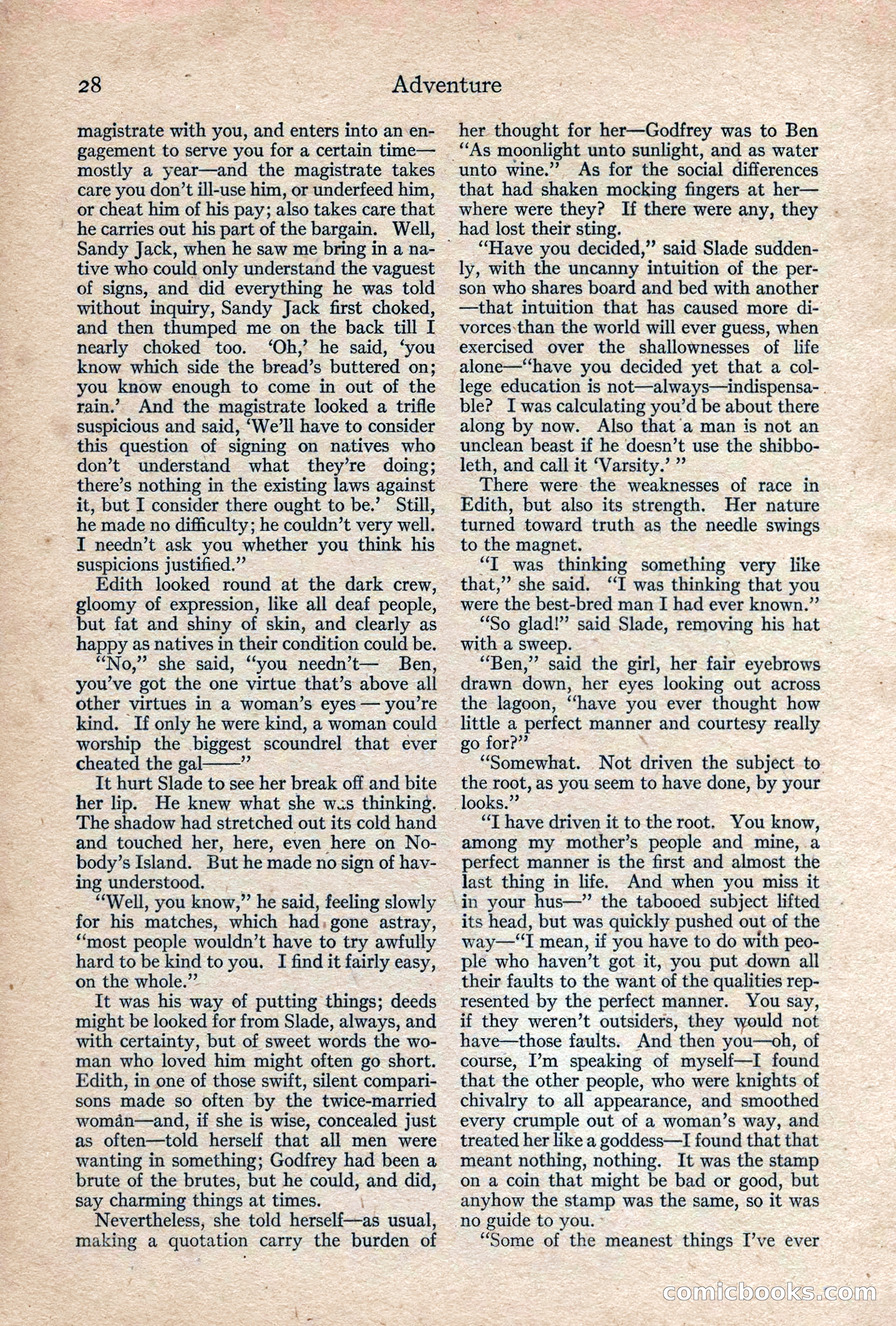
A restored page from Pulp Fiction, 1917. Page through the whole issue in the reader above.
📄 Transcribed text from this page (OCR, searchable)
Machine-transcribed from the original scan — historical spelling and the odd misread are preserved.
28 magistrate with you, and enters into an en- gagement to serve you for a certain time— mostly a year—and the magistrate takes care you don’t ill-use him, or underfeed him, or cheat him of his pay; also takes care that he carries out his part of the bargain. Well, Sandy Jack, when he saw me bring in a na- tive who could only understand the vaguest of signs, and did everything he was told without inquiry, Sandy Jack first choked, and then thumped me on the back till I nearly choked too. ‘Oh,’ he said, ‘you know which side the bread’s buttered on; you know enough to come in out of the rain.’ And the magistrate looked a trifle suspicious and said, ‘We’ll have to consider this question of signing on natives who don’t understand what they’re doing; there’s nothing in the existing laws against it, but I consider there ought to be.’ Still, he made no difficulty; he couldn’t very well. * I needn’t ask you whether you think his suspicions justified.” Edith looked round at the dark crew, gloomy of expression, like all deaf people, but fat and shiny of skin, and clearly as happy as natives in their condition could be. “No,” she said, “you needn’t— Ben, you’ve got the one virtue that’s above all other virtues in a woman’s eyes — you're kind. If only he were kind, a woman could worship the biggest scoundrel that ever cheated the gal——”’ It hurt Slade to see her break off and bite her lip. He knew what she was thinking. The shadow had stretched out its cold hand and touched her, here, even here on No- body’s Island. But he made no sign of hav- ing understood. “Well, you know,” he said, feeling slowly for his matches, which had, ,gone astray, “most people wouldn’t have to try awfully hard to be kind to you. I find it fairly easy, on the whole.” It was his way of putting things; deeds might be looked for from Slade, always, and with certainty, but of sweet words the wo- man who loved him might often go short. Edith, in one of those swift, silent compari- sons made so often by the twice-married woman—and, if she is wise, concealed just as often—told herself that all men were wanting in something; Godfrey had been a ‘brute of the brutes, but he could, and did, say charming things at times. Nevertheless, she told herself—as usual, making a quotation carry the burden of Adventure her thought for her—Godfrey was to Ben “AS moonlight unto sunlight, and as water unto wine.” As for the social differences that had shaken mocking fingers at her— where were they? If there were any, they . _ had lost their sting. “Have you decided,” said Slade sudden- ly, with the uncanny intuition of the per- son who shares board and bed with another —that intuition that has caused more di- vorces:than the world will ever guess, when exercised over the shallownesses of life alone—‘‘have you decided yet that a col- lege education is not—always—indispensa- . ble? I was calculating you’d be about there along by now. Also that a man is not an unclean beast if he doesn’t use the shibbo- leth, and call it ‘Varsity.’ ” _ There were: the weaknesses of race in Edith, but also its strength. Her nature turned toward truth as the needle swings to the magnet. “IT was thinking something very like that,”’ she said. “I was thinking that you were the best-bred man I had ever known.” “So glad!” said Slade, removing his hat with a sweep. “Ben,” said the girl, her fair eyebrows drawn down, her eyes looking out across the lagoon, “have you ever thought how little a perfect manner and courtesy really po.forree. =~ “Somewhat. the root, as you seem to have done, by your -looks.”’ “T have driven it to the root. You know, among my mother’s people and mine, a perfect manner is the first and almost the last thing in life. And when you miss it in your hus—” the tabooed subject lifted its head, but was quickly pushed out of the way—I mean, if you have to do with peo- ple who haven’t got it, you put down all their faults to the want of the qualities rep- resented by the perfect manner. You say, if they weren’t outsiders, they would not have—those faults. And then you—oh, of course, I’m speaking of myself—I found that the other people, who were knights of chivalry to all appearance, and smoothed every crumple out of a woman’s way, and treated her like a goddess—I found that that meant nothing, nothing. It was the stamp on a coin that might be bad or good, but anyhow the stamp was the same, so it was no guide to you. ° “Some of the meanest things I’ve ever COMMICOoOoKS (C Not driven the subject to (©) Bi