
Pulp Fiction, 1917 · page 27 of 228
Adventure, February 1917 — page 27: what you’re looking at
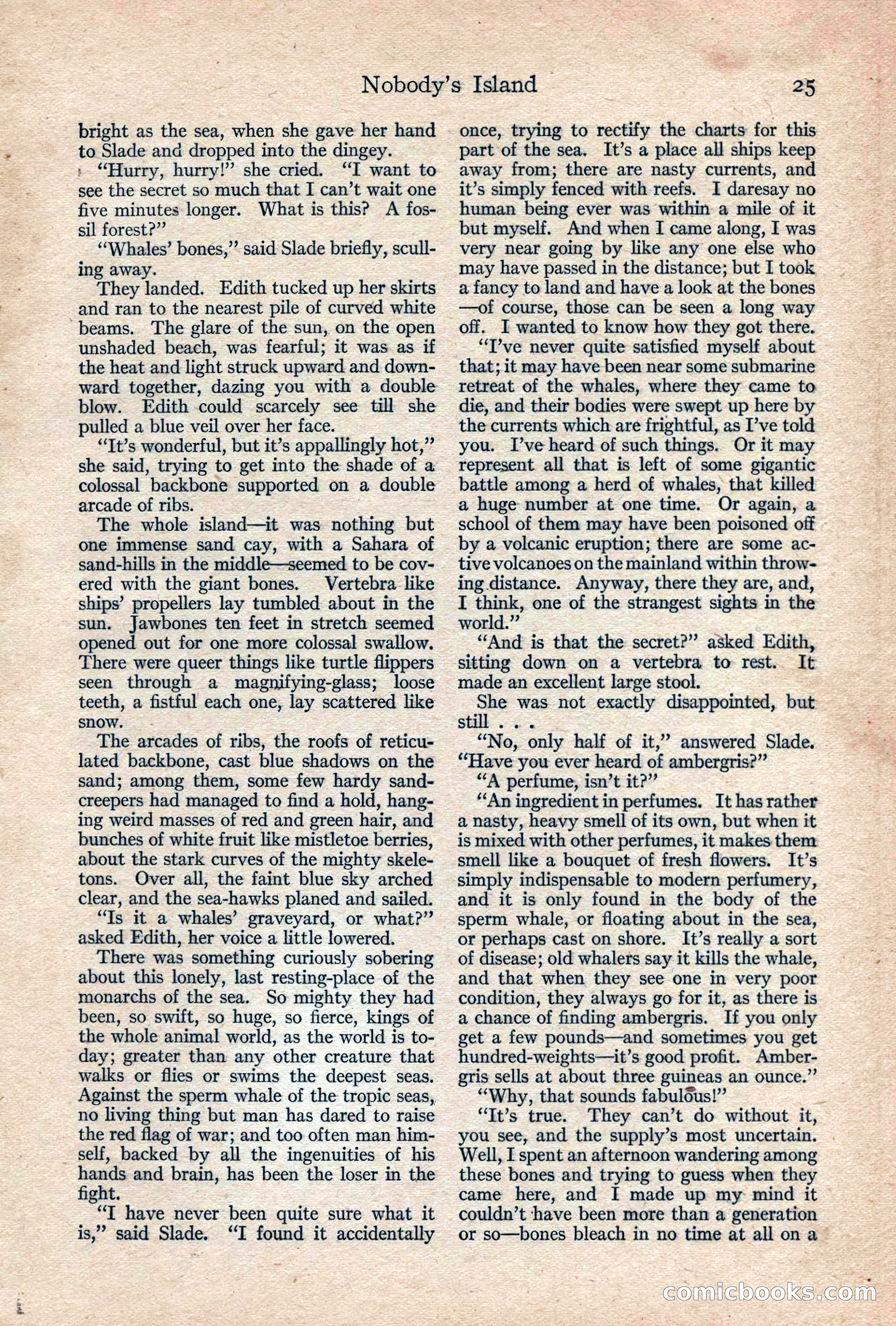
A restored page from Pulp Fiction, 1917. Page through the whole issue in the reader above.
📄 Transcribed text from this page (OCR, searchable)
Machine-transcribed from the original scan — historical spelling and the odd misread are preserved.
Nobody’s Island © bright as the sea, when she gave her hand to Slade and dropped into the dingey. + “Hurry, hurry!”’ she cried. “I want to see the secret so much that I can’t wait one five minutes longer. What is this? A fos- sil forest?” ‘Whales’ bones,’’ said Slade briefly, scull- ing away They jended. Edith tucked up her skirts and ran to the nearest pile of curved white beams. The glare of the sun, on the open unshaded beach, was fearful; it was as if the heat and light struck upward and down- ward together, dazing you with a double blow. Edith could scarcely see till she pulled a blue veil over her face. “Tt’s wonderful, but it’s appallingly hot,” she said, trying to get into the shade of a colossal backbone supported on a double arcade of ribs. The whole island—it was nothing but one immense sand cay, with a Sahara of sand-hills in the middle—seemed to be cov- ered with the giant bones. Vertebra like ships’ propellers lay tumbled about in the sun. Jawbones ten feet in stretch seemed opened out for one more colossal swallow. There were queer things like turtle flippers seen through a magnifying-glass; loose teeth, a fistful each one, lay scattered like snow. | The arcades of ribs, the roofs of reticu- lated backbone, cast blue shadows on the sand; among them, some few hardy sand- creepers had managed to find a hold, hang- ing weird masses of red and green hair, and bunches of white fruit like mistletoe berries, about the stark curves of the mighty skele- tons. Over all, the faint blue sky arched clear, and the sea-hawks planed and sailed. “Ts it a whales’ graveyard, or what?” asked Edith, her voice a little lowered. There was something curiously sobering about this lonely, last resting-place of the monarchs of the sea. So mighty they had been, so swift, so huge, so fierce, kings of the whole animal world, as the world is to- day; greater than any other creature that walks or flies or swims the deepest seas. Against the sperm whale of the tropic seas, no living thing but man has dared to raise the red flag of war; and too often man him- self, backed by all the ingenuities of his hands and brain, has been the loser in the fight. “T have never been quite sure what it is,” said Slade. “I found it accidentally 25 once, trying to rectify the charts for this part of the sea. It’s a place all ships keep away from; there are nasty currents, and it’s simply fenced with reefs. I daresay no human being ever was within a mile of it but myself. And when I came along, I was very near going by like any one else who may have passed in the distance; but I took a fancy to land and have a look at the bones —of course, those can be seen a long way off. I wanted to know how they got there. “T’ve never quite satisfied myself about that; it may have been near some submarine retreat of the whales, where they came to die, and their bodies were swept up here by the currents which are frightful, as I’ve told you. I’ve heard of such things. Or it may represent all that is left of some gigantic battle among a herd of whales, that killed a huge number at one time. Or again, a school of them may have been poisoned off - by a volcanic eruption; there are some ac- tive volcanoes on the mainland within throw- ing distance. Anyway, there they are, and, I think, one of the strangest sights in the world.” “And is that the secret?” asked Edith, sitting down on a vertebra to rest. It made an excellent large stool. She was not exactly disappointed, but “No, only half of it,’ answered Slade. “Have you ever heard of ambergris?” ““A perfume, isn’t it?” ‘An ingredient in perfumes. It has rather a nasty, heavy smell of its own, but when it is mixed with other perfumes, it makes them smell like a bouquet of fresh flowers. It’s simply indispensable to modern perfumery, and it is only found in the body of the sperm whale, or floating about in the sea, or perhaps cast on shore. It’s really a sort of disease; old whalers say it kills the whale, and that when they see one in very poor condition, they always go for it, as there is a chance of finding ambergris. If you only get a few pounds—and sometimes you get hundred-weights—it’s good profit. Amber- gris sells at about three guineas an ounce.’ “Why, that sounds fabuldus!”’ “it’s. true. you see, and the supply’s most uncertain. Well, I spent an afternoon wandering among these bones and trying to guess when they came here, and I made up my mind it couldn’t ‘have been more than a generation They can’t do without it, or so—bones bleach in no time at all on a (CO) JOOKS con AAI