
Pulp Fiction, 1917 · page 222 of 228
Adventure, February 1917 — page 222: what you’re looking at
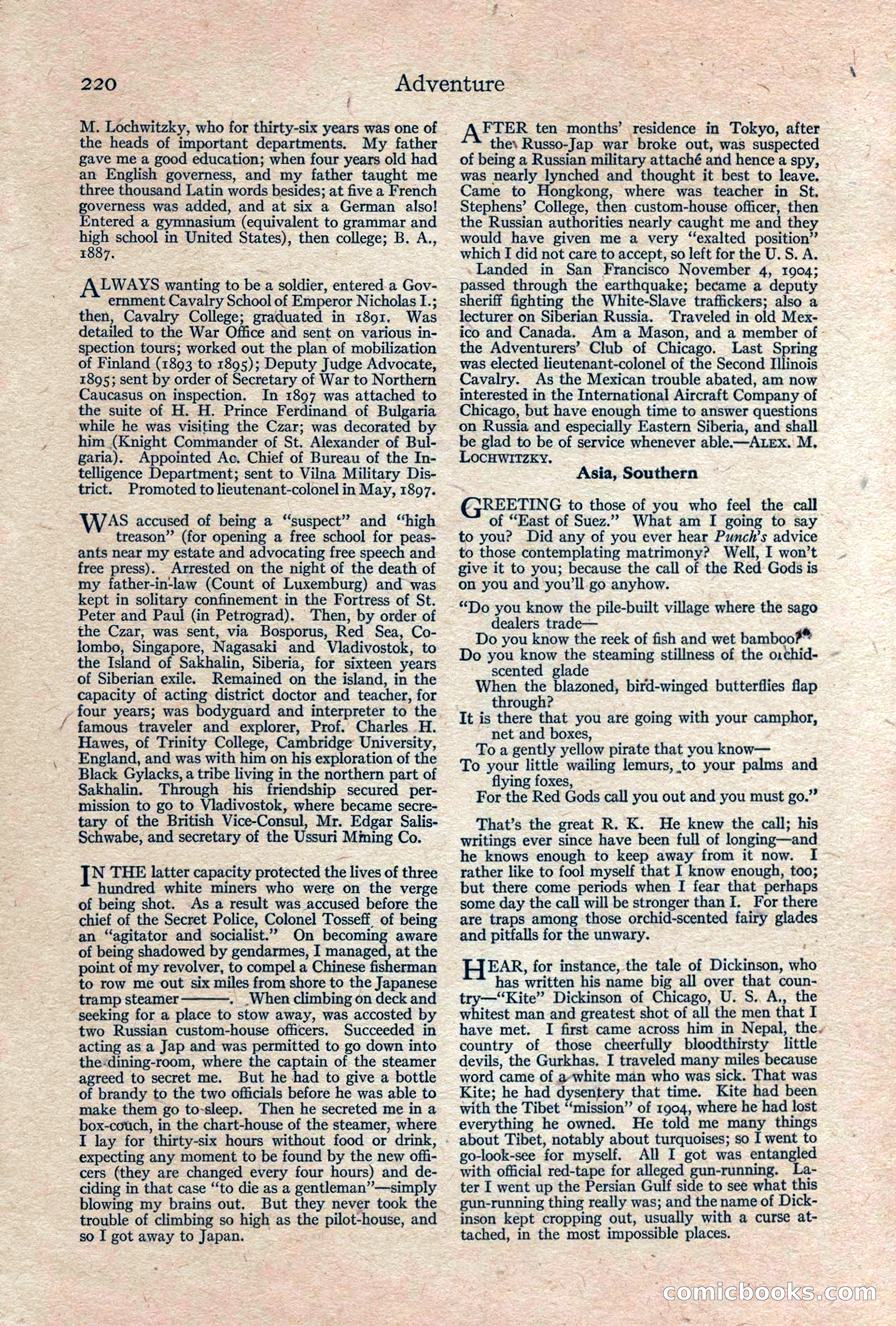
A restored page from Pulp Fiction, 1917. Page through the whole issue in the reader above.
📄 Transcribed text from this page (OCR, searchable)
Machine-transcribed from the original scan — historical spelling and the odd misread are preserved.
220 ; M. Lochwitzky, who for thirty-six years was one of the heads of important departments. My father gave me a good education; when four years old had an English governess, and my father taught me three thousand Latin words besides; at five a French governess was added, and at six a German also! Entered a gymnasium (equivalent to grammar and high school in United States), then college; B. A., 1887, LWAYS wanting to be a soldier, entered a Gov- ernment Cavalry School of Emperor Nicholas I.; then, Cavalry College; graduated in 1891. Was detailed to the War Office and sent on various in- spection tours; worked out the plan of mobilization of Finland (1893 to 1895); Deputy Judge Advocate, 1895; sent by order of Secretary of War to Northern Caucasus on inspection. In 1897 was attached to the suite of H. H. Prince Ferdinand of Bulgaria while he was visiting the Czar; was decorated by him (Knight Commander of St. Alexander of Bul- garia). Appointed Ac. Chief of Bureau of the In- telligence Department; sent to Vilna Military Dis- trict. Promoted to lieutenant-colonel in May, 1897. AS accused of being a “suspect” and “high treason” (for opening a free school for peas- ants near my estate and advocating free speech and - free press). Arrested on the night of the death of my father-in-law (Count of Luxemburg) and was kept in solitary confinement in the Fortress of St. Peter and Paul (in Petrograd). Then, by order of the Czar, was sent, via Bosporus, Red Sea, Co- lombo, Singapore, Nagasaki and Vladivostok, to the Island of Sakhalin, Siberia, for sixteen years of Siberian exile. Remained on the island, in the capacity of acting district doctor and teacher, for -four years; was bodyguard and interpreter to the ‘ famous traveler and explorer, Prof. Charles H. Hawes, of Trinity College, Cambridge University, _ England, and was with him on his exploration of the Black Gylacks, a tribe living in the northern part of Sakhalin. Through his friendship secured per- mission to go to Vladivostok, where became secre- tary of the British Vice-Consul, Mr. Edgar Salis- Schwabe, and secretary of the Ussuri Mming Co. JN THE latter capacity protected the lives of three hundred white miners who were on the verge of being shot. As a result was accused before the chief of the Secret Police, Colonel Tosseff, of being an “agitator and socialist.”” On becoming aware of being shadowed by gendarmes, I managed, at the point of my revolver, to compel a Chinese fisherman to row me out six miles from shore to the Japanese tramp steamer . .When climbing on deck and seeking for a place to stow away, was accosted by two Russian custom-house officers. Succeeded in acting as a Jap and was permitted to go down into the:dining-room, where the captain of the steamer agreed to secret me. But he had to give a bottle of brandy to the two officials before he was able to make them go to-sleep. Then he secreted me in a box-couch, in the chart-house of the steamer, where I lay for thirty-six hours without food or drink, - expecting any moment to be found by the new offi- cers (they are changed every four hours) and de- ciding in that case “‘to die as a gentleman”—simply blowing my brains out. But they never took the trouble of climbing so high as the pilot-house, and so I got away to Japan. | Adventure | | Ses AFTER ten months’ residence in Tokyo, after thes Russo-Jap war broke out, was suspected of being a Russian military attaché and hence a spy, was nearly lynched and thought it best to leave. Came to Hongkong, where was teacher in St. Stephens’ College, then custom-house officer, then the Russian authorities nearly caught me and they would have given me a very “exalted position” which I did not care to accept, so left for the U.S. A. Landed in San Francisco November 4, 1904; passed through the earthquake; became a deputy sheriff fighting the White-Slave traffickers; also a lecturer on Siberian Russia. Traveled in old Mex- ico and Canada. Am a Mason, and a member of - the Adventurers’ Club of Chicago. Last Spring was elected lieutenant-colonel of the Second Illinois Cavalry. As the Mexican trouble abated, am now interested in the International Aircraft Company of Chicago, but have enough time to answer questions on Russia and especially Eastern Siberia, and shall be glad to be of service whenever able.-—ALEx. M, LocHWITZKY. Asia, Southern €jREETING to those of you who feel the call of “East of Suez.” What am I going to say to you? Did any of you ever hear Punch’s advice to those contemplating matrimony? Well, I won’t give it to you; because the call of the Red Gods is on you and you'll go anyhow. “Do you know the pile-built village where the sago dealers trade— Do you know the reek of fish and wet bamboo#™ Do you know the steaming stillness of the o:chid- scented glade When the blazoned, bird-winged butterflies flap through? It is there that you are going with your camphor, net and boxes, To a gently yellow pirate that you know— To your little wailing lemurs, to your palms and flying foxes, : For the Red Gods call you out and you must go.” That’s the great R. K. He knew the call; his writings ever since have been full of longing—and he knows enough to keep away from it now. rather like to fool myself that I know enough, too; but there come periods when I fear that perhaps some day the call will be stronger than I. For there are traps among those orchid-scented fairy glades and pitfalls for the unwary. ie HEAR, for instance, the tale of Dickinson, who has written his name big all over that coun- try—‘‘Kite” Dickinson of Chicago, U. S. A., the whitest man and greatest shot of all the men that I have met. I first came across him in Nepal, the. country of those cheerfully bloodthirsty little devils, the Gurkhas, I traveled many miles because word came of a-white man who was sick. That was Kite; he had dysentery that time. Kite had been with the Tibet “mission” of 1904, where he had lost everything he owned. He told me many things about Tibet, notably about turquoises; so I went to go-look-see for myself. All I got was entangled with official red-tape for alleged gun-running. La- ter I went up the Persian Gulf side to see what this gun-running thing really was; and the name of Dick- inson kept cropping out, usually with a curse at- tached, in the most impossible places. nNichbook (G (E©) eC) ~