
Pulp Fiction, 1917 · page 214 of 228
Adventure, February 1917 — page 214: what you’re looking at
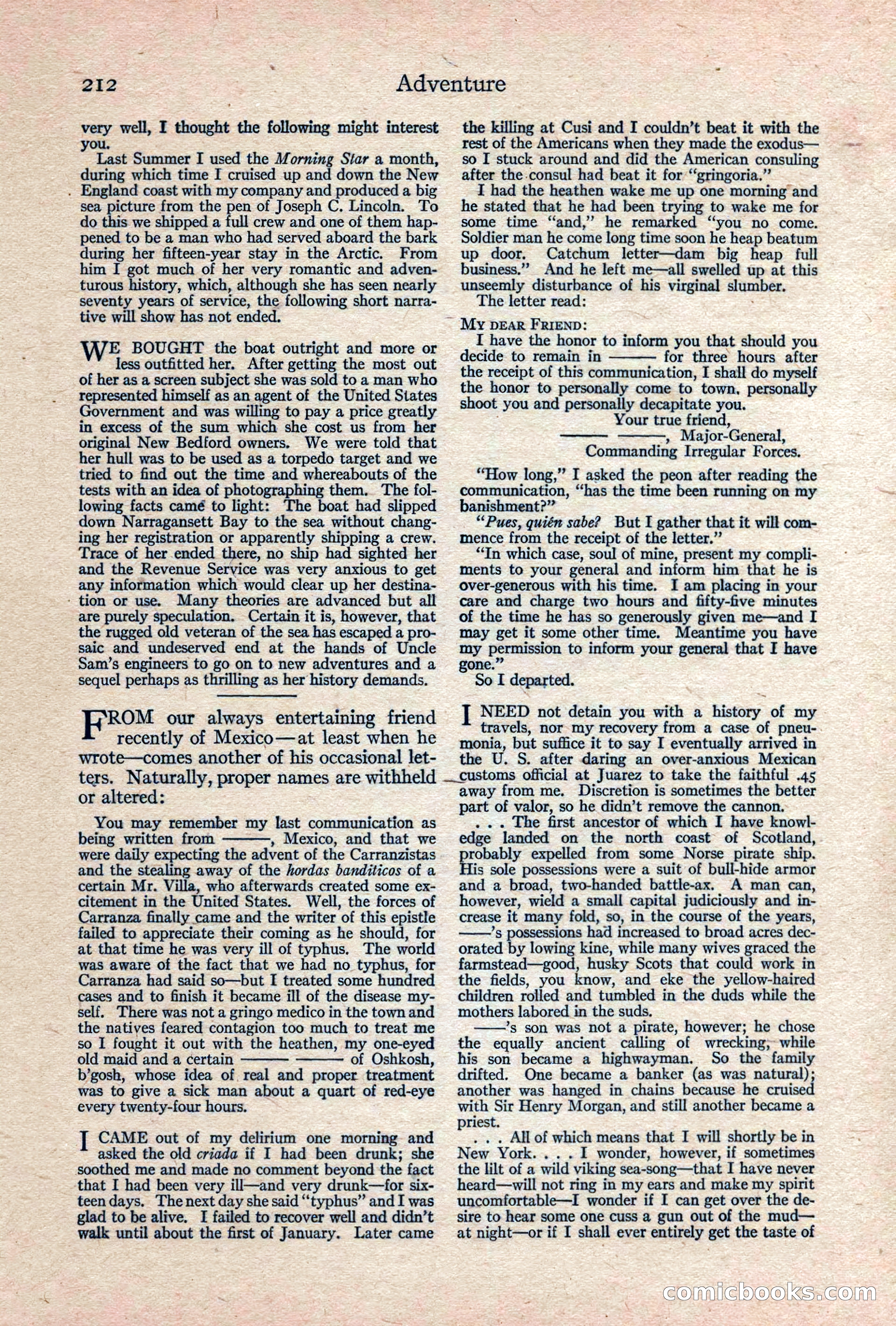
A restored page from Pulp Fiction, 1917. Page through the whole issue in the reader above.
📄 Transcribed text from this page (OCR, searchable)
Machine-transcribed from the original scan — historical spelling and the odd misread are preserved.
212 very well, I thought the following might interest you. Last Summer I used the Morning Star a month, during which time I cruised up and down the New . England coast with my company and produced a big sea picture from the pen of Joseph C. Lincoln. To do this we shipped a full crew and one of them hap- pened to be a man who had served aboard the bark during her fifteen-year stay in the Arctic. From him I got much of her very romantic and adven- turous history, which, although she has seen nearly seventy years of service, the following short narra- tive will show has not ended. WE BOUGHT the boat outright and more or less outfitted her. After getting the most out of her as a screen subject she was sold to a man who represented himself as an agent of the United States Government and was willing to pay a price greatly in excess of the sum which she cost us from her original New Bedford owners. We were told that her hull was to be used as a torpedo target and we tried to find out the time and whereabouts of the tests with an idea of photographing them. The fol- lowing facts camé to light: The boat had slipped down Narragansett Bay to the sea without chang- ing her registration or apparently shipping a crew. Trace of her ended there, no ship had sighted her and the Revenue Service was very anxious to get any information which would clear up her destina- ' tion or use. Many theories are advanced but all are purely speculation. Certain it is, however, that the peed old veteran of the sea has escaped a pro- saic and undeserved end at the panaie of Uncle Sam’s engineers to go on to new adventures and a sequel perhaps as thrilling as her history demands. PeRoM our always entertaining friend recently of Mexico—at least when he wrote—comes another of his occasional let- ters. Naturally, proper names are withheld or altered: You may remember my last communication as being written from , Mexico, and that we were daily expecting the advent of the Carranzistas and the sealing away of the hordas banditicos of a certain Mr. Villa, who afterwards created some ex- citement in the United States. Well, the forces of Carranza finally came and the writer of this epistle failed to appreciate their coming as he should, for at that time he was very ill of typhus. The world was aware of the fact that we had no typhus, for Carranza had said so—but I treated some hundred cases and to finish it became ill of the disease my- self. There was not a gringo medico in the town and the natives feared contagion too much to treat me so I fought it out with the heathen, my one-eyed old maid and a certain of Oshkosh, b’gosh, whose idea of real and proper treatment was to give a sick man about a quart of red-eye every twenty-four hours. i CAME out of my delirium one morning and asked the old criada if I had been drunk; she soothed me and made no comment beyond the fact that I had been very ill—and very drunk—for six- teen days. The next day she said “typhus” and I was glad to be alive. I failed to recover well and didn’t walk until about the first of January. Later came Adventure the killing at Cusi and I couldn’t beat it with the rest of the Americans when they made the exodus— so I stuck around and did the American consuling after the consul had beat it for “gringoria.”’ [ had the heathen wake me up one morning and he stated that he had been trying to wake me for some time “and,” he remarked “you no come. Soldier man he come long time soon he heap beatum up door. Catchum letter—dam big heap full business.” And he left me—all swelled up at this unseemly disturbance of his virginal slumber. The letter read: _ My DEAR FRIEND: I have the honor to inform you that should you decide to remain in for three hours after the receipt of this communication, I shall do myself the honor to personally come to town, personally shoot you and personally decapitate you. Your true friend, . Major-General, Commanding Irregular Forces. “How long,” I asked the peon after reading the communication, “has the time been running on my banishment?” “Pues, quién sabe? But I gather that it will com- mence from the receipt of the letter.” “In which case, soul of mine, present my compli- ments to your general and inform him that he is over-generous with his time. I am placing in your care and charge two hours and fifty-five minutes of the time he has so generously given me—and I may get it some other time. Meantime you have ~ 5 Segre to inform your general that I have oo departed. I NEED not detain you with a history of my travels, nor my recovery from a case of pneu- monia, but suffice it to say I eventually arrived in the U. S. after daring an over-anxious Mexican __ customs official at Juarez to take the faithful .45 away from me. Discretion is sometimes the better part of valor, so he didn’t remove the cannon. . .. The first ancestor of which I have knowl- edge landed on the north coast of Scotland, obably expelled from some Norse pirate ship. Fis sole possessions were a suit of bull-hide armor and a broad, two-handed battle-ax. A man can, however, wield a small capital judiciously and in- crease it many fold, so, in the course of the years, ——’s possessions had increased to broad acres dec- orated by lowing kine, while many wives graced the farmstead—good, husky Scots that could work in the fields, you know, and eke the yellow-haired children rolied and tumbled in the duds while the mothers labored in the suds. ——’s son was not a pirate, however; he chose the equally ancient calling of wrecking; while his son became a highwayman. So the family drifted. One became a banker (as was natural); another was hanged in chains because he cruised with ties Henry Morgan, and still another became a riest. e . All of which means that I will shortly be in New Vork. . I wonder, however, if sometimes the lilt of a wild viking sea-song—that I have never heard—will not ring in my ears and make my spirit uncomfortable—I wonder if I can get over the de- sire to hear some one cuss a gun out of the mud— at night—or if I shall ever entirely get the taste of 9)(0)(6) m S (E©) i