
Pulp Fiction, 1917 · page 209 of 228
Adventure, February 1917 — page 209: what you’re looking at
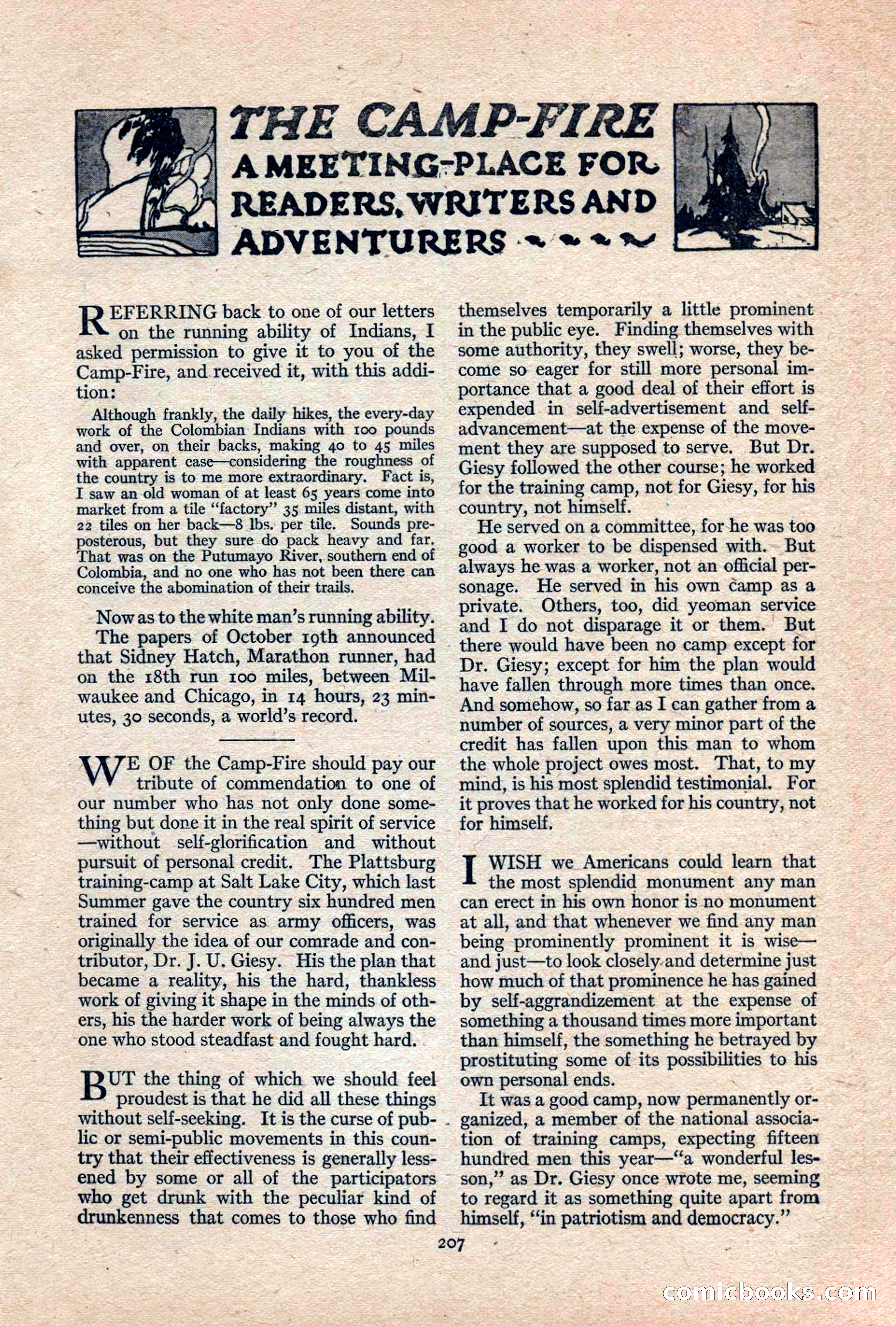
A restored page from Pulp Fiction, 1917. Page through the whole issue in the reader above.
📄 Transcribed text from this page (OCR, searchable)
Machine-transcribed from the original scan — historical spelling and the odd misread are preserved.
EFERRING back to one of our letters on the running ability of Indians, I asked permission to give it to you of the Camp-Fire, and received it, with this addi- tion: Although frankly, the daily hikes, the every-day work of the Colombian Indians with too pounds and over, on their backs, making 40 to 45 miles with apparent ease—considering the roughness of the country is to me more extrao . Fact is, I saw an old woman of at least 65 years come into market from a tile “factory” 35 miles distant, with 22 tiles on her back—8 Ibs. per tile. Sounds pre- posterous, but they sure do pack heavy and far. That was on the Putumayo River, southern end of Colombia, and no one who has not been there can conceive the abomination of their trails. -Nowas to the white man’s running ability. The papers of October 19th announced that Sidney Hatch, Marathon runner, had on the 18th run 100 miles, between Mil- waukee and Chicago, in 14 hours, 23 min- utes, 30 seconds, a world’s record. 3 WE OF the Camp-Fire should pay our tribute of commendation to one of our number who has not only done some- thing but done it in the real spirit of service —without self-glorification and without pursuit of personal credit. The Plattsburg training-camp at Salt Lake City, which last Summer gave the country six hundred men trained for service as army officers, was originally the idea of our comrade and con- tributor, Dr. J. U. Giesy. His the plan that became a reality, his the hard, thankless work of giving it shape in the minds of oth- ers, his the harder work of being always the ‘one who stood steadfast and fought hard. UT the thing of which we should feel proudest is that he did all these things without self-seeking. It is the curse of pub- lic or semi-public movements in this coun- try that their effectiveness is generally less- ened by some or all of the participators who get drunk with the peculiar kind of drunkenness that comes to those who find 1THE CAMP-FIRE j) A MEETING:PLACE FOR. | WRITERS AND | ADVENTURERS ee <a. Sa + themselves temporarily a little prominent _ in the public eye. Finding themselves with some authority, they swell; worse, they be- come so eager for still more personal im- portance that a good deal of their effort is expended in self-advertisement and self- advancement—at the expense of the move- ment they are supposed to serve. But Dr. Giesy followed the other course; he worked for the training camp, not for Giesy, for his country, not himself. He served on a committee, for he was too good a worker to be dispensed with. But always he was a worker, not an official per- sonage. He served in his own Camp as a private. Others, too, did yeoman service and I do not disparage it or them. But there would have been no camp except for Dr. Giesy; except for him the plan would have fallen through more times than once. And somehow, so far as I can gather from a number of sources, a very minor part of the credit has fallen upon this man to whom the whole project owes most. That, to my mind, is his most splendid testimonial. For it proves that he worked for his country, not - for himself, WISH we Americans could learn that the most splendid monument any man can erect in his own honor is no monument at all, and that whenever we find any man being prominently prominent it is wise— and just—to look closely-and determine just how much of that prominence he has gained by self-aggrandizement at the expense of something a thousand times more important than himself, the something he betrayed by prostituting some of its possibilities to his own personal ends. It was a good camp, now permanently or- ganized, a member of the national associa- tion of training camps, expecting fifteen hundted men this year—“‘a wonderful les- son,’’ as Dr. Giesy once wrote me, seeming to regard it as something quite apart from himself, ‘in patriotism and democracy.” 207. - JOOK (E@)