
Pulp Fiction, 1917 · page 205 of 228
Adventure, February 1917 — page 205: what you’re looking at
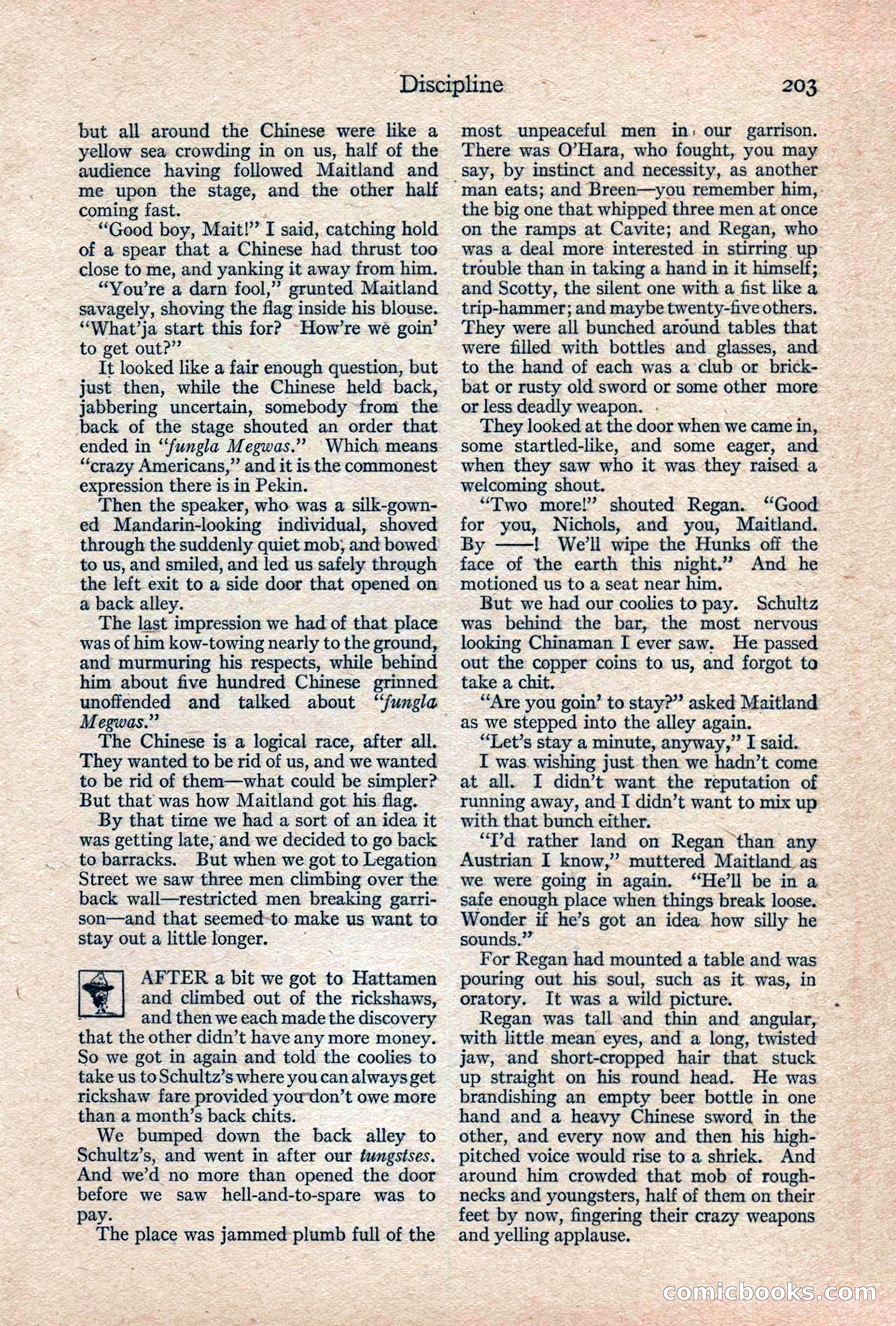
A restored page from Pulp Fiction, 1917. Page through the whole issue in the reader above.
📄 Transcribed text from this page (OCR, searchable)
Machine-transcribed from the original scan — historical spelling and the odd misread are preserved.
‘Discipline but all around the Chinese were like a yellow sea crowding in on us, half of the audience having followed Maitland and me upon the stage, and the other half coming fast. ~“Good boy, Mait!’’ I said, catching hold of a spear that a Chinese had thrust too close to me, and yanking it away from him. “You’re a darn fool,” grunted Maitland savagely, shoving the flag inside his blouse. “What’ja start this for? ~How’re we goin’ to get out?” It looked like a ba enough question, but just then, while the Chinese held back, jabbering uncertain, somebody from the back of the stage shouted an order that ended in ‘‘fungla Megwas.”’ Which means “crazy Americans,” and it is the commonest expression there is in Pekin. Then the speaker, who was a silk-gown- ed Mandarin-looking individual, shoved through the suddenly quiet mob; and bowed to us, and smiled, and led us safely through the left exit to a side door that opened on a back alley. The last impression we had of that place was of him kow-towing nearly to the ground, and murmuring his respects, while behind him about five hundred Chinese grinned unoffended and talked about ‘“fungla Megwas The he Chinese i is a logical race, after all. They wanted to be rid of us, and we wanted to be rid of them—what could be simpler? But that was how Maitland got his flag. By that time we had a sort of an idea it was getting late, and we decided to go back to barracks. But when we got to Legation Street we saw three men climbing over the back wall—restricted men breaking garri- son—and that seemed-to make us want to stay out a little longer. AFTER a bit we got to Hattamen and climbed out of the rickshaws, and then we each made the discovery that the other didn’t have any more money. So we got in again and told the coolies to take us toSchultz’s where you can always get rickshaw fare provided youdon’t owe more than a month’s back chits. We bumped down the back alley to Schultz’s, and went in after our fungstses. And we’d no more than opened the door before we saw hell-and-to-spare was to pay. The place was jammed plumb full of the most unpeaceful men in: our garrison. There was O’Hara, who fought, you may say, by instinct and necessity, as another “man eats; and Breen—you remember him, : the big one that whipped three men at once on the ramps at Cavite; and Regan, who was a deal more interested in stirring up trouble than in taking a hand in it himself; and Scotty, the silent one with a fist like a trip-hammer; and maybe twenty-five others. They were all bunched around tables that were filled with bottles and glasses, and to the hand of each was a club or brick- bat or rusty old sword or some other more or less deadly weapon. . They looked at the door when we came in, some startled-like, and some eager, and when they saw who it was they raised a welcoming shout. “Two more!” shouted Regan. “Good for you, Nichols, and you, Maitland. By ——! We’ll wipe the Hunks off the face of the earth this night.” And he motioned us to a seat near him. But we had our coolies to pay. Schultz was behind the bar, the most nervous looking Chinaman I ever saw. He passed out the copper coins to us, and forgot ta take a chit. 203 “Are you goin’ to stay?” asked Maitland eo _ as we stepped into the alley again. “Let’s stay a minute, anyway,” I said. I was. wishing just then we hadn’t come at all. I didn’t want the reputation of running away, and I didn’t want to mix up with that bunch either. “T’d rather land on Regan ‘than any Austrian I know,” muttered Maitland as we were going in again. “He’ll be in a safe enough place when things break loose. Wonder if he’s got an ideas how silly he sounds.” For Regan had mounted a table and was pouring out his soul, such as it was, in oratory. It was a wild picture. Regan was tall and thin and angular, with little mean eyes, and a long, twisted jaw, and short-cropped hair that stuck up straight on his round head. He was brandishing an empty beer bottle in one hand and a heavy Chinese sword in the other, and every now and then his high- pitched voice would rise to a shriek. And around him crowded that mob of rough- necks and youngsters, half of them on their feet by now, fingering their crazy weapons and yelling applause. COPNIGLOOOL< (E©)