
Pulp Fiction, 1917 · page 18 of 228
Adventure, February 1917 — page 18: what you’re looking at
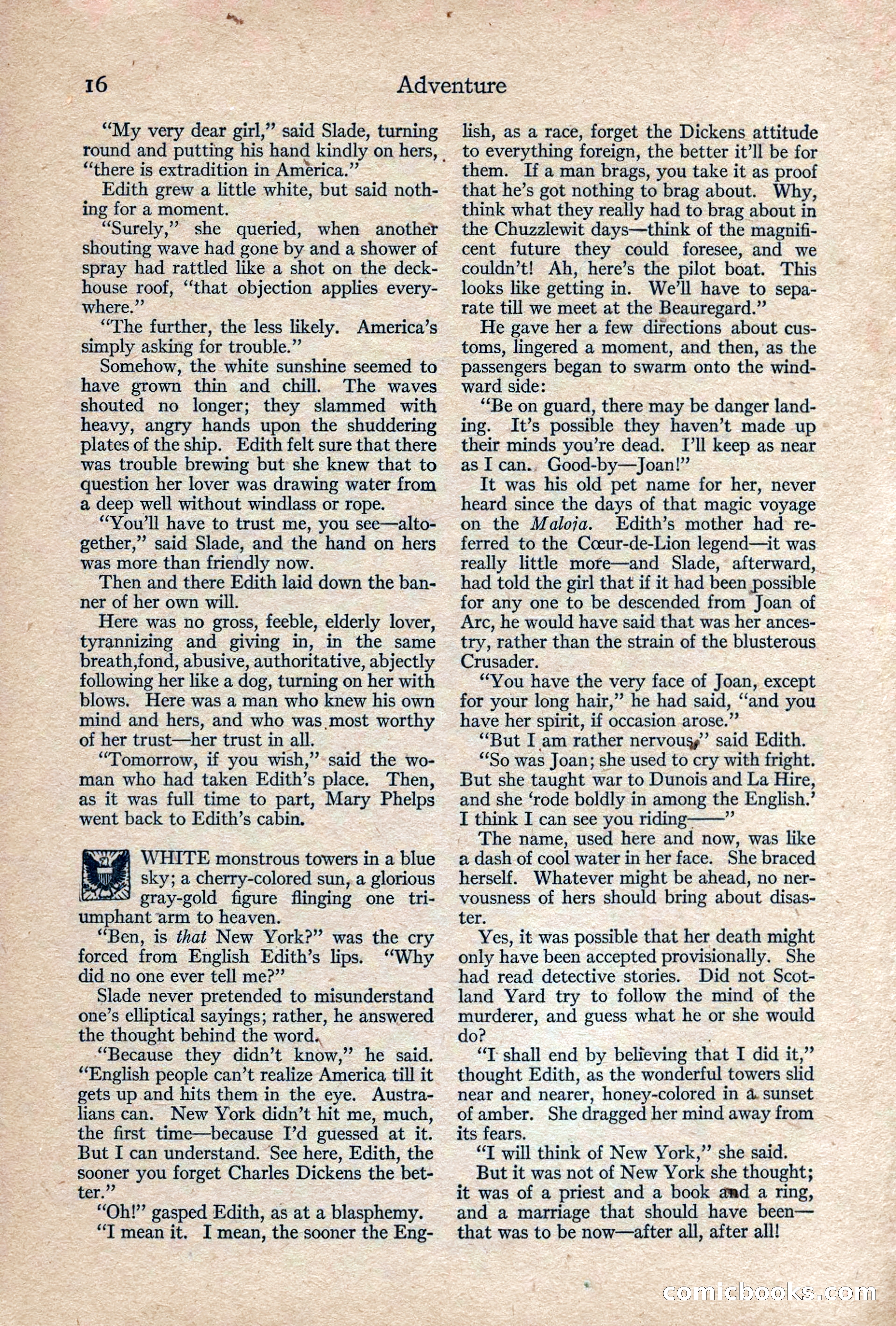
A restored page from Pulp Fiction, 1917. Page through the whole issue in the reader above.
📄 Transcribed text from this page (OCR, searchable)
Machine-transcribed from the original scan — historical spelling and the odd misread are preserved.
16 “My very dear girl,” said Slade, turning round and putting his hand kindly on hers, - “there is extradition in America.” Edith grew a little white, but said noth- ing for a moment. “Surely,” she queried, when another shouting wave had gone by and a shower of spray had rattled like a shot on the deck- house roof, ‘‘that objection applies every- where.” “The further, the less likely. America’s simply asking for trouble.” Somehow, the white sunshine seemed to have grown thin and chill. The waves shouted no longer; they slammed with heavy, angry hands upon the shuddering plates of the ship. Edith felt sure that there was trouble brewing but she knew that to question her lover was drawing water from a deep well without windlass or rope. “You'll have to trust me, you see—alto- gether,” said Slade, and the hand on hers was more than friendly now. Then and there Edith laid down the ban- ner of her own will. Here was no gross, feeble, elderly lover, tyrannizing and giving in, in the same breath,fond, abusive, authoritative, abjectly following her like a dog, turning on her with blows. Here was a man who knew his own mind and hers, and who was most worthy of her trust—her trust in all. “Tomorrow, if you wish,’’«said the wo- man who had taken Edith’s place. Then, as it was full time to part, Mary Phelps _ went back to Edith’s cabin. Rid WHITE monstrous towers in a blue MW; 3 sky; a cherry-colored sun, a glorious (QS gray-gold figure flinging one tri- umphant arm to heaven. “Ben, is that New York?” was the cry forced from English Edith’s lips; ‘Why - did no one ever tell me?” Slade never pretended to misunderstand one’s elliptical sayings; rather, he answered the thought behind the word. “Because they didn’t know,” he said. “English people can’t realize America till it gets up and hits them in the eye. Austra- lians can. New York didn’t hit me, much, the first time—because I’d guessed at it. But I can understand. See here, Edith, the sooner you forget Charles Dickens the bet- ter,” “Oh!”’ gasped Edith, as at a blasphemy. “T mean it. I mean, the sooner the Eng- Adventure lish, as a race, forget the Dickens attitude to everything foreign, the better it’ll be for them. If a man brags, you take it as proof that he’s got nothing to brag about. Why, think what they really had to brag about in the Chuzzlewit days—think of the magnifi- cent future they could foresee, and we couldn’t! Ah, here’s the pilot boat. This looks like getting in. We'll have to sepa- rate till we meet at the Beauregard.” He gave her a few directions about cus- toms, lingered a moment, and then, as the passengers began to swarm onto the wind- ward side: “Be on guard, there may be danger land- ing. It’s possible they haven’t made up their minds you’re dead. I’ll keep as near as I can.. Good-by—Joan!” It was his old pet name for her, never heard since the days of that magic voyage on the Maloja. Edith’s mother had re- ferred to the Cceur-de-Lion legend—it was really little more—and Slade, afterward, had told the girl that if it had been possible for any one to be descended from Joan of Arc, he would have said that was her ances- try, rather than the strain of the blusterous Crusader. “Vou have the very face of Joan, except for your long hair,” he had said, “and you have her spirit, if occasion arose.” “But I am rather nervousy” said Edith. “‘So was Joan; she used to cry with fright. But she taught war to Dunois and La Hire, and she ‘rode boldly in among the English.’ I think I can see you riding——” The name, used here and now, was like a dash of cool water in her face. She braced herself. Whatever might be ahead, no ner- vousness of hers should bring about disas- ter. Yes, it was possible that her death might only have been accepted provisionally. She had read detective stories. Did not Scot- land Yard try to follow the mind of the murderer, and guess what he or she would do? “T shall end by believing that I did i? thought Edith, as the wonderful towers slid near and nearer, honey-colored in 4. sunset of amber. She dragged her mind away from . its fears. | “T will think of New York,’’ she said. But it was not of New York she thought; it was of a priest and a book and a ring, and a marriage that should have been— that was to be now—after all, after all! comichbook (C@