
Pulp Fiction, 1917 · page 165 of 228
Adventure, February 1917 — page 165: what you’re looking at
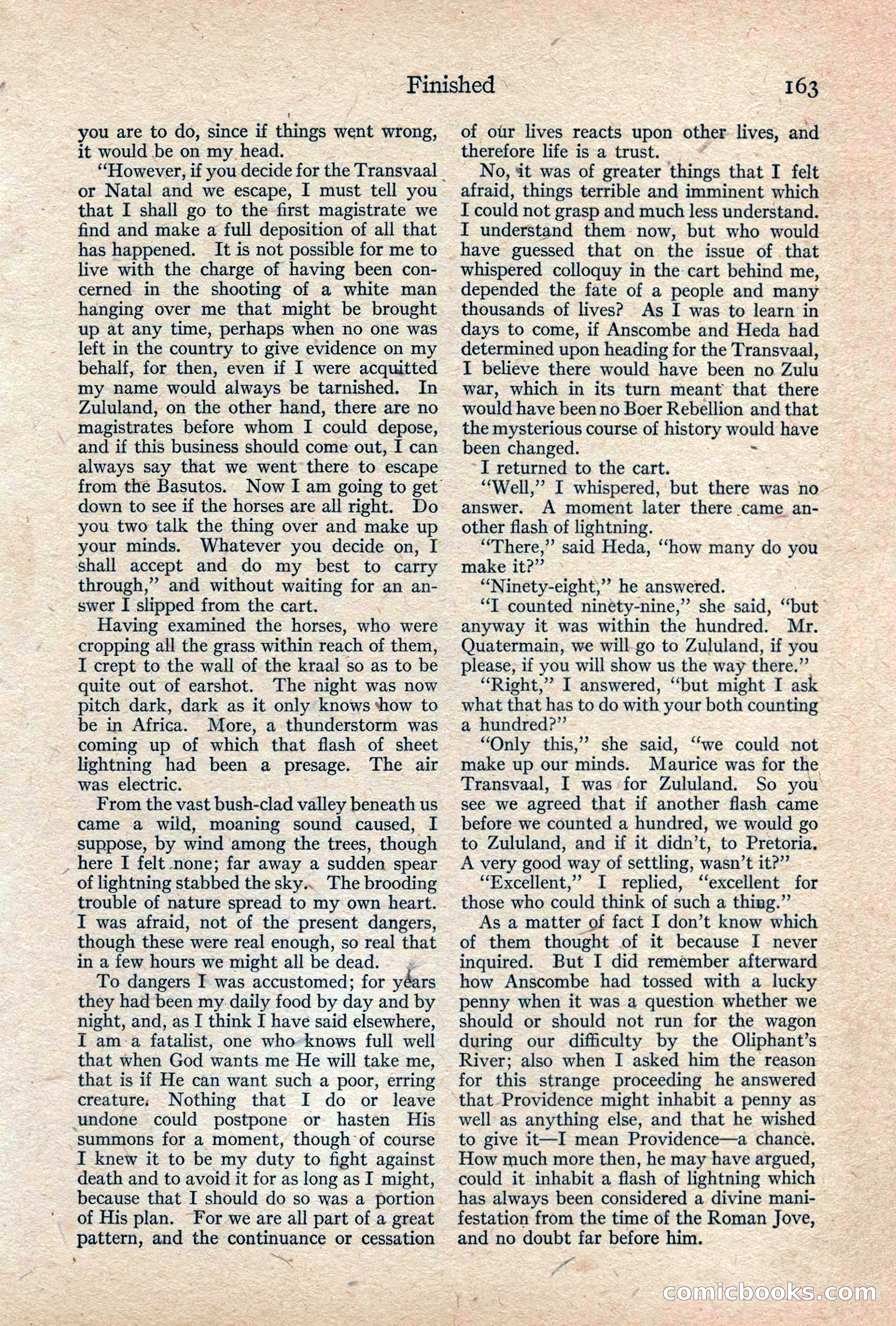
A restored page from Pulp Fiction, 1917. Page through the whole issue in the reader above.
📄 Transcribed text from this page (OCR, searchable)
Machine-transcribed from the original scan — historical spelling and the odd misread are preserved.
Finished © you are to do, since if things went wrong, it would be on my head. “However, if you decide for the Transvaal | or Natal and we escape, I must tell you that I shall go to the first magistrate we find and make a full deposition of all that has happened. It is not possible for me to live with the charge of having been con- cerned in the shooting of a white man hanging over me that might be brought up at any time, perhaps when no one was left in the country to give evidence on my behalf, for then, even if I were acquitted my name would always be tarnished. In Zululand, on the other hand, there are no magistrates before whom I could depose, and if this business should come out, I can always say that we went there to escape from the Basutos. down to see if the horses are all right. Do you two talk the thing over and make up your minds. Whatever you decide on, I shall accept and do my best to carry through,” and without waiting for an an- swer I slipped from the cart. Having examined the horses, who were cropping all the grass within reach of them, I crept to the wall of the kraal so as to be quite out of earshot. The night was now pitch dark, dark as it only knows show to be in Africa. More, a thunderstorm was coming up of which that flash of sheet lightning had been a presage. The air was electric. From the vast bush-clad valley beneath us came a wild, moaning sound caused, I suppose, by wind among the trees, though _ here I felt none; far away a sudden spear of lightning stabbed the sky.. The brooding trouble of nature spread to my own heart. I was afraid, not of the present dangers, though these were real enough, so real that in a few hours we might all be dead. To dangers I was accustomed; for yéars they had been my daily food by day and by night, and, as I think I have said elsewhere, I am-a fatalist, one who-knows full well that when God wants me He will take me, that is if He can want such a poor, erring creature. Nothing that I do or leave undone could postpone or hasten His summons for a moment, though of course I knew it to be my duty to fight against death and to avoid it for as long as I might, because that I should do so was a portion of His plan. For we are all part of a great pattern, and the continuance or cessation ™ ‘ “Se Now I am going to get of our lives reacts upon other ives and therefore life is a trust. No, it was of greater things that I felt 163° afraid, things terrible and imminent which | I could not grasp and much less understand. I understand them now, but who would have guessed that on the issue of that whispered colloquy in the cart behind me, depended the fate of a people and many thousands of lives? As I was to learn in days to come, if Anscombe and Heda had determined upon heading for the Transvaal, I believe there would have been no Zulu war, which in its turn meant that there would have been no Boer Rebellion and that the mysterious course of history would have been changed. ~I returned to the cart. “‘Well,’’ I whispered, but there was no~ answer. A moment later there came an- other flash of lightning. “There,” said Heda, “how many do you make it?” “Ninety-eight,” he answered. “T counted ninety-nine,” she said, “but anyway it was within the hundred. Mr. Quatermain, we will go to Zululand, if you please, if you will show us the way there.” “Right,” I answered, “but might I ask what that has to do with your both counting a hundred?” “Only this,’ she said, make up our minds. “we could not see we agreed that if another flash came before we counted a hundred, we would go to Zululand, and if it didn’t, to Pretoria. A very good way of settling, wasn’t it?” “Excellent,” I replied, “excellent for those who could think of such a thing.” As a matter of fact I don’t know which of them thought of it because I never inquired. But I did remember afterward how Anscombe had tossed with a lucky penny when it was a question whether we should or should not run for the wagon during our difficulty by the Oliphant’s River; also when I asked him the reason for this strange proceeding he answered that Providence might inhabit a penny as well as anything else, and that he wished to give it—I mean Providence—a chance. How much more then, he may have argued, could it inhabit a flash of lightning which has always been considered a divine mani- festation from the time of the Roman Jove, and no doubt far before him. (E) IOOkK mn Maurice was for the Transvaal, I was for Zululand. So you (EO) 3