
Pulp Fiction, 1917 · page 159 of 228
Adventure, February 1917 — page 159: what you’re looking at
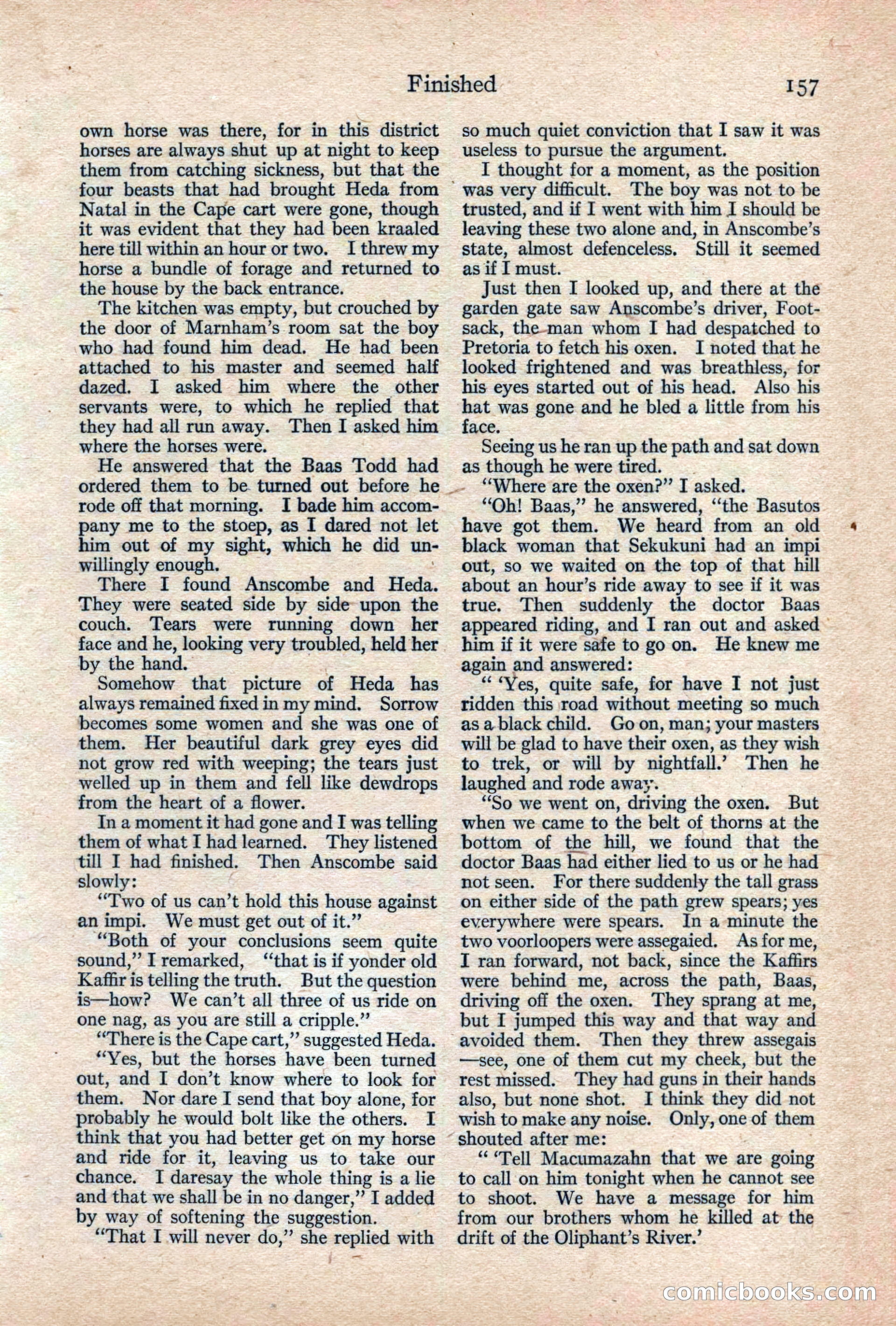
A restored page from Pulp Fiction, 1917. Page through the whole issue in the reader above.
📄 Transcribed text from this page (OCR, searchable)
Machine-transcribed from the original scan — historical spelling and the odd misread are preserved.
Finished. own horse was there, for in this district horses are always shut up at night to keep them from catching sickness, but that the four beasts that had brought Heda from Natal in the Cape cart were gone, though it was evident that they had been kraaled here till within an hour or two. I threw my horse a bundle of forage and returned to the house by the back entrance. The kitchen was empty, but crouched by the door of Marnham’s room sat the boy who had found him dead. He had been attached to his master and seemed half dazed. I asked him where the other servants were, to which he replied that they had all run away. Then I asked him where the horses were. He answered that the Baas Todd had ordered them to be turned out before he rode off that morning. I bade him accom- pany me to the stoep, as I dared not let him out of my sight, which he did un- willingly enough. There I found Anscombe and Heda. They were seated side by, side upon the couch. Tears were running down her face and he, looking very troubled, held her | by the hand. Somehow that picture of Heda has always remained fixedin my mind. Sorrow becomes some women and she was one of them. Her beautiful dark grey eyes did not grow red with weeping; the tears just welled up in them and fell like dewdrops from the heart of a flower. In a moment it had gone and I was telling them of what I had learned. They listened till I had finished. Then Anscombe said slowly: “Two of us can’t hold this house against animpi. We must get out of it.” “Both of your conclusions seem quite sound,’ ITremarked, “that is if yonder old Kaffir is telling the truth. But the question is—how? We can’t all three of us ride on one nag, as you are still a cripple.” “There is the Cape cart,”’ suggested Heda. “Yes, but the horses have been turned out, and I don’t know where to look for them. Nor dare I send that boy alone, for probably he would bolt like the others. I think that you had better get on my horse and ride for it, leaving us to take our chance. I daresay the whole thing is a lie and that we shall be in no danger,” I added by way of softening the suggestion. Be I will never do,” she replied with ? was very difficult. 157 so much quiet conviction that I saw it was useless to pursue the argument. I thought for a moment, as the position The boy was not to be trusted, and if I went with him I should be leaving these two alone and, in Anscombe’s state, almost defenceless. Still it seemed as if I must. Just then I looked up, and there at the garden gate saw Anscombe’s driver, Foot- sack, the-man whom I had despatched to Pretoria to fetch his oxen. I noted that he looked frightened and was breathless, for his eyes started out of his head. Also his hat was gone and he bled a little from his face. Seeing us he ran up the path and sat down as though he were tired. “Where are the oxen?” I asked. “Oh! Baas,” he answered, “‘the Basutos have got them. We heard from an old black woman that Sekukuni had an impi out, so we waited on the top of that hill about an hour’s ride away to see if it was true. Then suddenly the doctor Baas appeared riding, and I ran out and asked” him if it were safe to goon. He knew me again and answered: “Ves, quite safe, for have I not just ridden this road without meeting so much as a-black child. Goon, man; your masters will be glad to have their oxen, as they wish to trek, or will by nightfall. > Then he laughed and rode away. **So we went on, driving the oxen. But when we came to the belt of thorns at the bottom of the hill, we found that the doctor Baas had either lied to us or he had © not seen. For there suddenly the tall grass on either side of the path grew spears; yes everywhere were spears. In a minute the two voorloopers were assegaied. As for me, I ran forward, not back, since the Kaffirs were behind me, across the path, Baas, driving off the oxen. They sprang at me, but I jumped this way and that way and -avoided them. Then they threw assegais —see, one of them cut my cheek, but the rest missed. They had guns in their hands also, but none shot. I think they did not wish to make any noise. Only, one of them “shouted after me: “Tell Macumazahn that we are going to call on him tonight when he cannot see to shoot. We have a message for him from our brothers whom he killed at the drift of the Oliphant’s River.’ OOK COMUNE (E@)