
Pulp Fiction, 1917 · page 157 of 228
Adventure, February 1917 — page 157: what you’re looking at
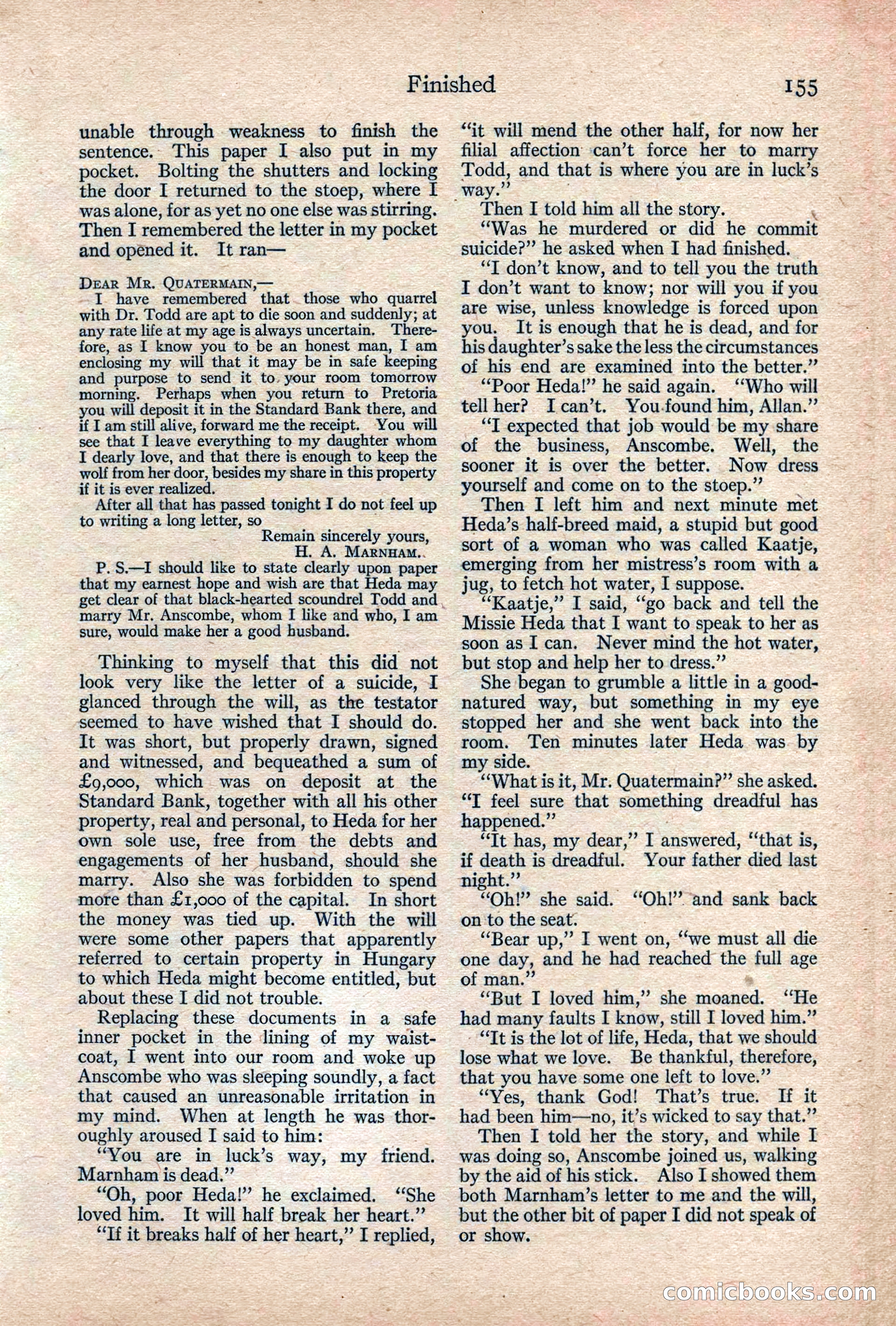
A restored page from Pulp Fiction, 1917. Page through the whole issue in the reader above.
📄 Transcribed text from this page (OCR, searchable)
Machine-transcribed from the original scan — historical spelling and the odd misread are preserved.
Finished unable through weakness to finish the sentence.. This paper I also put in my pocket. Bolting the shutters and locking the door I returned to the stoep, where I was alone, for as yet no one else was stirring. Then I remembered the letter in my pocket and opened it. It ran— DraR Mr. QUATERMAIN,— --I. have remembered that those who quarrel with Dr. Todd are apt to die soon and suddenly; at any rate life at my age is always uncertain, There- fore, as I know you to be an honest man, I am enclosing my will that it may be in safe keeping and purpose to send it to. your room tomorrow morning. Perhaps when you return to Pretoria you will deposit it in the Standard Bank there, and if I am still alive, forward me the receipt. You will see that I leave everything to my daughter whom I dearly love, and that there is enough to keep the wolf from her door, besides my share in this property if it is ever realized. After all that has passed tonight I do not feel up to writing a long letter, so 3 Remain sincerely yours, H. A. Marnuam.. P. S—I should like to state clearly upon paper that my earnest hope and wish are that Heda may get clear of that black-hearted scoundrel Todd and. marry Mr. Anscombe, whom I like and who, I am sure, would make her a good husband. Thinking to myself that this did not look very like the letter of a suicide, I glanced through the will, as the testator seemed to have wished that I should do. It was short, but properly drawn, signed and witnessed, and bequeathed a sum of £09,000, which was on deposit at the Standard Bank, together with all his other property, real and personal, to Heda for her own sole use, free from the debts and engagements of her husband, should she marry. Also she was forbidden to spend more than £1,000 of the capital. In short the money was tied up. With the will were some other papers that apparently referred to certain property in Hungary to which Heda might become entitled, but about these I did not trouble. Replacing these documents in a safe inner pocket in the lining of my waist- coat, I went into our room and woke up Anscombe who was sleeping soundly, a fact that caused an unreasonable irritation in my mind. When at length he was thor- oughly aroused I said to him: i “You are in luck’s way, my friend. Marnham is dead.” “Oh, poor Heda!” he exclaimed. ‘She loved him. It will half break her heart.” “If it breaks half of her heart,’’ I replied, 155 “it will mend the other half, for now her filial affection can’t force her to marry Todd, and that is where you are in luck’s way.” Then I told him all the story. ‘ “Was he murdered or did he commit suicide?”’ he asked when I had finished. | “T don’t know, and to tell you the truth I don’t want to know; nor will you if you are wise, unless knowledge is forced upon you. It is enough that he is dead, and for his daughter’s sake the less the circumstances of his end are examined into the better.” “Poor Heda!” he said again. ‘‘Who will tell her? Ican’t. You-found him, Allan.” “T expected that job would be my share of the business, Anscombe. Well, the sooner it is over the better. Now dress yourself and come on to the stoep.” Then I left him and next minute met Heda’s half-breed maid, a stupid but good sort of a woman who was called Kaatije, emerging from her mistress’s room with a jug, to fetch hot water, I suppose. ““Kaatje,” I said, “go back and tell the Missie Heda that I want to speak to her as soon as I can. Never mind the hot water, but stop and help her to dress.” She began to grumble a little in a good- natured way, but something in my eye stopped her and she went back into the room. Ten minutes later Heda was. by my side. ‘‘What is it, Mr. Quatermain?” she asked. “T feel sure that something dreadful has happened.” : “Tt has, my dear,” I answered, ‘“‘that is, if death is dreadful. Your father died last night.” “Oh!” she said. ‘Oh! and sank back on to the seat. : “Bear up,” I went on, ‘we must all die one day, and he had reached the full age of man.” ” “But I loved him,” she moaned. ‘He had many faults I know, still I loved him.” - “Tt is the lot of life, Heda, that we should lose what we love. Be thankful, therefore, that you have some one left to love.” “Ves, thank God! That’s true. [If it had been him—no, it’s wicked to say that.” Then I told her the story, and while I was doing so, Anscombe joined us, walking by the aid of his stick. Also I showed them both Marnham’s letter to me and the will, but the other bit of paper I did not speak of or show. (EO) o)(00)|\< (E@)