
Pulp Fiction, 1917 · page 152 of 228
Adventure, February 1917 — page 152: what you’re looking at
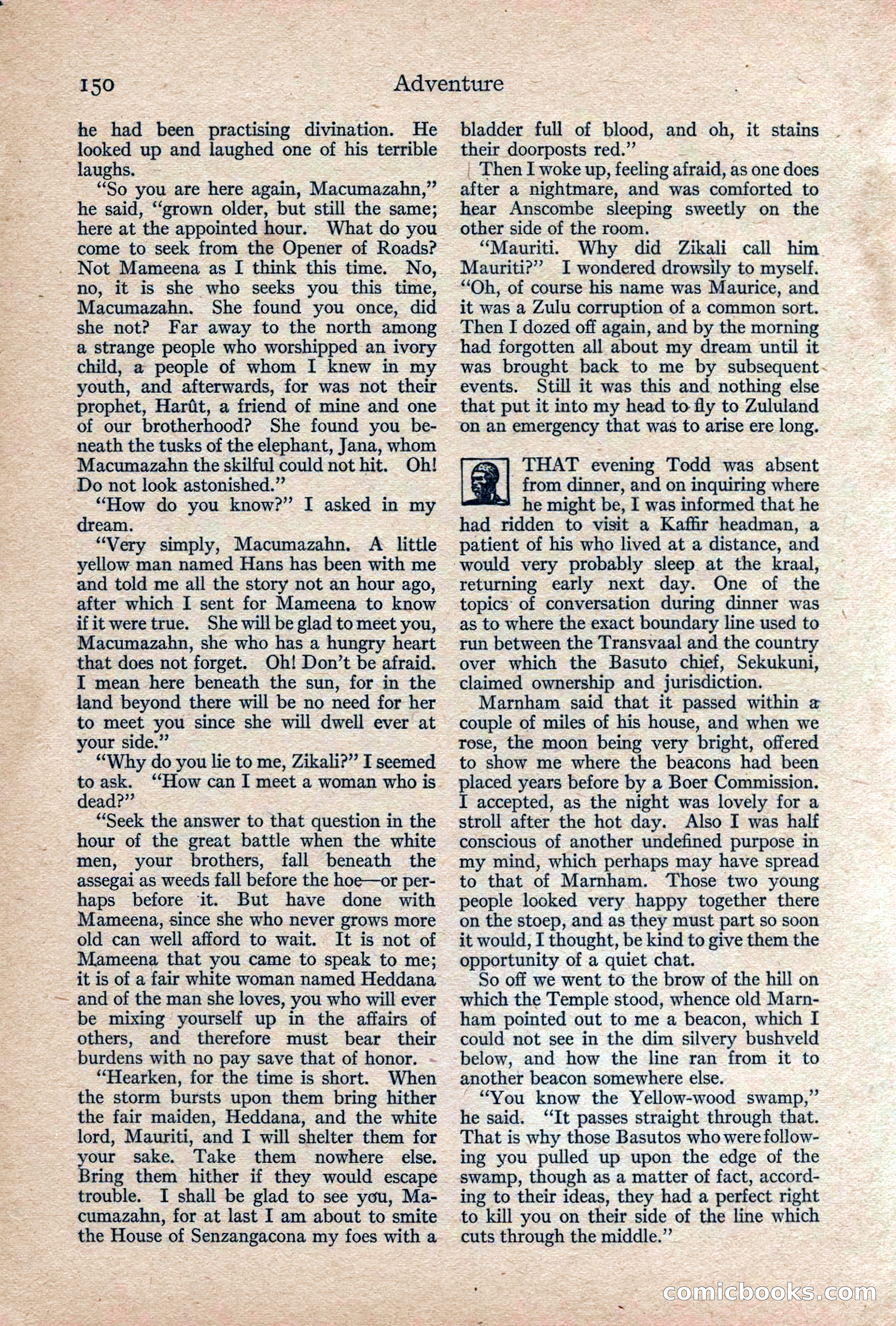
A restored page from Pulp Fiction, 1917. Page through the whole issue in the reader above.
📄 Transcribed text from this page (OCR, searchable)
Machine-transcribed from the original scan — historical spelling and the odd misread are preserved.
. Not Mameena as I think this time. 150 he had been practising divination. He looked up and laughed one of his terrible laughs. “So you are here again, Macumaza he said, “grown older, but still the same; here at the appointed hour. What do you come to seek from the Opener of Roads? No, no, it is she who seeks you this time, Macumazahn. She found you once, did she not? Far away to the north among a strange people who worshipped an ivory child, a people of whom I knew in my youth, and afterwards, for was not their prophet, Harit, a friend of mine and one of our brotherhood? She found you be- neath the tusks of the elephant, Jana, whom Macumazahn the skilful could not hit. Oh! Do not look astonished.” “Flow do you know?” I asked in my dream. “Very simply, Macumazahn. A little yellow man named Hans has been with me and told me all the story not an hour ago, after which I sent for Mameena to know ifit were true. She will be glad to meet you, Macumazahn, she who has a hungry heart that does not forget. Oh! Don’t be afraid. I mean here beneath the sun, for in the land beyond there will be no need for her to meet you since she will dwell ever at your side.” “Why do you lie to me, Zikali?”’ I seemed to ask. ‘How can I meet a woman who is dead?” “Seek the answer to that question in the hour of the great battle when the white men, your brothers, fall beneath the assegai as weeds fall before the hoe—or per- haps before it. But have done with Mameena, since she who never grows more old can well afford to wait. It is not of Mameena that you came to speak to me; it is of a fair white woman named Heddana and of the man she loves, you who will ever be mixing yourself up in the affairs of others, and therefore must bear their burdens with no pay save that of honor. ““Hearken, for the time is short. When the storm bursts upon them bring hither the fair maiden, Heddana, and the white lord, Mauriti, and I will shelter them for yee sake. Take them nowhere else. ring them hither if they would escape trouble. I shall be glad to see you, Ma- cumazahn, for at last I am about to smite the House of Senzangacona my foes with a Adventure bladder full of blood, and oh, it stains their doorposts red.”’ _ Then I woke up, feeling afraid, as one does as a nightmare, and was comforted to hear Anscombe sleeping sweetly on the other side of the room. “Mauriti. Why did Zikali call him Mauriti?”’ I wondered drowsily to myself. “Oh, of course his name was Maurice, and it was a Zulu corruption of a common sort. Then I dozed off again, and by the morning had forgotten all about my dream until it was brought back to me by subsequent- events. Still it was this and nothing else that put it into my head to fly to Zululand on an emergency that was to arise ere long. THAT evening Todd was absent - from dinner, and on inquiring where * he might be, I was informed that he had ridden to visit a Kaffir headman, a patient of his who lived at a distance, and would very probably sleep at the kraal, returning early next day. One of the topics of conversation during dinner was as to where the exact boundary line used to run between the Transvaal and the country over which the Basuto chief, Sekukuni, claimed ownership and jurisdiction. Marnham said that it passed within a couple of miles of his house, and when we tose, the moon being very bright, offered to show me where the beacons had been placed years before by a Boer Commission. I accepted, as the night was lovely for a stroll after the hot day. Also I was half conscious of another undefined purpose in my mind, which perhaps may have spread to that of Marnham. ‘Those two young people looked very happy together there on the stoep, and as they must part so soon it would, I thought, be kind to give them the opportunity of a quiet chat. So off we went to the brow of the hill on which the Temple stood, whence old Marn- ham pointed out to me a beacon, which I could not see in the dim silvery bushveld below, and how the line ran from it to another beacon somewhere else. “You know the Yellow-wood swamp,” he said. “It passes straight through that. That is why those Basutos who were follow- ing you pulled up upon the edge of the swamp, though as a matter of fact, accord- ing to their ideas, they had a perfect right to kill you on their side of the line which cuts through the middle.” JOOK (c@) (E€©) oS