
Pulp Fiction, 1917 · page 14 of 228
Adventure, February 1917 — page 14: what you’re looking at
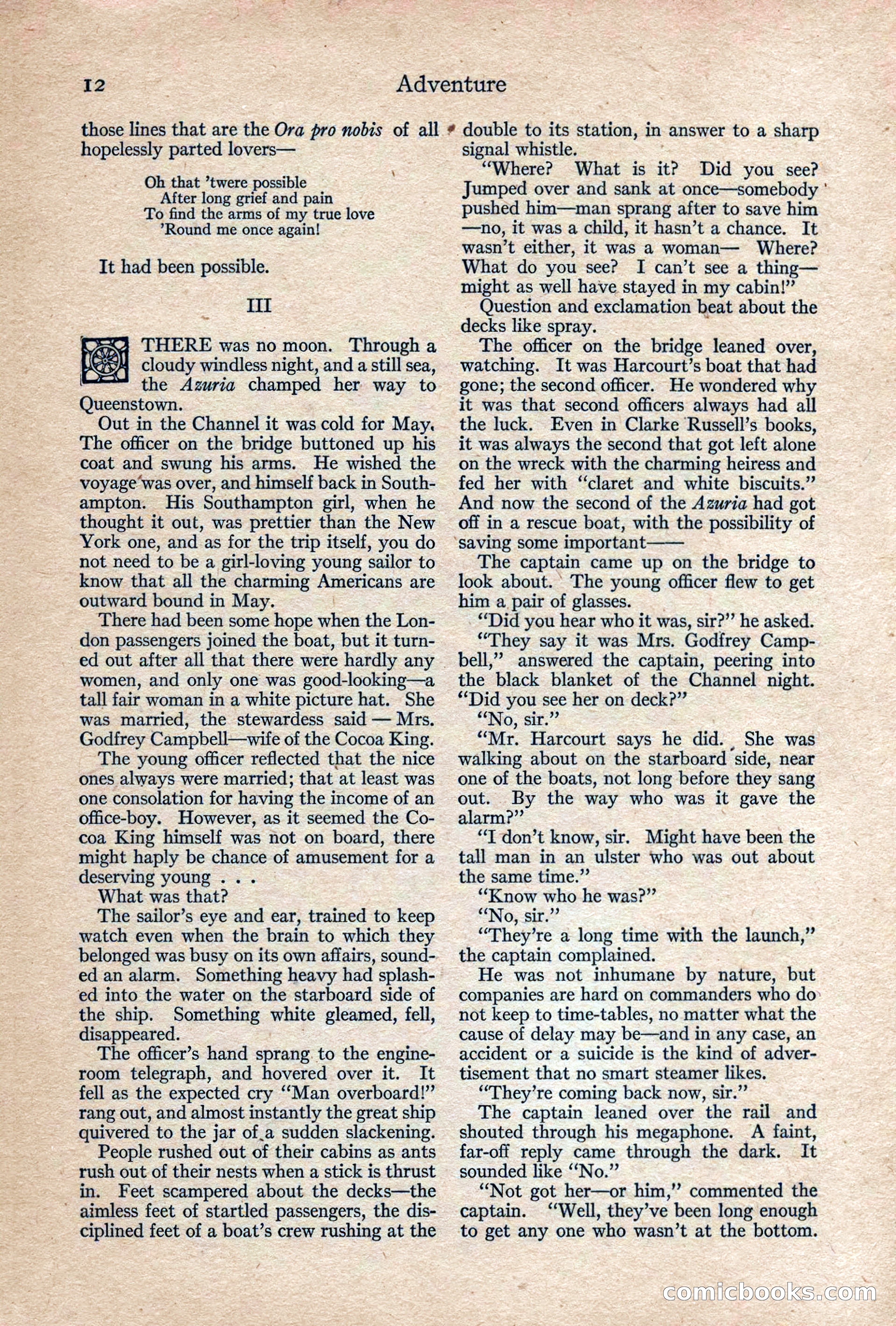
A restored page from Pulp Fiction, 1917. Page through the whole issue in the reader above.
📄 Transcribed text from this page (OCR, searchable)
Machine-transcribed from the original scan — historical spelling and the odd misread are preserved.
I2 Adventure those lines that are the Ora pro nobis of all # double to its station, in answer to a sharp hopelessly parted lovers— \ Oh that ’twere possible After long grief and pain To find the arms of my true love *Round me once again! It had been possible. Ill THERE was no moon. Through a Beas cloudy windless night, and a still sea, ——" the Azuria champed her way to Queenstown. _ Out in the Channel it was cold for May. The officer on the bridge buttoned up his coat and swung his arms. He wished the voyage'was over, and himself back in South- ampton. His Southampton girl, when he thought it out, was prettier than the New York one, and as for the trip itself, you do not need to be a girl-loving young sailor to know that all the charming Americans are outward bound in May. There had been some hope when the Lon- _don passengers joined the boat, but it turn- _ ed out after all that there were hardly any © women, and only one was good-looking—a tall fair woman in a white picture hat. She was married, the stewardess said — Mrs. Godfrey Campbell—wife of the Cocoa King. The young officer reflected that the nice ones always were married; that at least was one consolation for having the income of an office-boy. However, as it seemed the Co- coa King himself was not on board, there might haply be chance of amusement for a deserving young ... What was that? The sailor’s eye and ear, trained to keep watch even when the brain to which they belonged was busy on its own affairs, sound- ed an alarm. Something heavy had splash- ed into the water on the starboard side of the ship. Something white gleamed, fell, disappeared. The officer’s hand sprang. to the engine- room telegraph, and hovered over it. It fell as the expected cry ‘‘Man overboard!” rang out, and almost instantly the great ship quivered to the jar of_a sudden slackening. People rushed out of their cabins as ants rush out of their nests when a stick is thrust in. Feet scampered about the decks—the - aimless feet of startled passengers, the dis- ciplined feet of a boat’s crew rushing at the ‘wasn’t either, it was a woman— signal whistle. “Where? What is it? Did you see? Jumped over and sank at once—somebody ' pushed him—man sprang after to save him —no, it was a child, it hasn’t a chance. It Where? What do you see? I can’t see a thing— might as well have stayed in my cabin!” Question and exclamation beat about the decks like spray. The officer on the bridge leaned over, watching. It was Harcourt’s boat that had gone; the second officer. He wondered why it was that second officers always had all the luck. Even in Clarke Russell’s books, it was always the second that got left alone on the wreck with the charming heiress and fed her with “claret and white biscuits.” And now the second of the Azuria had got off in a rescue boat, with the possibility of ‘saving some important—— The captain came up on the bridge to look about. ' The young officer flew to get him a pair of glasses. “Did you hear who it was, sir?’’ he asked. “They say it was Mrs. Godirey Camp- bell,” answered the captain, peering into the black blanket of the Channel night. “Did you see her on deck?” “No, sir. 3) “Mr, Harcourt says he did. She was walking about on the starboard ‘side, near one of the boats, not long before they sang out. By the way who was it gave the alarm?” “T don’t know, sir. Might have been the tall man in an ulster who was out about the same time.” “Know who he was?” *‘No, sir.” “They’re a long time with the launch,” the captain complained. He was not inhumane by nature, but companies are hard on commanders who do not keep to time-tables, no matter what the cause of delay may be—and in any case, an accident or a suicide is the kind of adver- tisement that no smart steamer likes. ‘“‘They’re coming back now, sir.” The captain leaned over the rail and shouted through his megaphone. A faint, far-off reply came through the dark. It sounded like ‘‘No.” “Not got her—or him,’’ commented the captain. ‘‘Well, they’ve been long enough to get any one who wasn’t at the bottom. EOPMICLO© G (E©@) im S