
Pulp Fiction, 1917 · page 137 of 228
Adventure, February 1917 — page 137: what you’re looking at
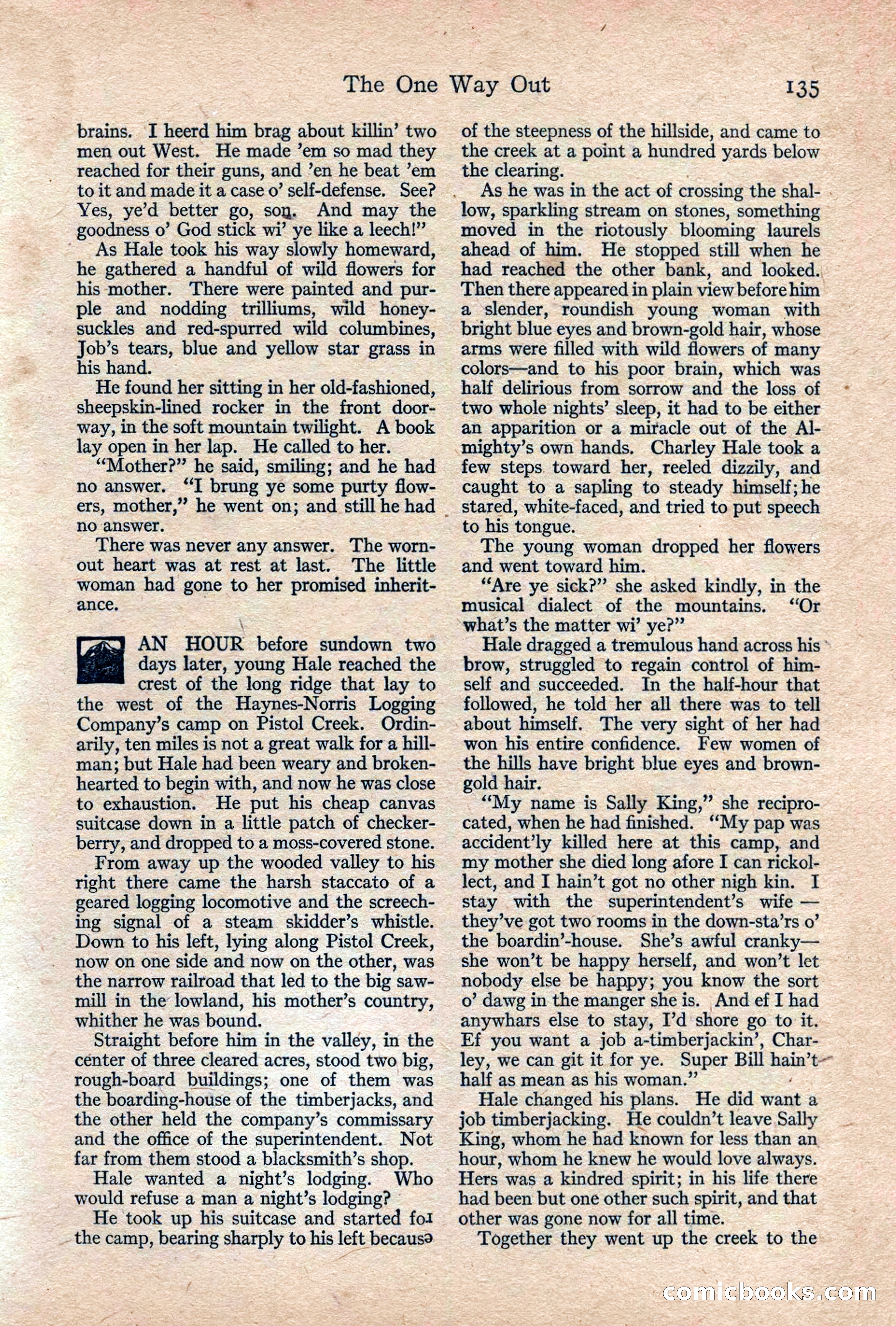
A restored page from Pulp Fiction, 1917. Page through the whole issue in the reader above.
📄 Transcribed text from this page (OCR, searchable)
Machine-transcribed from the original scan — historical spelling and the odd misread are preserved.
The One Way Out brains. I heerd him brag about killin’ two men out West. He made ’em so mad they reached for their guns, and ’en he beat ’em to it and made it a case 0’ self-defense. See? Yes, ye’d better go, sou. And may the goodness o’ God stick wi’ ye like a leech!” As Hale took his way slowly homeward, he gathered a handful of wild flowers for his mother. There were painted and pur- ple and nodding trilliums, wild honey- suckles and red-spurred wild columbines, Job’s s tears, blue and yellow star grass in his hand. He found her sitting in her old-fashioned, sheepskin-lined rocker in the front door- way, in the soft mountain twilight. A book lay open in her lap. He called to her. ““Mother?” he said, smiling; and he had no answer. “I brung ye some purty flow- ers, mother,” he went on; and still he had — no answer. There was never any answer. The worn- out heart was at rest at last. The little woman had gone to her promised inherit- ance. AN HOUR before sundown two days later, young Hale reached the crest of the long ridge that lay to the west of the Haynes-Norris Logging Company’s camp on Pistol Creek. Ordin- arily, ten miles is not a great walk for a hill- man; but Hale had been weary and broken- hearted to begin with, and now he was close to exhaustion. He put his cheap canvas suitcase down in a little patch of checker- berry, and dropped to a moss-covered stone. From away up the wooded valley to his right there came the harsh staccato of a geared logging locomotive and the screech- ing signal of a steam skidder’s whistle. Down to his left, lying along Pistol Creek, now on one side and now on the other, was the narrow railroad that led to the big saw- mill in the lowland, his mother’s country, whither he was bound. Straight before him in the valley, in the center of three cleared acres, stood two big, rough-board buildings; one of them was the boarding-house of the timberjacks, and the other held the company’s commissary and the office of the superintendent. Not far from them stood a blacksmith’s shop. Hale wanted a night’s lodging. Who would refuse a man a night’s lodging? — He took up his suitcase and started fol - the camp, bearing sharply to his left because a 135 of the steepness of the hillside, and came to the creek at a point a hundred yards below the clearing. As he was in the act of crossing the shal- . low, sparkling stream on stones, something moved in the riotously blooming laurels ahead of him. He stopped still when he had reached the other bank, and looked. Then there appeared in plain view before him a slender, roundish young woman with bright blue eyes and brown-gold hair, whose arms were filled with wild flowers of many colors—and to his poor brain, which was half delirious from sorrow and the loss of two whole nights’ sleep, it had to be either an apparition or a miracle out of the Al- mighty’s own hands. Charley Hale took a few steps. toward her, reeled dizzily, and caught to a sapling to steady himself; he stared, white-faced, and tried to put speech to his tongue. The young woman ee her flowers and went toward “Are ye sick?” she asked kindly, in the musical dialect of the mountains. “Or ~what’s the matter wi’ ye?” Hale dragged a tremulous hand across his ° brow, struggled to regain control of him- self and succeeded. In the half-hour that followed, he told her all there was to tell about himself. The very sight of her had won his entire confidence. Few women of the hills have bright blue eyes and brown- gold hair. “My name is Sally King,” she recipro- cated, when he had finished. “My pap was accident’ly killed here at this camp, and my mother she died long afore I can rickol- lect, and I hain’t got no other nigh kin. I stay with the superintendent’s wife — they’ve got two rooms in the down-sta’rs 0’ the boardin’-house. She’s awful cranky— she won’t be happy herself, and won’t let nobody else be happy; you know the sort o’ dawg in the manger she is. And ef I had anywhars else to stay, I’d shore go to it. Ef you want a job a-timberjackin’, Char- ley, we can git it for ye. half as mean as his woman.’ Hale changed his plans. He did wate a job timberjacking. He couldn’t leave Sally King, whom he had known for less than an hour, whom he knew he would love always. Hers was a kindred spirit; in his life there had been but one other such spirit, and that other was gone now for all time. 93 Together they went up the creek to the SGOMIcCbOOks (C Super Bill Soe eS (Eo)