
Pulp Fiction, 1916 · page 96 of 228
Adventure Magazine, March 1916 — page 96: what you’re looking at
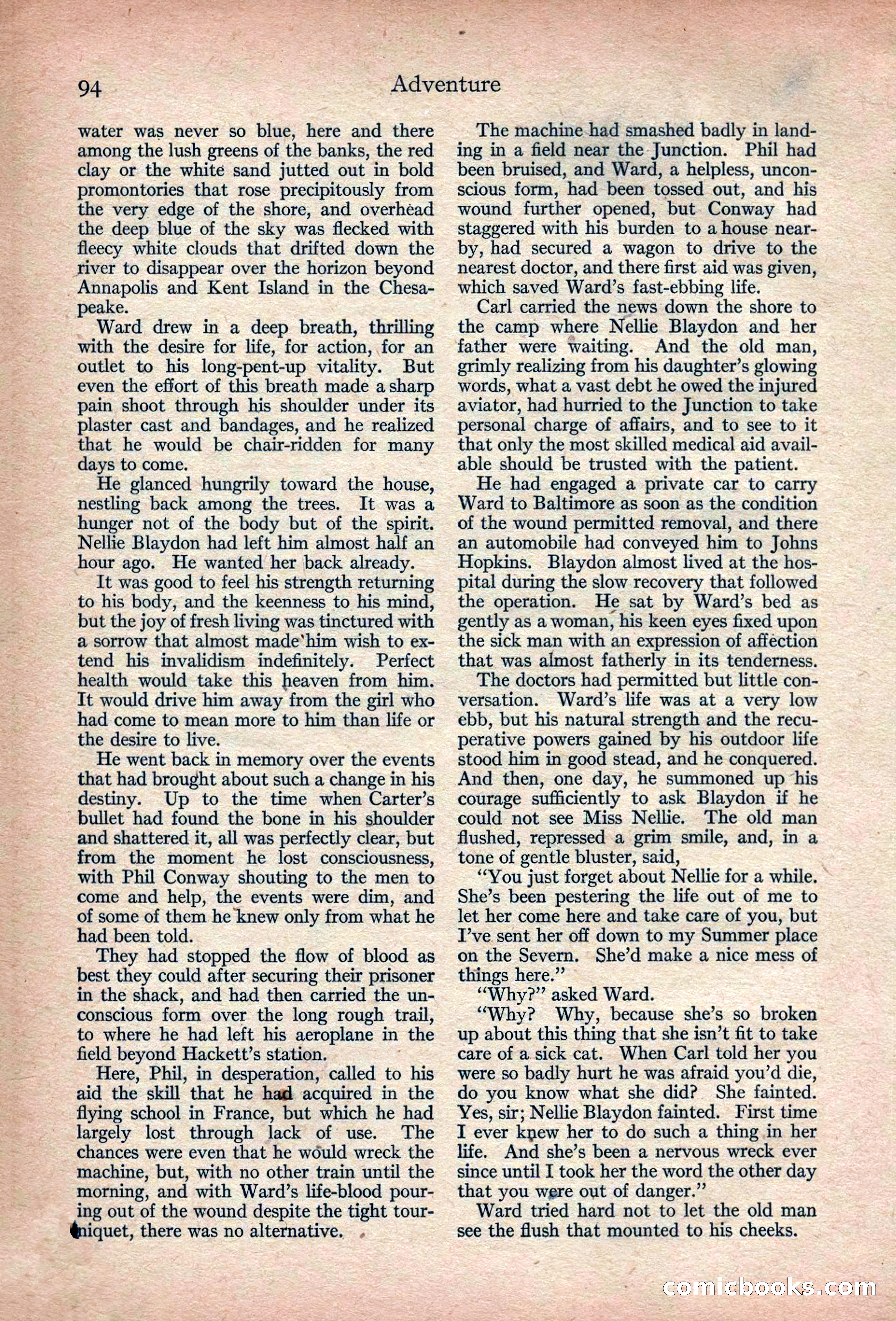
A restored page from Pulp Fiction, 1916. Page through the whole issue in the reader above.
📄 Transcribed text from this page (OCR, searchable)
Machine-transcribed from the original scan — historical spelling and the odd misread are preserved.
94 water was never so blue, here and there among the lush greens of the banks, the red clay or the white sand jutted out in bold promontories that rose precipitously from the very edge of the shore, and overhead the deep blue of the sky was flecked with fleecy white clouds that drifted down the river to disappear over the horizon beyond _Annapolis and Kent Island in the Chesa- _ peake. Ward drew in a deep breath, thrilling with the desire for life, for action, for an outlet to his long-pent-up vitality. But even the effort of this breath made a sharp pain shoot through his shoulder under its plaster cast and bandages, and he realized that he would be chair-ridden for many days to come. He glanced hungrily toward the house, nestling back among the trees. It was a hunger not of the body but of the spirit. Nellie Blaydon had left him almost half an hour ago. He wanted her back already. It was good to feel his strength returning to his body, and the keenness to his mind, but the joy of fresh living was tinctured with a sorrow that almost made*him wish to ex- tend his invalidism indefinitely. Perfect health would take this heaven from him. It would drive him away from the girl who had come to mean more to him than life or the desire to live. He went back in memory over the events that had brought about such a change in his destiny. Up to the time when Carter’s bullet had found the bone in his shoulder and shattered it, all was perfectly clear, but from the moment he lost consciousness, with Phil Conway shouting to the men to come and help, the events were dim, and of some of them he knew only from what he had been told. They had stopped the flow of blood as best they could after securing their prisoner in the shack, and had then carried the un- conscious form over the long rough trail, to where he had left his aeroplane in the field beyond Hackett’s station. Here, Phil, in desperation, called to his aid the skill that he had acquired in the flying school in France, but which he had largely lost through lack of use. The chances were even that he would wreck the machine, but, with no other train until the morning, and with Ward’s life-blood pour- ing out of the wound despite the tight tour- @hiquet, there was no alternative. . Adventure The machine-had smashed badly in land- ing in a field near the Junction. Phil had been bruised, and Ward, a helpless, uncon- scious form, had been tossed out, and his wound further opened, but Conway had staggered with his burden to a house near- by, had secured a wagon to drive to the nearest doctor, and there first aid was given, which saved Ward’s fast-ebbing life. Carl carried the news down the shore to the camp where Nellie Blaydon and her father were waiting. And the old man, grimly realizing from his daughter’s glowing words, what a vast debt he owed the injured aviator, had hurried to the Junction to take personal charge of affairs, and to see to it that only the most skilled medical aid avail- able should be trusted with the patient. He had engaged a private car to carry Ward to Baltimore as soon as the condition of the wound permitted removal, and there an automobile had conveyed him to Johns Hopkins. Blaydon almost lived at the hos- pital during the slow recovery that followed the operation. He sat by Ward’s bed as gently as a woman, his keen eyes fixed upon the sick man with an expression of affection that was almost fatherly in its tenderness. The doctors had permitted but little con- versation. Ward’s life was at a very low ebb, but his natural strength and the recu- perative powers gained by his outdoor life stood him in good stead, and he conquered. And then, one day, he summoned up his courage sufficiently to ask Blaydon if he could not see Miss Nellie. The old man flushed, repressed a grim smile, and, in a tone of gentle bluster, said, “You just forget about Nellie for a while. She’s been pestering the life out of me to let her come here and take care of you, but I’ve sent her off down to my Summer place on the Severn. She’d make a nice mess of things here.” “Why?” asked Ward. “Why? Why, because she’s so broken up about this thing that she isn’t fit to take care of a. sick cat. When Carl told her you were so badly hurt he was afraid you’d die, do you know what she did? She fainted. Yes, sir; Nellie Blaydon fainted. First time I ever knew her to do such a thing in her life. And she’s been a nervous wreck ever since until I took her the word the other day that you were out of danger.”’ Ward tried hard not to let the old man see the flush that mounted to his cheeks. 0\(0(0) gS (EC) (COMMING