
Pulp Fiction, 1916 · page 7 of 228
Adventure Magazine, March 1916 — page 7: what you’re looking at
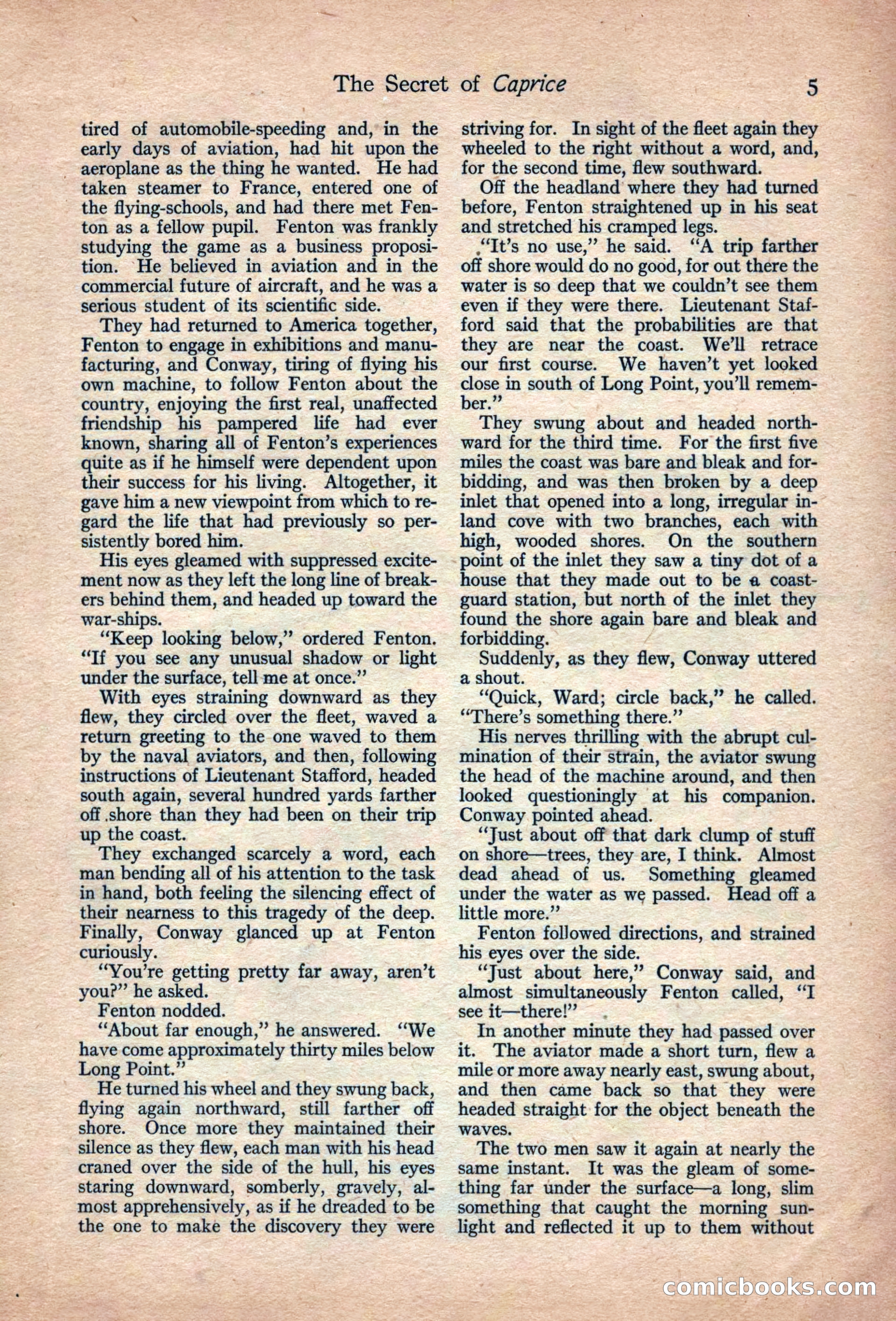
A restored page from Pulp Fiction, 1916. Page through the whole issue in the reader above.
📄 Transcribed text from this page (OCR, searchable)
Machine-transcribed from the original scan — historical spelling and the odd misread are preserved.
The Secret of Caprice | | 5 tired of automobile-speeding and, in the early days of aviation, had hit upon the _ aeroplane as the thing he wanted. He had taken steamer to France, entered one of _ the flying-schools, and had there met Fen- ton as a fellow pupil. Fenton was frankly studying the game as a business proposi- tion. He believed in aviation and in the commercial future of aircraft, and he was a serious student of its scientific side. They had returned to America together, Fenton to engage in exhibitions and manu- facturing, and Conway, tiring of flying his own machine, to follow Fenton about the country, enjoying the first real, unaffected friendship his pampered life had ever known, sharing all of Fenton’s experiences quite as if he himself were dependent upon their success for his living. Altogether, it gave him a new viewpoint from which to re- gard the life that had previously so per- sistently bored him. His eyes gleamed with suppressed excite- ment now as they left the long line of break- ers behind them, and headed up toward the war-ships. “Keep looking below,” ordered Fenton. “If you see any unusual shadow or light under the surface, tell-me at once.” With eyes straining downward as they flew, they circled over the fleet, waved a return greeting to the one waved to them by the naval aviators, and then, following instructions of Lieutenant Stafford, headed south again, several hundred yards farther off shore than they had been on their trip up the coast. They exchanged scarcely a word, each man bending all of his attention to the task in hand, both feeling the silencing effect of their nearness to this tragedy of the deep. Finally, Conway glanced up at Fenton curiously. “You're getting pretty far away, aren’t your” he asked. Fenton nodded. “About far enough,” he answered. ‘“We have come approximately thirty miles below Long Point.” He turned his wheel and they swung back, flying again northward, still farther off shore. Once more they maintained their silence as they flew, each man with his head craned over the side of the hull, his eyes staring downward, somberly, gravely, al- most apprehensively, as if he dreaded to be the one to make the discovery they were striving for. In sight of the fleet again they wheeled to the right without a word, and, for the second time, flew southward. Off the headland where they had turned before, Fenton straightened up in his seat and stretched his cramped legs. “It’s no use,” he said. “A trip farther off shore would do no good, for out there the water is so deep that we couldn’t see them even if they were there. Lieutenant Staf- ford said that the probabilities are that they are near the coast. We'll retrace our first course. We haven’t yet looked — south of Long Point, you'll remem- er.’ They swung about and headed north- ward for the third time. For the first five miles the coast was bare and bleak and for- bidding, and was then broken by a deep inlet that opened into a long, irregular in- land cove with two branches, each with high, wooded shores. On the southern point of the inlet they saw a tiny dot of a house that they made out to be a coast- guard station, but north of the inlet they found the shore again bare and bleak and forbidding. Suddenly, as they flew, Conway uttered a shout. “Quick, Ward; circle back,” he called. “‘There’s something there.”’ His nerves thrilling with the abrupt cul- mination of their strain, the aviator swung the head of the machine around, and then looked questioningly at his companion. Conway pointed ahead. “Just about off that dark clump of stuff on shore—trees, they are, I think. Almost dead ahead of us. Something gleamed under the water as we passed. Head off a little more.” Fenton followed directions, and strained his eyes over the side. “Just about here,” Conway said, and almost simultaneously Fenton called, “TI see it—there!” ~ . In another minute they had passed over it. The aviator made a short turn, flew a mile or more away nearly east, swung about, and then came back so that they were headed straight for the object beneath the waves. The two men saw it again at nearly the same instant. It was the gleam of some- thing far under the surface—a long, slim something that caught the morning sun- light and reflected it up to them without “S scomichboo con