
Pulp Fiction, 1916 · page 57 of 228
Adventure Magazine, March 1916 — page 57: what you’re looking at
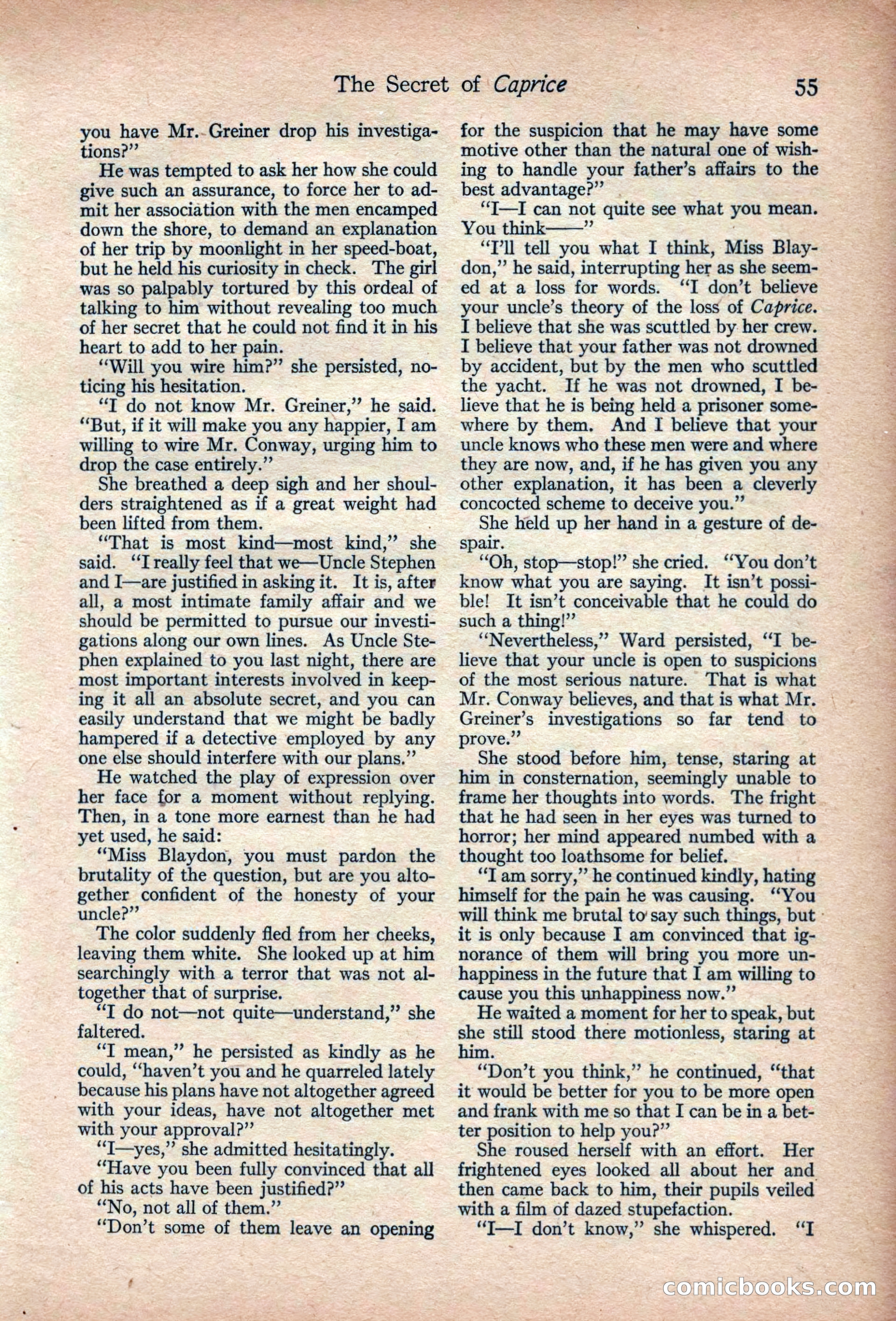
A restored page from Pulp Fiction, 1916. Page through the whole issue in the reader above.
📄 Transcribed text from this page (OCR, searchable)
Machine-transcribed from the original scan — historical spelling and the odd misread are preserved.
The Secret you have Mr.-Greiner drop his investiga- tions?” He was tempted to ask her how she could give such an assurance, to force her to ad- mit her association with the men encamped _ down the shore, to demand an explanation of her trip by moonlight i in her speed-boat, but he held his curiosity in check. The girl was so palpably tortured by this ordeal of talking to him without revealing too much of her secret that he could not find it in his heart to add to her pain. ‘Will you wire him?” she persisted, no- ticing his hesitation. “T do not know Mr. Greiner,” he said. “But, if it will make you any happier, I am willing to wire Mr. Conway, urging him to drop the case entirely.”’ She breathed a deep sigh and her shoul- ders straightened as if a great weight had been lifted from them. “That is most kind—most kind,” she said. “Treally feel that we—Uncle Stephen and I—are justified in asking it. It is, after all, a most intimate family affair and we should be permitted to pursue our investi- gations along our own lines. As Uncle Ste- phen explained to you last night, there are most important interests involved in keep- ing it all an absolute secret, and you can easily understand that we might be badly hampered if a detective employed by any one else should interfere with our plans,” He watched the play of expression over her face for a moment without replying. Then, in a tone more earnest than he had yet used, he said: “Miss Blaydon, you must pardon the brutality of the question, but are you alto- gether confident of the honesty of your uncle?” The color suddenly fled from her cheeks, leaving them white. She looked up at him searchingly with a terror that was not al- together that of surprise. “T do not—not quite—understand,” she faltered. Aas mean,’ ’ he persisted as kindly as he could, ‘ chaven’t you and he quarreled lately because his plans have not altogether agreed with your ideas, have not altogether met with your approval?” “‘I—yes,”’ she admitted hesitatingly. “Have you been fully convinced that all of his acts have been justified?” “No, not all of them.” ‘Don’t some of them leave an opening 59 for the suspicion that he may have some motive other than the natural one of wish- ing to handle your father’s affairs to the best advantage?” | “T—TI can not quite see what you mean. You think——” of Caprice “Tl tell you what I think, Miss Blay- — don,” he said, interrupting her as she seem- ed at a loss for words. “I don’t believe your uncle’s theory of the loss of Caprice. I believe that she was scuttled by her crew. I believe that your father was not drowned by accident, but by the men who scuttled the yacht. lieve that he is being held a prisoner some- where by them. And I believe that your uncle knows who these men were and where they are now, and, if he has given you any other explanation, it has been a cleverly concocted scheme to deceive you.” She held up her hand in a gesture of de- spair. “Oh, stop—stop!” she cried. ‘“‘You don’t know what you are saying. It isn’t possi- ble! It isn’t conceivable that he could do such a thing!” ‘‘Nevertheless,”’ Ward persisted, “I be- lieve that your uncle is open to suspicions of the most serious nature. That is what If he was not drowned, I be- | Mr. Conway believes, and that is what Mr. — Greiner’s investigations so far tend to prove.” She stood before him, tense, staring at him in consternation, seemingly unable to frame her thoughts into words. that he had seen in her eyes was turned to horror; her mind appeared numbed with a thought too loathsome for belief. “Tam sorry,” he continued kindly, hating himself for the pain he was causing. ‘You will think me brutal to’ say such things, but - it is only because I am convinced that ig- norance of them will bring you more un- happiness in the future that I am willing to cause you this unhappiness now.’ He waited a moment for her to speak, but she still stood there motionless, staring at him. “Don’t you think,” he continued, “that it would be better for you to be more open and frank with me so that I can be in a bet- ter position to help you?” She roused herself with an effort. Her frightened eyes looked all about her and then came back to him, their pupils veiled with a film of dazed stupefaction. “J—I don’t know,” she whispered. “I cS Eomichoo (S The fright . (E(@) aS