
Pulp Fiction, 1916 · page 37 of 228
Adventure Magazine, March 1916 — page 37: what you’re looking at
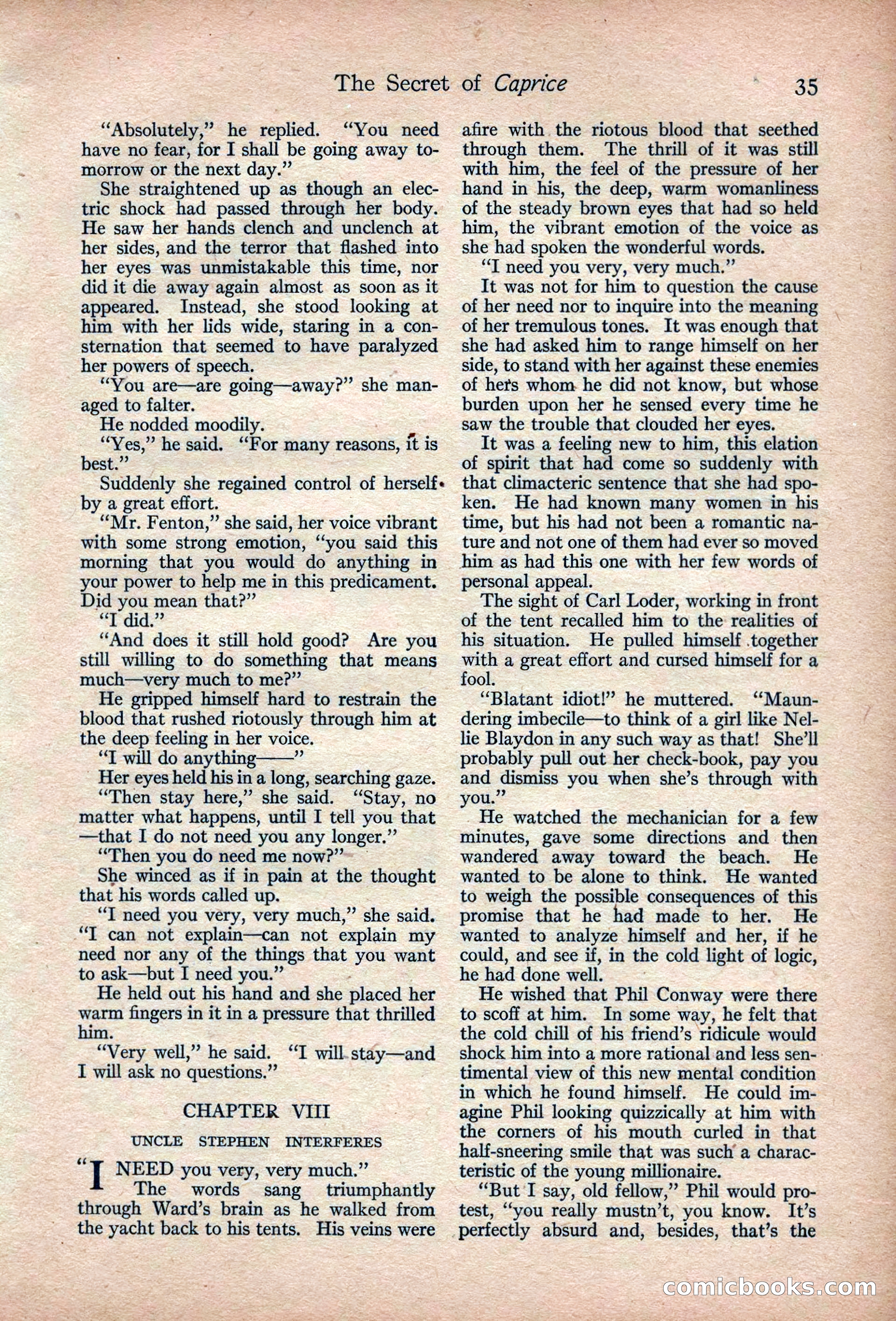
A restored page from Pulp Fiction, 1916. Page through the whole issue in the reader above.
📄 Transcribed text from this page (OCR, searchable)
Machine-transcribed from the original scan — historical spelling and the odd misread are preserved.
The Secret “Absolutely,” he replied. “You need have no fear, for I shall be going away to- morrow or the next day.” She straightened up as though an elec- tric shock had passed through her body. He saw her hands clench and unclench at her sides, and the terror that flashed into her eyes was unmistakable this time, nor did it die away again almost as soon as it appeared. Instead, she stood looking at him with her lids wide, staring in a con- sternation that seemed to have paralyzed her powers of speech. “You are—are going—away?” she man- aged to falter. He nodded moodily. “Yes,” he said. Por many reasons, it is best.” Suddenly she regained control of herself« by a great effort. “Mr. Fenton,” she said, her voice vibrant with some strong emotion, “you said this morning that you would do anything in your power to help me in this predicament. Did you mean that?” aT did.’’ “And does it still hold good? Are you still willing to do something that means much—very much to me?” He gripped himself hard to restrain the blood that rushed riotously through him at the deep feeling in her voice. “T will do anything & Her eyes held his in a long, searching gaze. “Then stay here,” she said. “Stay, no matter what happens, until I tell you that —that I do not need you any longer.” “Then you do need me now?” She winced as if in pain at the thought that his words called up. “IT need you very, very much,” she said. “T can not explain—can not explain my need nor any of the things that you want to ask—but I need you.’ He held out his hand and she placed her ita fingers in it in a pressure that thrilled “T will. stay—and “Very well,” he said. I will ask no questions.” CHAPTER VIII UNCLE STEPHEN INTERFERES ‘| NEED you very, very much.”’ The words sang _ triumphantly through Ward’s brain as he walked from the yacht back to his tents. His veins were of Caprice afire with the riotous blood that seethed through them. ‘The thrill of it was still with him, the feel of the pressure of her hand in his, the deep, warm womanliness of the steady brown eyes that had so held him, the vibrant emotion of the voice as she had spoken the wonderful words. “IT need you very, very much.” It was not for him to question the cause of her need nor to inquire into the meaning of her tremulous tones. It was enough that she had asked him to range himself on her side, to stand with her against these enemies of hers whom. he did not know, but whose burden upon her he sensed every time he saw the trouble that clouded her eyes. 35, It was a feeling new to him, this elation of spirit that had come so suddenly with that climacteric sentence that she had spo- ken. He had known many women in his time, but his had not been a romantic na- ture and not one of them had ever so moved him as had this one with her few words of personal appeal. The sight of Carl Loder, working in front of the tent recalled him to the realities of his situation. He pulled himself together with a great effort and cursed himself for a fool. “Blatant idiot!” he muttered. ‘Maun- dering imbecile—to think of a girl like Nel- lie Blaydon in any such way as that! She’ll probably pull out her check-book, pay you and dismiss you when she’s through with you.” _ He watched the mechanician for a few minutes, gave some directions and then wandered away toward the beach. He wanted to be alone to think. He wanted to weigh the possible consequences of this promise that he had made to her. He wanted to analyze himself and her, if he could, and see if, in the cold light of logic, he had done well. . He wished that Phil Conway were there to scoff at him. In some way, he felt that the cold chill of his friend’s ridicule would shock him into a more rational and less sen- : timental view of this new mental condition in which he found himself. He could im- agine Phil looking quizzically at him with the corners of his mouth curled in that half-sneering smile that was such a charac- teristic of the young millionaire. “But I say, old fellow,” Phil would pro- test, “you really mustn’t, you know. It’s perfectly absurd and, besides, that’s the COLPMIE MOO KS (E(0)