
Pulp Fiction, 1916 · page 32 of 228
Adventure Magazine, March 1916 — page 32: what you’re looking at
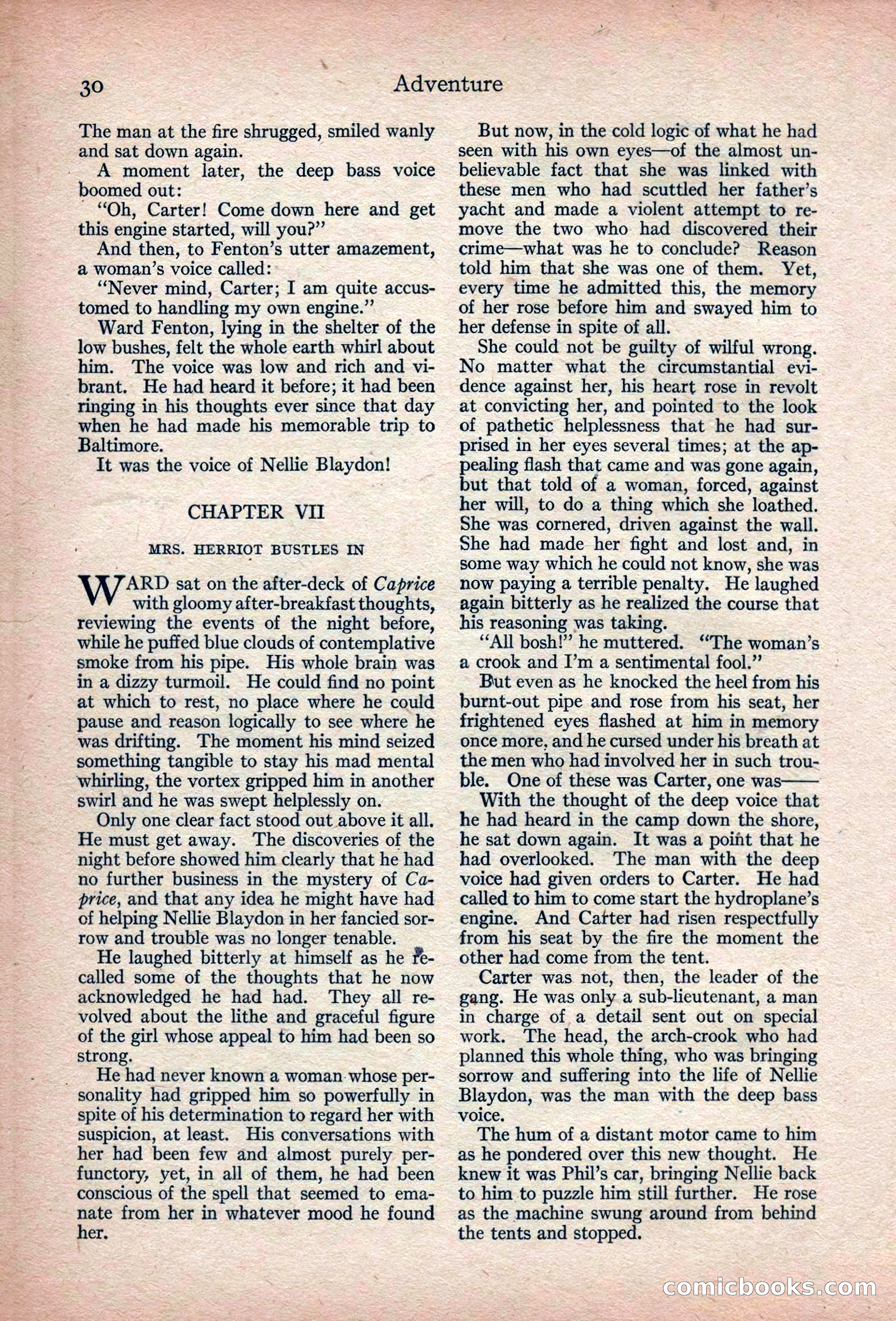
A restored page from Pulp Fiction, 1916. Page through the whole issue in the reader above.
📄 Transcribed text from this page (OCR, searchable)
Machine-transcribed from the original scan — historical spelling and the odd misread are preserved.
a a a Bi i P ud av - 30 ~ Adventure The man at the fire shrugged, smiled wanly and sat down again. A moment later, the deep bass voice boomed out: “Oh, Carter! Come down here and get this engine started, will you?” And then, to Fenton’s utter amazement, a woman’s voice called: “Never mind, Carter; I am quite accus- tomed to handling my own engine.” Ward Fenton, lying in the shelter of the low bushes, felt the whole earth whirl about him. The voice was low and rich and vi- brant. He had heard it before; it had been ringing in his thoughts ever since that day when he had made his memorable trip to Baltimore. It was the voice of Nellie Blaydon! CHAPTER VII MRS. HERRIOT BUSTLES IN ARD sat on the after-deck of Caprice with gloomy after-breakfast thoughts, reviewing the events of the night before, while he puffed blue clouds of contemplative smoke from his pipe. His whole brain was in a dizzy turmoil. He could find no point at which to rest, no place where he could pause and reason logically to see where he was drifting. The moment his mind seized something tangible to stay his mad mental whirling, the vortex gripped him in another swirl and he was swept helplessly on. Only one clear fact stood out above it all. He must get away. The discoveries of the night before showed him clearly that he had no further business in the mystery of Ca- price, and that any idea he might have had of helping Nellie Blaydon in her fancied sor- row and trouble was no longer tenable. He laughed bitterly at himself as he fe- called some of the thoughts that he now acknowledged he had had. They all re- volved about the lithe and graceful figure of the girl whose appeal to him had been so strong. He had never known a woman. whose per- sonality had gripped him so powerfully in spite of his determination to regard her with suspicion, at least. His conversations with her had been few and almost purely per- functory, yet, in all of them, he had been conscious of the spell that seemed to ema- = from her in whatever mood he found er. But now, in the cold logic of what he had seen with his own eyes—of the almost un- believable fact that she was linked with these men who had scuttled her father’s yacht and made a violent attempt to re- move the two who had discovered their crime—what was he to conclude? Reason told him that she was one of them. Yet, every time he admitted this, the memory of her rose before him and swayed him to her defense in spite of all. She could not be guilty of wilful wrong. No matter what the circumstantial evi- dence against her, his heart rose in revolt at convicting her, and pointed to the look of pathetic helplessness that he had sur- prised in her eyes several times; at the ap- pealing flash that came and was gone again, but that told of a woman, forced, against her will, to do a thing which she ‘loathed. She was cornered, driven against the wall. She had made her fight and lost and, in some way which he could not know, she was now paying a terrible penalty. He laughed again bitterly as he realized the course that his reasoning was taking. ‘All bosh!”’ he eae “The woman’s a crook and I’m a sentimental fool.” But even as he knocked the heel from his | burnt-out pipe and rose from his seat, her frightened eyes flashed at him in memory once more, and he cursed under his breath at the men who had involved her in such trou- ble. One of these was Carter, one was—— With the thought of the deep voice that he had heard in the camp down the shore, he sat down again. It was a point that he had overlooked. The man with the deep voice had given orders to Carter. He had called to him to come start the hydroplane’s engine. And Cafter had risen respectfully from his seat by the fire the moment the other had come from the tent. Carter was not, then, the leader of the gang. He was only a sub-lieutenant, a man in charge of a detail sent out on special work. The head, the arch-crook who had planned this whole thing, who was bringing sorrow and suffering into the life of Nellie Blaydon, was the man with the deep bass voice. The hum of a distant motor came to him as he pondered over this new thought. He knew it was Phil’s car, bringing Nellie back to him to puzzle him still further. He rose as the machine swung around from behind the tents and stopped. GEomichbooks (Q) (EO)