
Pulp Fiction, 1916 · page 209 of 228
Adventure Magazine, March 1916 — page 209: what you’re looking at
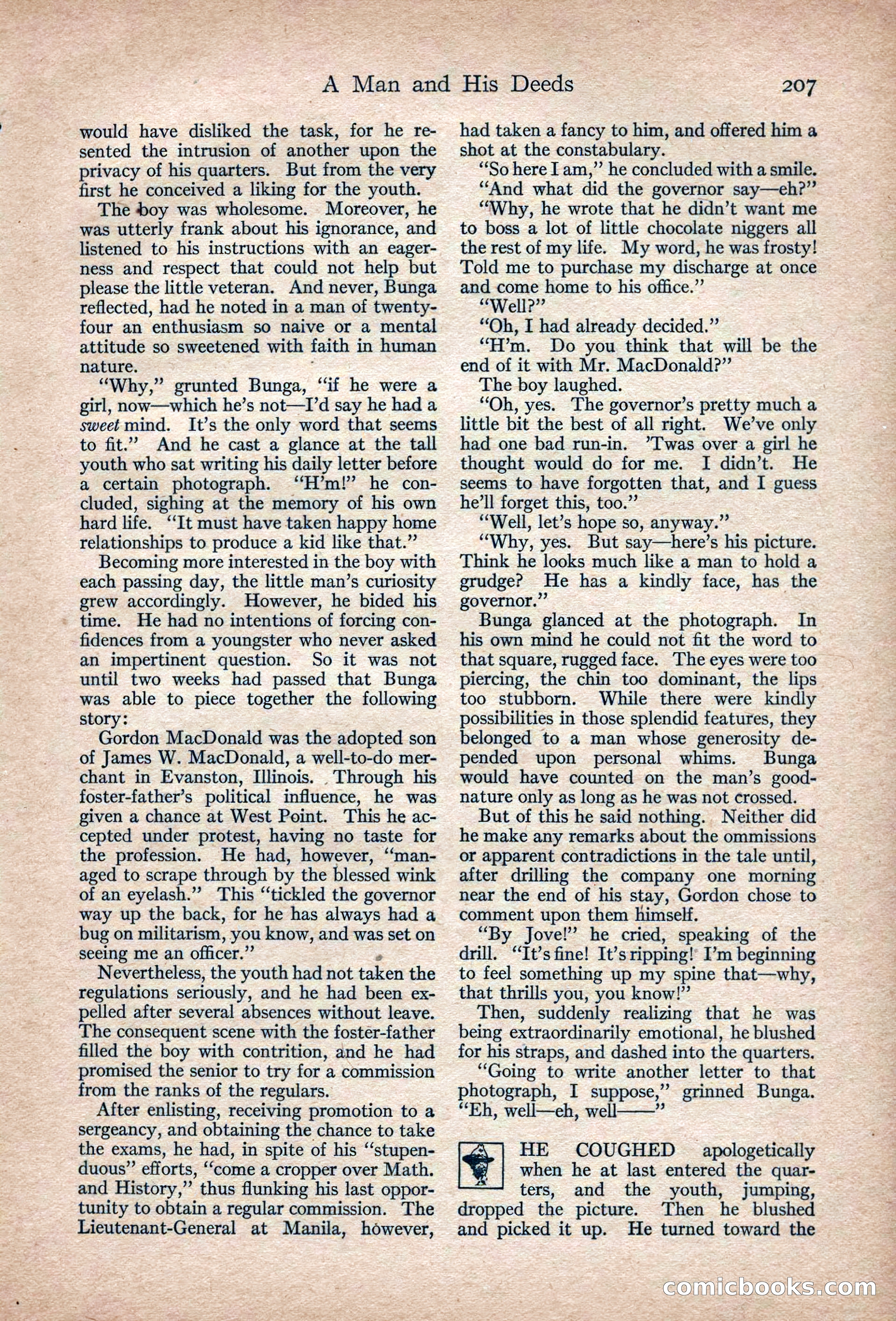
A restored page from Pulp Fiction, 1916. Page through the whole issue in the reader above.
📄 Transcribed text from this page (OCR, searchable)
Machine-transcribed from the original scan — historical spelling and the odd misread are preserved.
A Man and His Deeds would have disliked the task, for he re- sented the intrusion of another upon the privacy of his quarters. But from the very first he conceived a liking for the youth. The boy was wholesome. Moreover, he was utterly frank about his ignorance, and listened to his instructions with an eager- ness and respect that could not help but please the little veteran. And never, Bunga reflected, had he noted in a man of twenty- four an enthusiasm so naive or a mental attitude so sweetened with faith i in human nature. “Why,” grunted Bunga, “if he were a girl, now—which he’s not—I’d say he had a sweet mind. It’s the only word that seems to fit.’ And he cast a glance at the tall youth who sat writing his daily letter before a certain photograph. ‘‘H’m!” he con- cluded, sighing at the memory of his own hard life. ‘It must have taken happy home relationships to produce a kid like that.” Becoming more interested in the boy with each passing day, the little man’s curiosity grew accordingly. However, he bided his - time. He had no intentions of forcing con- fidences from a youngster who never asked an impertinent question. So it was not until two weeks had passed that Bunga was able to piece together the following story: Gordon MacDonald was the adopted son of James W. MacDonald, a well-to-do mer- chant in Evanston, Illinois. . Through his foster-father’s political influence, he was given a chance at West Point. This he ac- cepted under protest, having no taste for the profession. He had, however, “‘man- aged to scrape through by the blessed wink of an eyelash.” This “tickled the governor way up the back, for he has always had a bug on militarism » you know, and was set on seeing me an officer.” Nevertheless, the youth had not taken the regulations seriously, and he had been ex- pelled after several absences without leave. The consequent scene with the foster-father filled the boy with contrition, and he had promised the senior to try for a commission from the ranks of the regulars. After enlisting, receiving promotion to a sergeancy, and obtaining the chance to take the exams, he had, in spite of his ‘‘stupen- duous” effc orts, ““come a cropper over Math. and History,” thus flunking his last oppor- tunity to obtain a regular commission. The Lieutenant-General at Manila, however, 207 had taken a fancy to him, and offered him a shot at the constabulary. “So here Iam,” he concluded with a smile. “And what did the governor say—eh?” “Why, he wrote that he didn’t want me to boss a lot of little chocolate niggers all the rest of my life. My word, he was frosty! Told me to purchase my discharge at once and come home to his office.” “Well?” “Oh, I had already decided.” “H’m. Do you think that will be the end of it with Mr. MacDonald?” The boy laughed. “Oh, yes. The governor’s pretty much a little bit the best of all right. We’ve only had one bad run-in. “Iwas over a girl he thought would do for me. I didn’t. He seems to have forgotten that, and I guess he’ll forget this, too.” “Well, let’s hope so, anyway.” “Why, yes. But say—here’s his picture. Think he looks much like a man to hold a grudge? He has a kindly face, has the governor.” Bunga glanced at the photograph. In his own mind he could not fit the word to that square, rugged face. The eyes were too piercing, the chin too dominant, the lips too stubborn. While there were kindly possibilities in those splendid features, they belonged to a man whose generosity de- pended upon personal whims. Bunga would have counted on the man’s good- nature only as long as he was not crossed. But of this he said nothing. Neither did he make any remarks about the ommissions or apparent contradictions in the tale until, after drilling the company one morning near the end of his stay, Gordon chose to comment upon them himself. ¢ ‘By drill. “ips fine! It’s ripping! I’m beginning to feel something up my spine that—why, that thrills you, you know!” Then, suddenly realizing that he was being extraordinarily emotional, he blushed for his straps, and dashed into the quarters. “Going to write another letter to that photograph, I suppose,” grinned Bunga. “Eh, well—eh, well——” HE COUGHED §$apologetically ha when he at last entered the quar- ters, and the youth, jumping, dropped the picture. Then he blushed and picked it up. He turned toward the Jove!” he cried, speaking of the JOO ECOL AMUE ) CS (EO) im