
Pulp Fiction, 1916 · page 19 of 228
Adventure Magazine, March 1916 — page 19: what you’re looking at
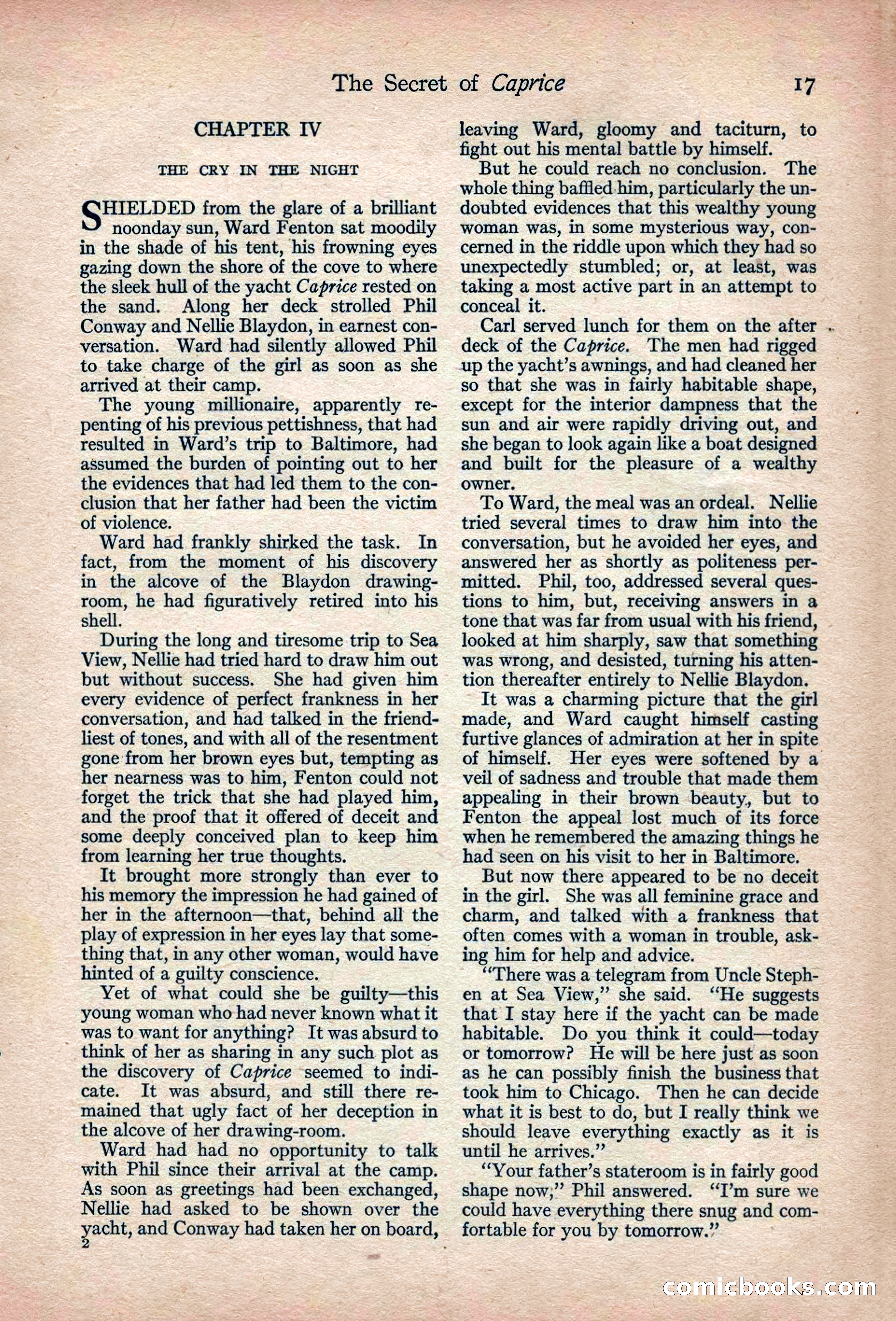
A restored page from Pulp Fiction, 1916. Page through the whole issue in the reader above.
📄 Transcribed text from this page (OCR, searchable)
Machine-transcribed from the original scan — historical spelling and the odd misread are preserved.
The Secret CHAPTER IV THE CRY IN THE NIGHT ee eDER from the glare of a brilliant noonday sun, Ward Fenton sat moodily in the shade of his tent, his frowning eyes gazing down the shore of the cove to where the sleek hull of the yacht Caprice rested on the sand. Along her deck strolled Phil Conway and Nellie Blaydon, in earnest con- versation. Ward had silently allowed Phil to take charge of the girl as soon as she arrived at their camp. The young millionaire, apparently re- penting of his previous pettishness, that had resulted in Ward’s trip to Baltimore, had assumed the burden of pointing out to her the evidences that had led them to the con- clusion that her father had been the victim of violence. Ward had frankly shirked the task. In fact, from the moment of his discovery in the alcove of the Blaydon drawing- room, he had figuratively retired into his shell. During the long and tiresome trip to Sea View, Nellie had tried hard to draw him out but without success. She had given him every evidence of perfect frankness in her conversation, and had talked in the friend- liest of tones, and with all of the resentment gone from her brown eyes but, tempting as her nearness was to him, Fenton could not forget the trick that she had played him, and the proof that it offered of deceit and some deeply conceived plan to keep him from learning her true thoughts. It brought more strongly than ever to his memory the impression he had gained of her in the afternoon—that, behind all the play of expression in her eyes lay that some- thing that, in any other woman, would have hinted of a guilty conscience. Yet of what could she be guilty—this young woman who had never known what it - was to want for anything? It was absurd to think of her as sharing in any such plot as the discovery of Caprice seemed to indi- cate. It was absurd, and still there re- mained that ugly fact of her deception in the alcove of her drawing-room. Ward had had no opportunity to talk with Phil since their arrival at the camp. As soon as greetings had been exchanged, Nellie had asked to be shown over the yacht, and Conway had taken her on board, of Caprice 17 leaving Ward, gloomy and taciturn, to fight out his mental battle by himself. But he could reach no conclusion. The whole thing baffled-him, particularly the un- doubted evidences that this wealthy young woman was, in some mysterious way, con- cerned in the riddle upon which they had so unexpectedly stumbled; or, at least, was taking a most active part in an attempt to conceal it. Carl served lunch for them on the after deck of the Caprice. The men had rigged up the yacht’s awnings, and had cleaned her so that she was in fairly habitable shape, except for the interior dampness that the sun and air were rapidly driving out, and she began to look again like a boat designed and built for the pleasure of a wealthy owner. To Ward, the meal was an ordeal. Nellie tried several times to draw him into the conversation, but he avoided her eyes, and answered her as shortly as politeness per- mitted. Phil, too, addressed several ques- tions to him, but, receiving answers in a q tone that was far from usual with his friend, ~ looked at him sharply, saw that something was wrong, and desisted, turning his atten- tion thereafter entirely to Nellie Blaydon. It was a charming picture that the girl made, and Ward caught himself casting furtive glances of admiration at her in spite of himself. Her eyes were softened by a veil of sadness and trouble that made them appealing in their brown beauty, but to Fenton the appeal lost much of its force when he remembered the amazing things he had seen on his visit to her in Baltimore. But now there appeared to be no deceit in the girl. She was all feminine grace and charm, and talked with a frankness that often comes with a woman in trouble, ask- ing him for help and advice. ‘There was a telegram from Uncle Steph- en at Sea View,” she said. “He suggests that I stay here if the yacht can be made habitable. Do you think it could—today or tomorrow? He will be here just as soon as he can possibly finish the business that took him to Chicago. Then he can decide what it is best to do, but I really think we should leave everything exactly as it is until he arrives.” “Your father’s stateroom is in fairly good shape now;” Phil answered. ‘I’m sure we could have everything there snug and com- fortable for you by tomorrow.” GEomichoo (Q) (E@) ots ith i Hh yin