
Pulp Fiction, 1916 · page 185 of 228
Adventure Magazine, March 1916 — page 185: what you’re looking at
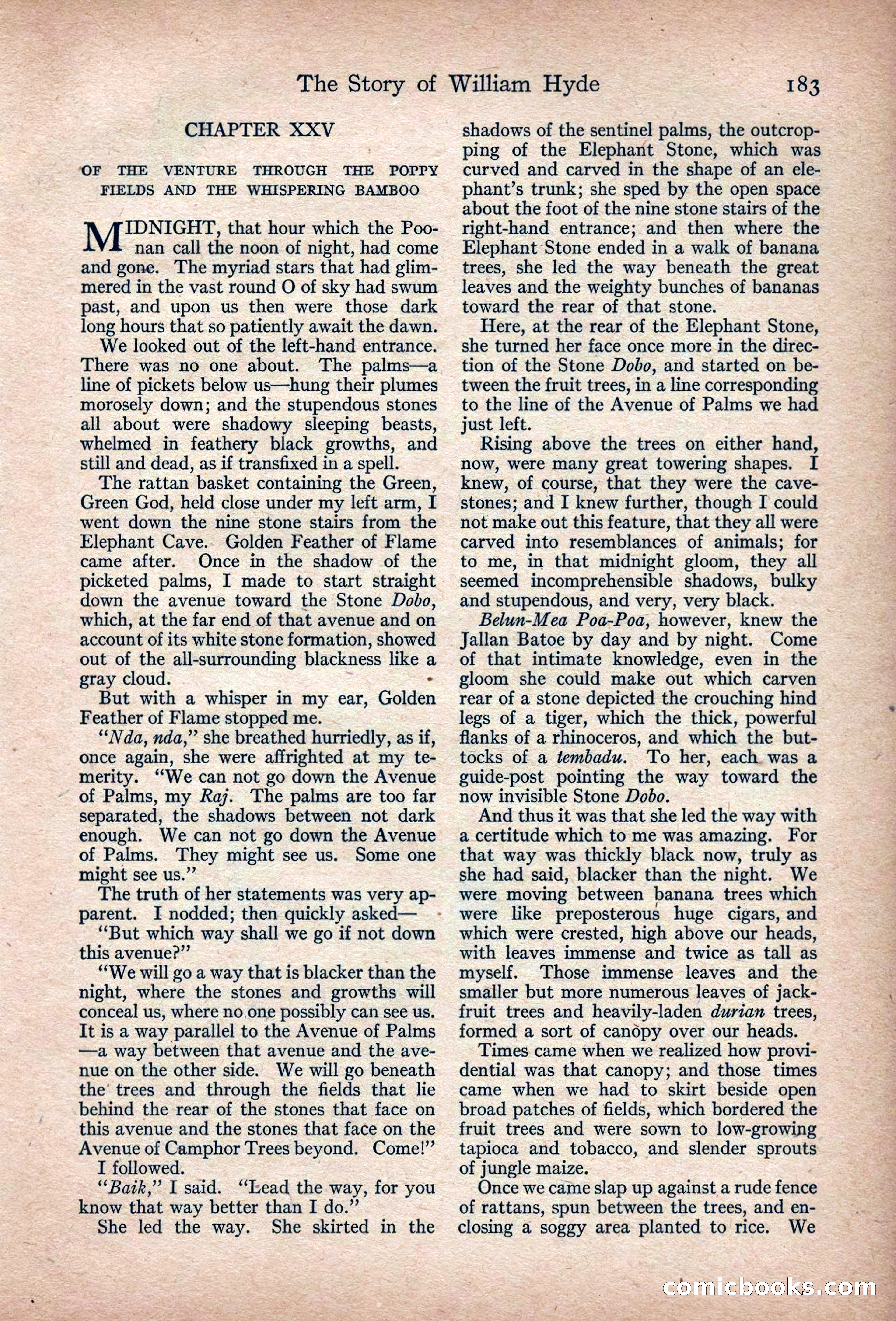
A restored page from Pulp Fiction, 1916. Page through the whole issue in the reader above.
📄 Transcribed text from this page (OCR, searchable)
Machine-transcribed from the original scan — historical spelling and the odd misread are preserved.
The Story of William Hyde CHAPTER XXV OF THE VENTURE THROUGH THE POPPY FIELDS AND THE WHISPERING BAMBOO IDNIGHT, that hour which the Poo- nan call the noon of night, had come and gone. The myriad stars that had glim- mered in the vast round O of sky had swum past, and upon us then were those dark long hours that so patiently await the dawn. We looked out of the left-hand entrance. There was no one about. The palms—a line of pickets below us—hung their plumes morosely down; and the stupendous stones all about were shadowy sleeping beasts, whelmed in feathery black growths, and still and dead, as if transfixed in a spell. The rattan basket containing the Green, Green God, held close under my left arm, I went down the nine stone stairs from the Elephant Cave. Golden Feather of Flame came after. Once in the shadow of the picketed palms, I made to start straight down the avenue toward the Stone Dodo, which, at the far end of that avenue and on account of its white stone formation, showed _ out of the all-surrounding blackness like a gray cloud. ° But with a whisper in my ear, Golden Feather of Flame stopped me. “‘Nda, nda,” she breathed hurriedly, as if, once again, she were affrighted at my te- merity. “We can not go down the Avenue of Palms, my Raj. The palms are too far separated, the shadows between not dark enough. We can not go down the Avenue of Palms. They might see us. Some one might see us.’ The truth of her statements was very ap- parent. I nodded; then quickly asked— “But which way shall we go if not down this avenue?”’ . “We will go a way that is blacker than the night, where the stones and growths will conceal us, where no.one possibly can see us. It is a way parallel to the Avenue of Palms —a way between that avenue and the ave- nue on the other side. We will go beneath the’ trees and through the fields that lie behind the rear of the stones that face on this avenue and the stones that face on the Avenue of Camphor Trees beyond. Come!” I followed. “Batk,” I said. ‘ead the way, for you know that way better than I do.” She led the way. She skirted in the 183 shadows of the sentinel palms, the outcrop- ping of the Elephant Stone, which was curved and carved in the shape of an ele- phant’s trunk; she sped by the open space about the foot of the nine stone stairs of the right-hand entrance; and then where the Elephant Stone ended in a walk of banana trees, she led the way beneath the great leaves and the weighty bunches of bananas toward the rear of that stone. Here, at the rear of the Elephant Stone, she turned her face once more in the direc- tion of the Stone Dobo, and started on be- tween the fruit trees, in a line corresponding to the line of the Avenue of Palms we had just left. Rising above the trees on either hand, now, were many great towering shapes. I knew, of course, that they were the cave- stones; and I knew further, though I could not make out this feature, that they all were carved into resemblances of animals; for to me, in that midnight gloom, they all seemed incomprehensible shadows, bulky and stupendous, and very, very black. Belun-Mea Poa-Poa, however, knew the ~ Jallan Batoe by day and by night. Come of that intimate knowledge, even in the gloom she could make out which carven rear of a stone depicted the crouching hind legs of a tiger, which the thick, powerful flanks of a rhinoceros, and which the but- tocks of a tembadu. To her, each. was a guide-post pointing the way toward the now invisible Stone Dobo. And thus it was that she led the way with a certitude which to me was amazing. For that way was thickly black now, truly as she had said, blacker than the night. We were moving between banana trees which were like preposterous huge cigars, and which were crested, high above our heads, with leaves immense and twice as tall as myself. Those immense leaves and the smaller but more numerous leaves of jack- fruit trees and heavily-laden durian trees, formed a sort of canopy over our heads. Times came when we realized how provi- dential was that canopy; and those times came when we had to skirt beside open broad patches of fields, which bordered the fruit trees and were sown to low-growing tapioca and tobacco, and slender sprouts of jungle maize. Once we came slap up against a rude fence of rattans, spun between the trees, and en- closing a soggy area planted to rice. We Gomichooks (e “A >» ° b>.