
Pulp Fiction, 1916 · page 178 of 228
Adventure Magazine, March 1916 — page 178: what you’re looking at
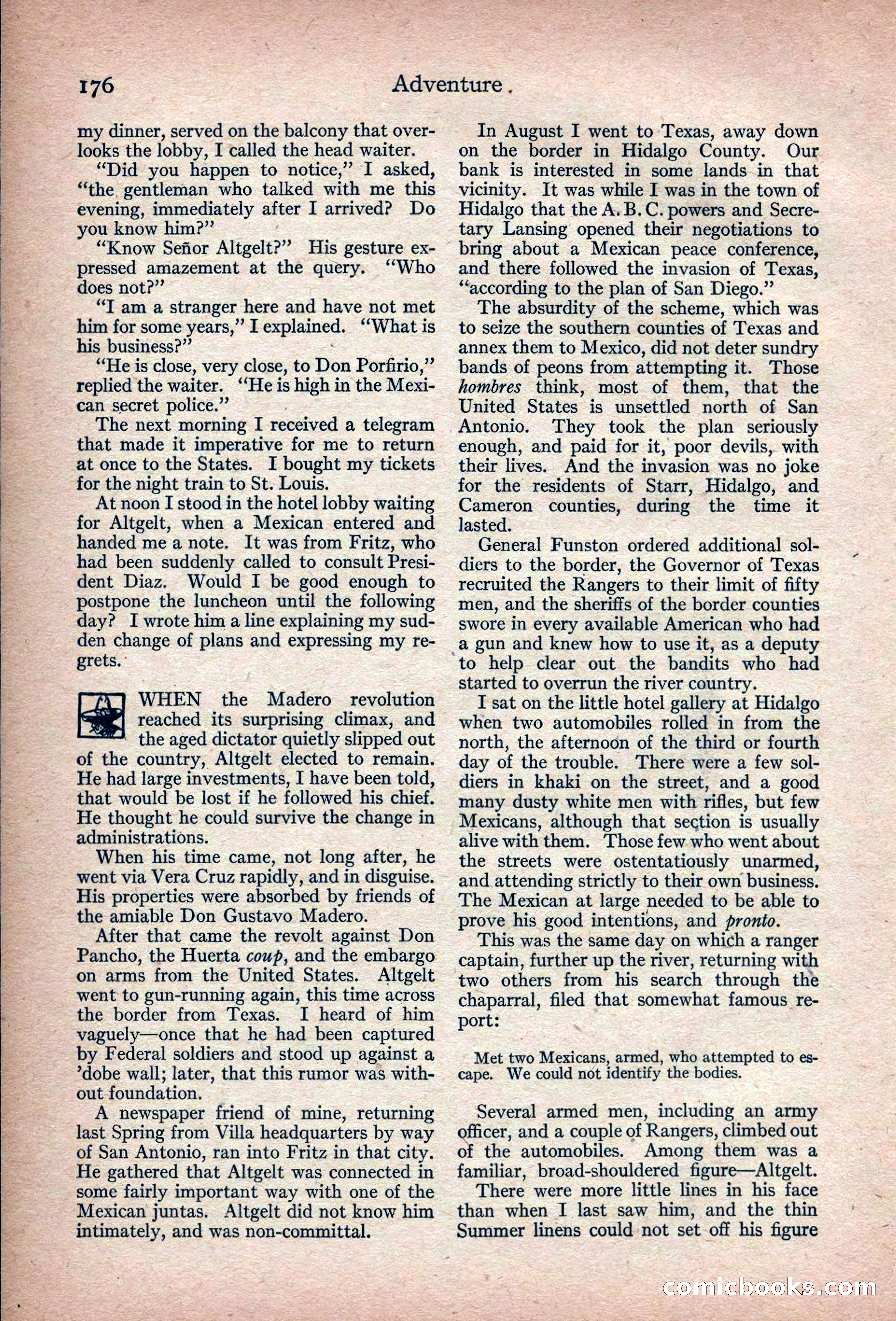
A restored page from Pulp Fiction, 1916. Page through the whole issue in the reader above.
📄 Transcribed text from this page (OCR, searchable)
Machine-transcribed from the original scan — historical spelling and the odd misread are preserved.
176 my dinner, served on the balcony that over- looks the lobby, I called the head waiter. “Did you happen to notice,” I asked, “the gentleman who talked with me this evening, immediately after I arrived? Do you know him?” “Know Sefior Altgelt?” His gesture ex- pressed amazement at the query. ‘Who does not?” “T am a stranger here and have not met him for some years,’ I explained. “What is his business?” “He is close, very close, to Don Porfirio,” replied the waiter. ‘He is high in the Mexi- can secret police.” The next morning I received a telegram that made it imperative for me to return at once to the States. I bought my tickets for the night train to St. Louis. At noon I stood in the hotel lobby waiting for Altgelt, when a Mexican entered and handed me a note. It was from Fritz, who had been suddenly called to consult Presi- dent Diaz. Would I be good enough to postpone the luncheon until the following day? I wrote him a line explaining my sud- den change of plans and expressing my re- grets.: WHEN the Madero revolution reached its surprising climax, and the aged dictator quietly slipped out of the country, Altgelt elected to remain. He had large investments, I have been told, that would be lost if he followed his chief. He thought he could survive the change in administrations. When his time came, not long after, he went via Vera Cruz rapidly, and in disguise. His properties were absorbed by friends of the amiable Don Gustavo Madero. After that came the revolt against Don Pancho, the Huerta coup, and the embargo on arms from the United States. Altgelt went to gun-running again, this time across the border from Texas. I heard of him vaguely—once that he had been captured by Federal soldiers and stood up against a *dobe wall; later, that this rumor was with- out foundation. A newspaper friend of mine, returning last Spring from Villa headquarters by way of San Antonio, ran into Fritz in that city. He gathered that Altgelt was connected in some fairly important way with one of the Mexican juntas. Altgelt did not know him intimately, and was non-committal. Adventure . In August I went to Texas, away down on the border in Hidalgo County. Our bank is interested in some lands in that vicinity. It was while I was in the town of Hidalgo that the A. B. C. powers and Secre- tary Lansing opened their negotiations to bring about a Mexican peace conference, and there followed the invasion of Texas, “according to the plan of San Diego.” The absurdity of the scheme, which was to seize the southern counties of Texas and annex them to Mexico, did not deter sundry bands of peons from attempting it. Those hombres think, most of them, that the United States is unsettled north of San Antonio. They took the plan seriously enough, and paid for it, poor devils, with their lives. And the invasion was no joke for the residents of Starr, Hidalgo, and Cameron counties, during the time it lasted. General Funston ordered additional sol- diers to the border, the Governor of Texas recruited the Rangers to their limit of fifty men, and the sheriffs of the border counties swore in every available American who had _a gun and knew how to use it, as a deputy to help clear out the bandits who had started to overrun the river country. I sat on the little hotel gallery at Hidalgo when two automobiles rolled in from the north, the afternoon of the third or fourth day of the trouble. There were a few sol- diers in khaki on the street, and a good many dusty white men with rifles, but few Mexicans, although that section is usually alive with them. Those few who went about the streets were ostentatiously unarmed, and attending strictly to their own business. The Mexican at large needed to be able to prove his good intentions, and pronto. This was the same day on which a ranger captain, further up the river, returning with two others from his search through the chaparral, filed that somewhat famous re- port: Met two Mexicans, armed, who attempted to es- cape. We could not identify the bodies. Several armed men, including an army officer, and a couple of Rangers, climbed out of the automobiles. Among them was a familiar, broad-shouldered figure—Altgelt. There were more little lines in his face than when I last saw him, and the thin Summer linens could not set off his figure Eomichbooks CO An)